
Claude plans can eat over 40% of Anthropic’s compute
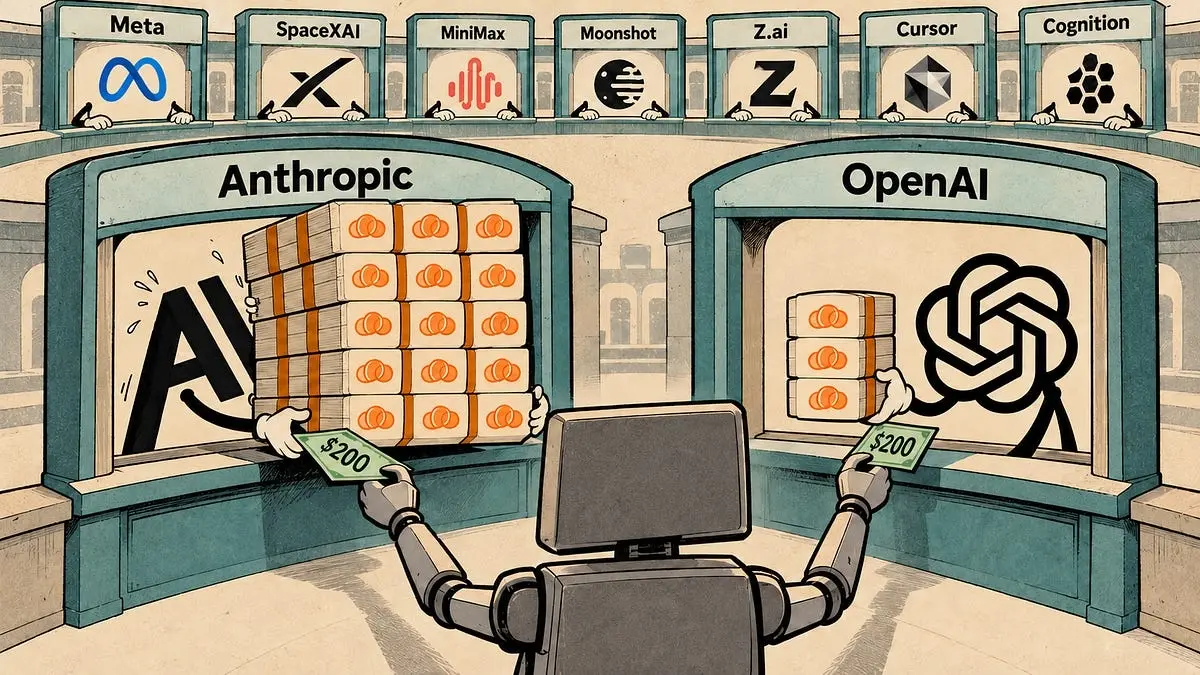
SemiAnalysis measured how far each OpenAI and Anthropic subscription meter moves per million tokens. In an October 5 report, it found that Opus 5.5 on any Claude plan delivers roughly 5x the API-equivalent value of GPT 6.1 Sol on OpenAI’s plans. If your daily driver is a mid-tier model, a Claude subscription currently buys far more agentic work per dollar than OpenAI’s, by the firm’s measure. At the top tier the picture is different: Fable 5.1 and GPT-6 Astra limits come out about the same.
API-equivalent value is what the tokens a plan allows in a month would cost at API list prices. SemiAnalysis computes it for an agentic workload shaped like its own usage in September. Comparing on that basis flatters Opus, since 6.1 Sol is much cheaper per token. But the firm says the gap is “still massive” when you count raw tokens instead of dollars.
On OpenAI’s $200 plan
In the week before the report, OpenAI halved the tokens its $200 plan gets for each model tier, and SemiAnalysis’s tracking confirmed the cut Tibo had announced. Plans bought before the cut keep the old, higher limits until October 29. Plans bought now start on the lower limits immediately. For Sol-class models, API-equivalent value fell by more than half, because OpenAI also cut the cached input price for 6.1 Sol. Each token is now worth less at API rates, and there are half as many of them.
The new $500 tier buys only 21% more Astra than the old $200 plan did, and its API-equivalent value on Sol-class models is actually lower, again because of the 6.1 Sol price cut. The tier’s headline feature is 300 TPS Ultrafast, and SemiAnalysis is still testing its limits.
Paying for a bigger plan also gets you less extra than it used to. Before the cut, Pro 100 gave about 2x the per-dollar value of Plus on Astra, and Pro 200 gave another ~2x on top of Pro 100 across all models. Now Pro 100, 200 and 500 all give the same tokens per dollar for every model. Plus is comparable on Sol but a relatively worse deal on Astra. Anthropic’s tiers already gave the same per-dollar value across the board.
Fable, Astra and the 50% cap
At the top tier the two labs are close, with one structural difference: Fable can use only 50% of a Claude plan’s limit. On the $200 plans, you would still have half your Claude limit left after burning $2,485 worth of Fable 5.1, while the OpenAI plan is fully exhausted after $2,897 of Astra. That untouched half is what you’d spend on Opus 5.5, which is where the ~5x gap shows up.
OpenAI’s one structural advantage is that none of its Pro plans has a 5-hour limit, which makes it easier to use more of the monthly allowance. On Claude plans the 5-hour window and the weekly cap are independent limits, and either one can be hit first. SemiAnalysis’s month is capped by the weekly limits, since the 5-hour window resets many times a week. It doesn’t think the missing 5-hour limit offsets what it puts, in that passage, at a ~4x higher API-equivalent value for Opus 5.5 on Claude plans.
The firm names two limits on its own yardstick. If a model is an unusually good or bad deal at API prices, its API-equivalent value will mislead. And token efficiency, how many tokens a model needs to finish the same job, is left out, since SemiAnalysis says the industry lacks reliable data on it and doesn’t consider the tasks in the Artificial Analysis Intelligence Index representative of real work.
How the meters were read
Anthropic doesn’t publish exact token numbers for its caps. Its support documentation says Claude Code limits are “based on a combination of your subscription plan and current demand.” So SemiAnalysis treats a plan as a pool of credits, with each model and token type drawing a different number of them. Because those credit ratios can differ sharply from API price ratios, a plan’s value depends on the combination of plan, model and workload.
To measure the credit cost, the firm ran repeated calls built to maximize one token type at a time: input, cache writes, cache reads or output. It used a portion of War and Peace for input, since some models refuse large blocks of gibberish, and a technical essay to force long outputs. It counted the tokens consumed between ticks of the provider’s meter, discarded the partial steps at the start and end of each run, and kept adding steps until the range was within ±5%. If 500M cache-read tokens didn’t move the meter, it assumed cache reads were free.
Limits that move
Subscriptions matter more to the labs’ economics than their revenue share suggests. By SemiAnalysis’s rough numbers, they bring Anthropic only 10% of revenue but can take over 40% of its inference compute, which lowers blended revenue per megawatt by about $36M. Assuming 100% utilization and 92% API gross margins, maxing out Opus 5.5 works out to a -369% gross margin on a subscription, against 1% for Fable 5.1. At a more realistic 20% average utilization, the figures rise to 6% and 80%.
The labs cut subscriber subsidies in different ways. Anthropic gives less API-equivalent value on its more premium models. The drop from Sonnet 5.5 to Opus 5.5 is small, but the drop to Fable 5.1 is large. OpenAI moved its plans to roughly Fable-level limits all at once. Price cuts have also eroded value quietly. Opus 5.5 cut input and output prices by 20% from Opus 5 and cache reads by 60%. Anthropic raised Opus token limits by about 20% on Max and about 50% on Pro, which wasn’t enough to offset the price cut. It didn’t raise Fable limits at all with 5.1. OpenAI left Sol limits on the $200 plan unchanged when 6.1 Sol shipped, and API-equivalent value dropped about 30%.
On the Claude side, the weekly numbers already reflect a change: on September 14 Claude Code’s standard weekly limits settled 25% above the original baseline, which left subscribers with 17% less than the temporary boost had given them.
Limits can also change without any announcement. One of three identical subscriptions SemiAnalysis tested with one provider had limits about 20% lower than the other two. The provider said the account was part of an “extremely tiny” A/B test, that it “didn’t just decrease limits wholesale,” and that it was testing “how to better balance when people hit limits.”
Up next

Pentagon quits Claude, which sources say ran until last week
The Pentagon has ceased using Anthropic products, a Defense Department official told the BBC on Monday, yet multiple people say Claude was still sifting military intelligence as recently as last week.
Related stories
- Anthropic deleted the post that called a cut a 25% raise
- Claude Max subscribers are auditing Anthropic’s meter
- Claude’s free Team year for startups lasted only days
- Claude Startups widens its door, with up to $45K in perks
- Cheaper rivals outdraw Anthropic’s best model, FT says
- Priciest tokens still pull the most gateway spend
Comments
No comments yet. Be the first.
Join the conversation
Sign in to leave a comment. It appears after moderation.