
Haiku 5.5 ranks #2 of 182 and burns 440M tokens doing it
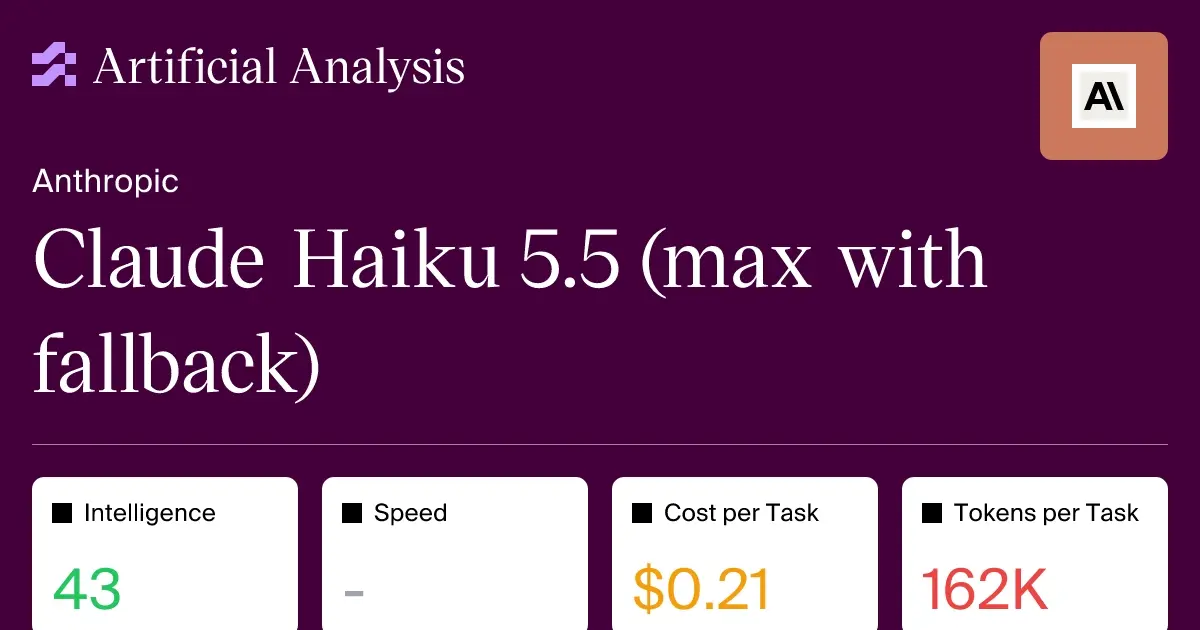
Artificial Analysis has scored Claude Haiku 5.5 at 43 on its Intelligence Index, with the model running at max effort. That ranks it second of the 182 models in its comparison class, where the median score is 13. Anthropic released the model on October 7. The Artificial Analysis model page covers the reasoning variant, tested on Anthropic’s own API and labelled “Max, Default Fallback”.
The score is only half the result. To reach it, Haiku 5.5 wrote 440M output tokens across the index, more than four times the class median of 100M. Its wait before the first answer token came to 415.30 seconds.
Who is in the class of 182?
Artificial Analysis doesn’t rank proprietary models against the whole field. It groups them with proprietary and open-weights models in the same price range, using a blended price weighted 3:1 toward input tokens, with brackets below $0.15 per million tokens, from $0.15 to $1, and above $1. Reasoning models are compared with reasoning and non-reasoning models alike. So the median of 13 comes from models priced like Haiku 5.5, and a score of 43 sits well clear of it.
The index, version 4.3.2, combines 10 evaluations. They include Terminal-Bench 4.0 for agentic coding in a terminal, Humanity’s Last Exam, AA-LCR for reasoning over long context, GDPval-AA for real-world work tasks, and AA-Omniscience, which penalises hallucinated answers. Two of the ten, SciCode and CritPt, are marked “under review”.
Anthropic’s bigger model is the obvious comparison. In September, Sonnet 5.5 at max effort scored 56 on the same index and ranked third of 216 in its own price class, after writing 410M output tokens. The smaller model produced more tokens than its bigger sibling.
What the bill looks like
On list price, Haiku 5.5 charges $0.10 per million input tokens and $0.50 per million output tokens, against class medians of $0.25 and $0.90. Cache hits get a 90% discount. At the mix Artificial Analysis uses for its second blend (70% cache hits, 20% fresh input, 10% output), the price comes to $0.08 per million tokens.
Haiku 5.5 is a reasoning model: it works through a problem in thinking tokens before it answers, and those tokens are billed as output. That is where the low rates meet the high token count. A full index task costs $0.21 on average, and on cost per task Haiku 5.5 ranks 46th of 182, far below its second place on intelligence. Sonnet 5.5 cost $7.60 per index task in September, so Haiku 5.5 runs the same index for about a thirty-sixth of the price, scoring 43 against 56.
The headline rates come with a limit. On its Haiku page, Anthropic prices the model by prompt length: up to 100K tokens it’s $0.10 in and $0.50 out, above 100K it’s $0.50 in and $2.50 out, five times the short-prompt rate on both sides. The context window runs to 1M tokens, so long-context work lands on the higher rate. Anthropic says prompt caching saves up to 90% and batch processing 50%. The model is on the Claude Platform, AWS, Google Cloud, Microsoft Foundry and Claude Code under the API name claude-haiku-5-5.
Fast stream, long wait
Raw generation speed is the strong number. Haiku 5.5 streams 243.4 tokens per second, ninth of 182, against a class median of 110.9. Artificial Analysis measures that speed only after the first chunk arrives. Its latency figure works differently: for reasoning models it includes thinking time, and Haiku 5.5 posts 415.30 seconds there, nearly seven minutes, against a median of 2.17 seconds.
Anthropic pitches Haiku 5.5 for real-time, latency-sensitive work: chat, voice agents, live support, in-app assistants. It also pitches it as a subagent, with a stronger model such as Fable or Opus planning the work and handing subtasks to many Haiku instances running in parallel. A wait of nearly seven minutes at max effort fits none of the real-time cases.
But max is one end of a dial. Haiku 5.5 is the first Haiku with effort controls, which Anthropic says let teams tune cost against intelligence task by task, and the 43, the 440M tokens and the 415.30 seconds all belong to the top setting.
Up next
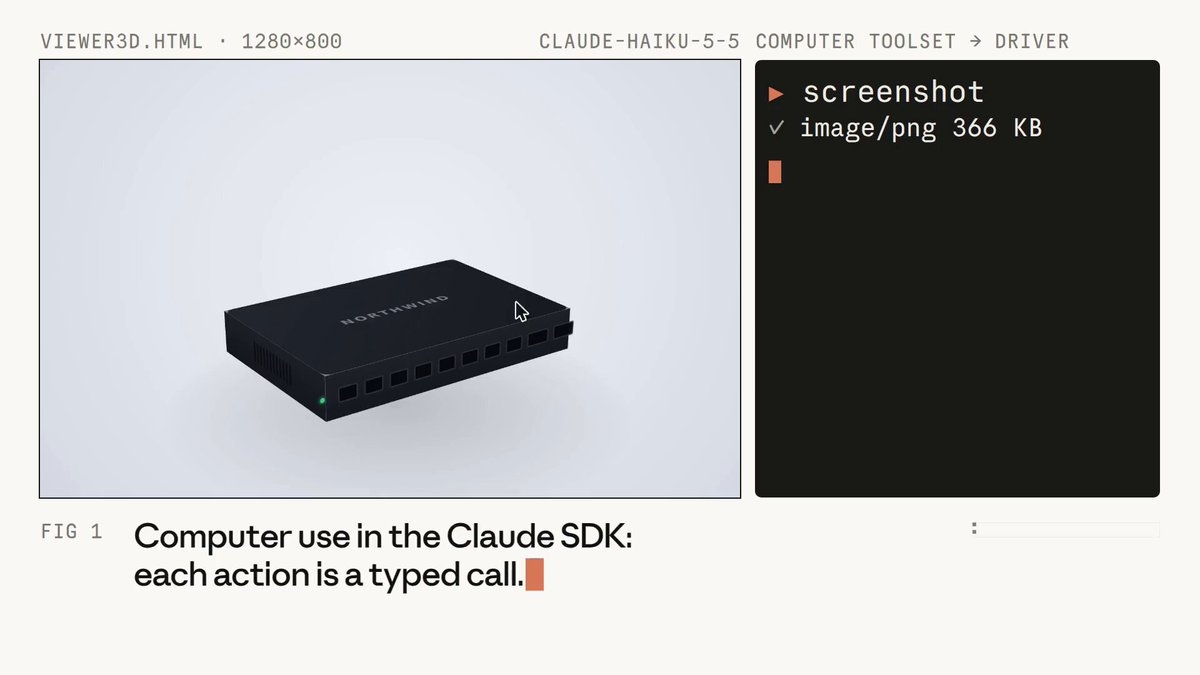
Claude’s SDKs run the click loop, but the browser is yours, Video
Anthropic moved the computer use loop into Claude’s Python and TypeScript SDKs, so they route every click and keystroke to your driver. The browser itself isn’t included, though, and you write or borrow the driver.
Related stories
- Sonnet 5.5 hits third place by writing 410M tokens
- Claude Fable 5.2 drops to $8/$40 and runs up to 30% faster
- Haiku 5.5 cuts token prices 90% on prompts under 100k
- Claude Code on Pro lists Haiku 5.5 as the recommended default
- Sonnet 5.5 edges past Opus 5.5 on Terminal-Bench 4.0
- Max effort adds nothing to Fable 5.1’s ARC-AGI-2 score
Comments
No comments yet. Be the first.
Join the conversation
Sign in to leave a comment. It appears after moderation.