
Rysh puts a Claude or Codex agent in every terminal pane
Rysh is an Apache-2.0 terminal multiplexer written in Go. A session in Rysh is a background daemon, so a Claude or Codex agent in one of its panes keeps running after you close the terminal and picks up the same conversation when the session is stopped and started again. Everything else in the design builds on that daemon: panes that hold agents, a shared board where agents post to each other, and named fleets of agents mixing both vendors.
The project’s README on GitHub, current as of August 17, describes the CLI and links five narrated video walkthroughs. The first four are recorded against the build the install line gives you, so every command shown is one you can type. The README points even long-time tmux and Zellij users to the first video: the panes look familiar, but the session model under them is different.
A session that outlives the window
A Rysh session is a daemon plus its panes. rysh create work creates and attaches one (-d leaves it detached), rysh attach and rysh detach move you in and out, and rysh stop shuts the daemon down. Closing the terminal window detaches from the session and leaves it running.
Rysh also records which agent each pane runs. ##claude starts Claude in the current pane and ##codex starts Codex. After a stop and start, the same conversations come back. The second video tests this directly: Claude and Codex are each given a codeword, the session is stopped outright, and after the restart both agents resume on their own and repeat the codeword they were told before the stop. ##pane new --claude "start on the parser" goes a step further and opens a new pane with an agent that is already working on a task.
The layout is nested. A tab holds lanes (columns), a lane holds stacks, and a stack holds panes, Zellij-style: one pane expanded, the rest collapsed to a title bar showing [N/M]. ##new grid 2x3x4 builds two tabs of three lanes with four panes each, which is 24 panes from one command. ##move pane <p> to-lane <lane> moves a live pane elsewhere, and Ctrl+S plus a digit switches between panes in a stack.
Each pane has four input modes enabled by default, and pressing Esc twice cycles through them: shell (a real PTY, the pseudo-terminal that full-screen programs like vim and htop expect), prompt (input goes to the LLM), rysh (multiplexer commands, the ones prefixed ##) and chat (conversation with no tool access). ##mode new <mode> adds further modes. From outside a session, rysh exec -- '##<cmd>' runs the same commands and prints their output.
How the agents coordinate
Agents and the user communicate through the agents board. ##board open opens it as a pane, and you can post milestones and reply to threads there. An agent inside a pane can post without taking focus, using rysh board post --as "$RYSH_PANE" -- 'parser wiring done', and can read back recent posts with rysh board tail --limit 20.
##board agent up adds a board agent: a hidden pane running Claude that sits between the other agents, routes their messages, and refuses a request it knows is stale. You can display it without moving focus and hide it again while it keeps running.
A fleet is a named group of panes with its own board, so its traffic stays out of the session-wide stream (rysh board tail --fleet epic-07). Registering a fleet opens no panes, and forgetting one leaves its panes running. Fleets can be all Claude, all Codex or a mix, with the same commands in each case.
The fourth video shows a fleet working. A Claude agent named roadmap sets the goal, a Codex agent named fleet-manager splits it into work orders, two workers build in parallel, and the manager sends one correction back to a worker before signing off. The result is a browser todo manager with no backend and no build step. The fifth video, the longest at four minutes, covers what the project calls graph engineering: a fleet’s org chart treated as a graph. Orders travel down the edges as messages and results come back up on the board. Two workers with no edge between them give independent verdicts, and removing an edge changes the fleet’s behaviour.
Here the agents are separate interactive CLIs from two vendors, and the multiplexer holds them together. Claude’s own orchestration works inside a single session: Anthropic’s Claude Platform docs describe subagents running in their own threads, with delegation one level deep and at most 25 child threads at a time. The same docs warn that every agent in a run uses tokens and recommend setting a session budget. That warning applies at least as much to a stack of independent sessions. Developer Dariusz Parys wrote that a 13-minute run of Claude Code’s experimental agent teams in tmux used a lot of tokens and cut heavily into the weekly limit on his Max 5 plan.
The closest existing tool is Claude Squad, which also manages Claude Code, Codex, Gemini and other local agents from the terminal. It requires tmux and gh, and gives each task its own isolated git workspace. Rysh does its own terminal emulation: the source includes a fork of the vt10x emulator with scrollback, plus actors for workspaces, tabs, panes and agents that communicate over NATS.
Secrets and SecretNAT
Rysh holds provider credentials and runs shell commands, so the README spends some space on secrets. SecretNAT is on by default, and it only covers outgoing traffic. Before a request leaves the machine, secrets in the request body are replaced with tokens. The mapping is stored locally and can be reversed: ##snat get <token> shows the real value in your own pane, and the model only ever sees the token. On the way back, a response that contains a live credential in plaintext is reported in the pane, but responses are not rewritten, and the README says that is by design.
Installing it, and the Windows gap
There are two binaries, and they are not interchangeable. This repository builds rysh. The packaged product is ry, a separate distribution with its own channels and documentation, and nothing in it is built from this repository. The names differ so one machine can have both installed. A script or alias written for one will not run against the other, and rysh version or ry version tells you which one you have.
The open-source build installs with go install github.com/rysh-ai/rysh-cli-code/cmd/rysh@latest and requires Go 1.25.3 or newer, the minimum declared in the module’s go.mod. A prebuilt installer at packages.rysh.ai/install-rysh.sh fetches the newest Apache-2.0 release at run time. RYSH_VERSION pins a specific release and RYSH_INSTALL_DIR sets the install location. For development against the shared module, the rysh-cli-parent superrepo provides the Makefile, the Go workspace and CI. The first run is rysh onboard --provider anthropic --key-env ANTHROPIC_API_KEY, which checks the key, writes a project-local rysh.config.yaml and opens a session, followed by rysh doctor.
On native Windows, Rysh compiles and runs but cannot open a pane. The PTY layer has no ConPTY implementation (ConPTY is Windows’ pseudo-console API), so platform.PTYSupported is false. Every command that opens a session is refused up front with WSL guidance, rather than starting a session that then fails on the first pane. The release archive for that target is labelled cli-only. The commands that need no pane still work, including rysh send, rysh exec, rysh prompt and rysh list-sessions, and they can control a session running inside WSL from the Windows side. For full sessions on Windows, WSL2 is the supported path, and the Linux build runs there unmodified.
The repository is a one-way export of a tree developed elsewhere, so any commit pushed directly to it is overwritten by the next export. CONTRIBUTING.md explains where patches should go instead. The README is just as firm about vulnerability reports, which go through private channels: “Rysh runs shell commands and holds provider credentials on a developer’s machine, so a public report is an exploit notice.”
Up next
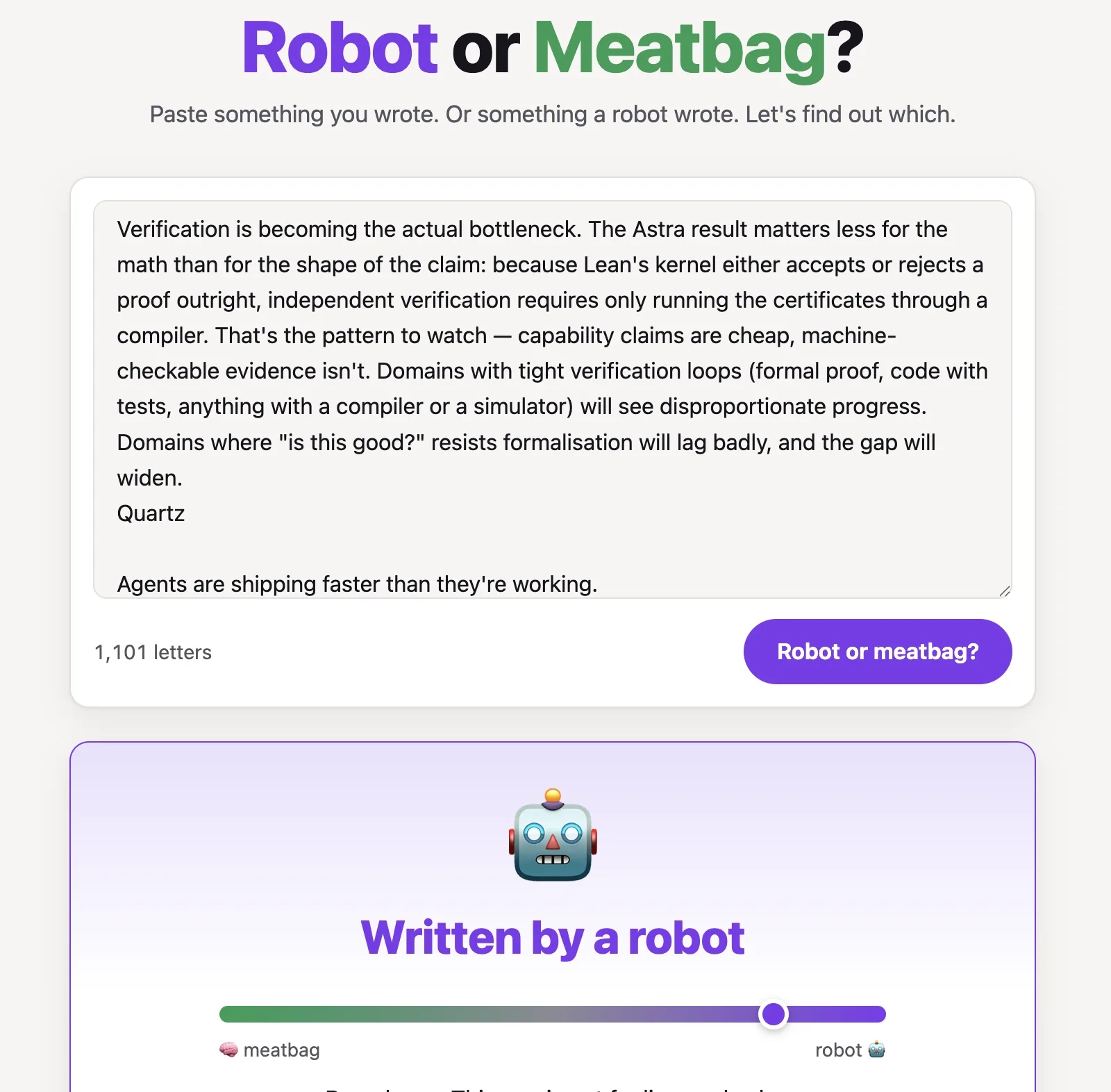
Counting four-letter runs spots Claude Opus 5 text
A detector that only counts four-letter runs separates Claude Opus 5 from human writing at 0.925 ROC AUC, no watermark key needed. The version that never saw formal-register rewrites scores 0.153 on them.
Related stories
- Oh My Subagents keeps Claude Code teams running
- Open-source Scion clones only the slice you ask for
- One YAML persona, rendered for four coding agents
- Flaky tests after a 10x speedup, and what Claude got wrong
- Tokendoctor cut its author’s Claude Code cost 38%
- Cursor hosts and deploys apps its cloud agents build
Comments
No comments yet. Be the first.
Join the conversation
Sign in to leave a comment. It appears after moderation.