
A coding agent that never leaves the laptop, if it’s an M5
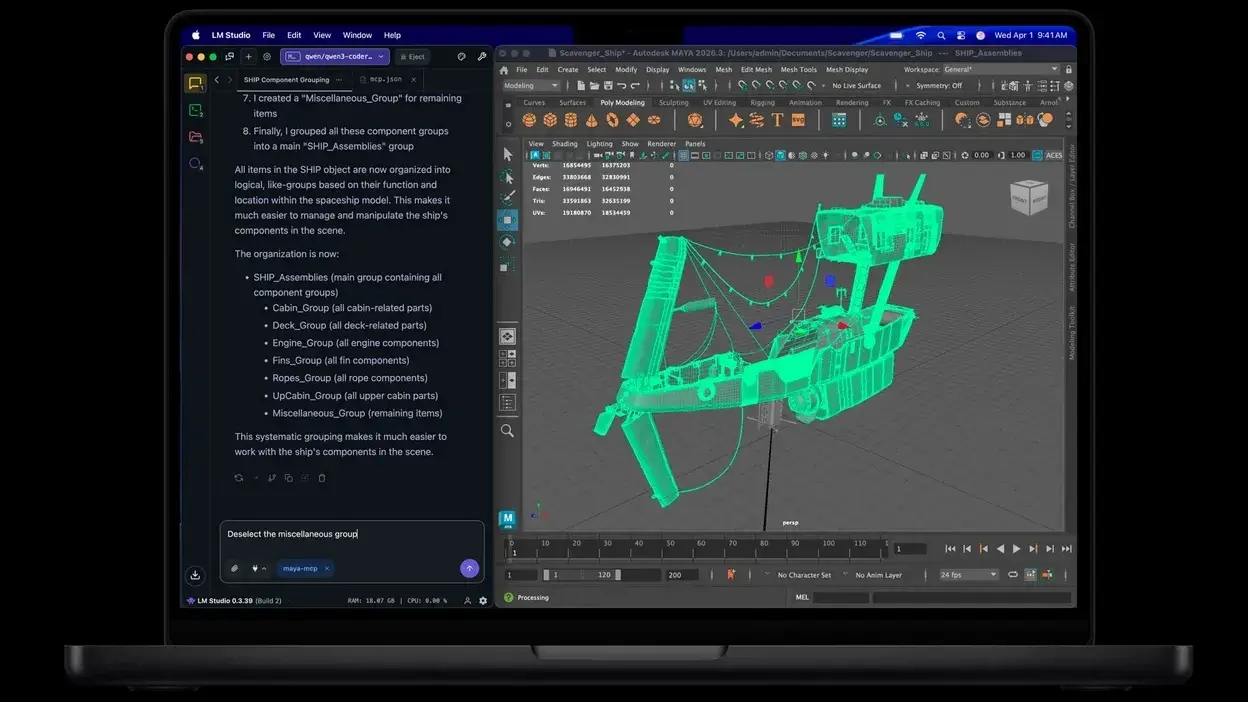
JetBrains has released Junie Local, a free version of its Junie coding agent that runs entirely on the developer’s machine. For this version JetBrains picked the model, quantized it and tuned both the inference engine and the agent harness around that one combination, so the developer no longer has to. Head of marketing Dmitry Savelev explained the choices in an August 24 blog post, as The New Stack reports.
Local models in Junie are not new in themselves. Developers could already point the agent at Ollama or LM Studio, load any model and run against it, and the Junie site lists “Supports locally running models” under its free tier. Cline, Continue and Aider work the same way, and GitHub added local-model support to Copilot CLI in April, including an offline mode for air-gapped setups. In all of these the developer still does the assembly: choosing a model and a quantization that fits the hardware, setting up the runtime and context window, and finding a combination the agent can actually work with. That last step is where things often break, because models small enough to run on a laptop tend to struggle with the tool calls, reasoning and long-running tasks an agent depends on.
Junie Local takes that work away. The developer picks Junie Local in the model selector, where it sits next to the cloud models, or types /local. Junie then downloads the model and inference engine (about 20 GB in total), starts a local server and switches itself over. Nothing else needs installing, there is no endpoint to configure and no model profile to write. From then on the Qwen model shows up in the CLI like any other option, and inference stays on the machine.
The model is Qwen3.6-27B, an open-weight model released in April, running at 4-bit. The engine is built on mlx-vlm, which in turn runs on MLX, Apple’s machine-learning framework for Apple Silicon. Ollama took a similar route in March, when it moved its Apple Silicon engine onto MLX to make use of the chips’ unified memory, the single pool of RAM that the CPU and GPU share.
JetBrains deliberately skipped Qwen3.8-27B, which came out earlier in August with improvements. According to Savelev, Qwen3.8 worked reliably inside Junie only with its reasoning mode switched on, and with reasoning on, tasks took roughly four times longer. “On today’s Macs, 3.6 wins,” he writes.
The tuning focused on prefill, the stage in which the model reads source files, prompts and other context before it writes its first token. Tokens per second only measures generation speed, and JetBrains ties its hardware requirements to this prefill bottleneck. “Everyone benchmarks generation speed,” Savelev writes. “For a coding agent, that turns out to be the wrong number to chase because most of the time is spent on prefill, while the model reads files to work out what is going on. Optimizing for prefill is where the real gains were.”
The minimum hardware is macOS 26, an Apple M5 chip or newer and at least 64 GB of unified memory. On a MacBook Pro, 64 GB means an M5 Pro or M5 Max, so for now the free agent runs only on high-end Macs. JetBrains says it plans to cut memory requirements, support more hardware and keep optimizing the stack. “We know that an M5 Mac with 64 GB of RAM is a big ask,” Savelev writes. “We are not going to pretend otherwise. That is simply what it costs to run a 27B model well today, and it is the number we are working hardest to bring down.”
Because Junie Local is free and unmetered, JetBrains recommends it for long, mechanical jobs: refactors and renames across many files, filling gaps in test coverage, dependency upgrades and framework migrations. On JetBrains’ paid plans, usage comes out of credits: AI Pro costs $8.33 per user per month and includes 10 AI Credits per 30 days, and AI Ultimate costs $25.00 and includes 35. “Long, repetitive, mechanical work is exactly what an agent is for, and exactly what you stop asking for when you are keeping an eye on your balance,” Savelev writes. He expects that most users will notice little gap against stronger cloud models in everyday work, but he concedes that complex architectural reasoning is still better left to those models.
Privacy is the other half of the pitch. When the whole agent runs locally, no model provider sits between the developer and the code. That matters for teams working on proprietary code, under client NDAs, or anywhere sending source to a third party is not allowed. “Everything after the download happens on your hardware, so your prompts, source, and diffs stay put,” Savelev writes.
Up next

Anthropic’s culture interview asks about a stock at zero
Sit down for Anthropic’s culture interview and, per Axios, you may be asked how you’d feel if a safety call sent the stock to zero. One applicant said honestly that they wouldn’t be happy, and the interviewer didn’t like the answer.
Related stories
- DeepSeek open-sources its agent harness under MIT
- Hugging Face sends language model calls via OpenRouter
- Cursor hosts and deploys apps its cloud agents build
- AWS Emulator mocks 438 AWS APIs, written by agents
- OpenAI’s Pando cut monorepo push latency nearly 5x
- Claude API enforces thinking blocks and moves to Rust
Comments
No comments yet. Be the first.
Join the conversation
Sign in to leave a comment. It appears after moderation.