
Gemini etched into silicon: the “Frozen v2” chip claim
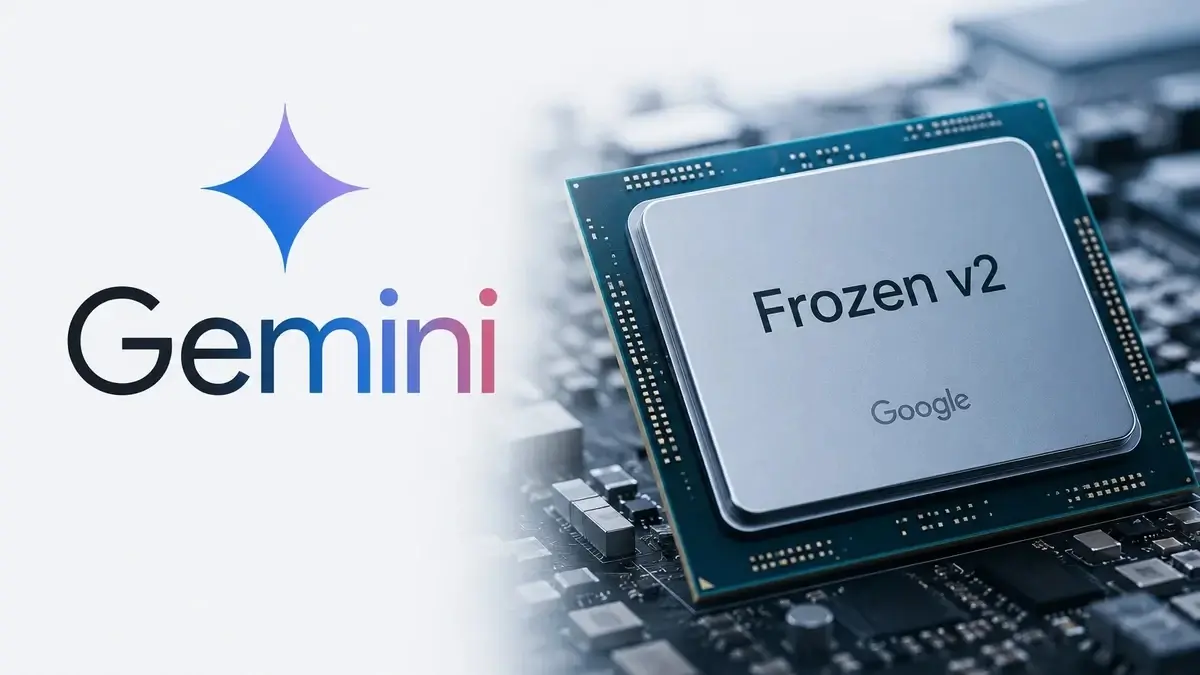
Alphabet is developing a custom chip, “Frozen v2”, that builds architectural elements of the Gemini model directly into the silicon, The Information reported. The target is six to ten times more tokens per watt than Google’s newest TPUs.
Mike DiBiase covered the report in Stansberry Research’s Weekend Edition on August 16. He writes that the chip is designed specifically for inference, the continuous work of answering user prompts, and that Alphabet could start using it as early as 2028.
Six to ten times what?
The multiple measures power efficiency: the same model served with less energy per token. Tom’s Hardware put it as “six to ten times more tokens per unit of power than the newest generation of Google’s TPUs.” It also said The Information’s sources describe the project as partly a response to a compute shortage, one serious enough that Google Cloud has turned down deals with outside customers.
In a data centre with a fixed power budget, more tokens per watt means more inference sold from the same buildings. Google has not officially confirmed the project, and the six-to-ten-times figure is a projection from engineers familiar with the design, not a benchmarked result, Tech Times noted. The same outlet reported that Alphabet shares climbed as much as 3.7% intraday on the Monday of the report and closed the session up 1.51%.
What hardwiring buys
A general-purpose accelerator doesn’t know which model it will run. So at runtime it has to decide which arithmetic units to activate, how to schedule memory fetches and how to route data between cores. With Gemini’s architecture built in, the correct routing is laid down physically and those decisions go away, Tech Times explained. It sees the bigger saving in memory traffic: off-chip memory accesses consume “roughly two orders of magnitude more energy than the arithmetic operations they support,” and a large model cannot fit in a chip’s small cache. Frozen v2 would fuse several sequential computation steps into one hardware primitive, writing only the final result and never moving the intermediate values. Software already does this on conventional chips under the name operator fusion; Frozen v2 would fix it in the hardware.
DiBiase describes the same effect in shorter terms: less physical movement of data and fewer calculations per response.
The price is flexibility. Chip design and manufacturing take years, so the name carries a bet that Gemini’s architecture has settled enough to freeze, and that its topology won’t change enough by deployment to erode the gains.
The load it would serve
DiBiase’s figures show the scale. The Gemini app has 950 million monthly active users, and Google’s models process 22 billion tokens per minute. Google Cloud brought in nearly $60 billion last year, about 15% of Alphabet’s sales, growing 36% against 20% for Amazon’s and Microsoft’s cloud businesses; last quarter its sales grew 82%. Anthropic, a Google Cloud customer, recently committed to $200 billion in Google Cloud spending over the next five years. Alphabet expects this year’s capital expenditure to approach $205 billion, while operating cash flow was $165 billion last year and is expected to come close to $200 billion this year.
His argument is that if Alphabet’s models stay roughly competitive while being served much more cheaply, the company can cut prices and take market share. “The next phase of AI won’t be won by the company with the smartest model,” he writes. “It’s going to be won by the company that figures out how to deliver AI at the lowest cost.”
Up next
Anthropic revenue reportedly jumps to more than $11.5B in second quarter
Revenue crossed $11.5 billion in one quarter, Bloomberg reported from documents it viewed, up from $4.73 billion in Q1 and $787 million a year earlier. The figures stay preliminary, with an IPO possible as soon as this fall.
Related stories
- First results land for OpenAI’s Jalapeño inference chip
- Google’s TPU Sync cut TTFT by up to 90% in its own tests
- Google adds TPU 8i Max for big contexts, 8tx for secure data
- A $15 billion loan for an Anthropic-linked data center campus in Texas
- Apollo and Blackstone raise $36 billion for Anthropic’s chips
- Six countries get Gemini Tasks free, the EU doesn’t
Comments
No comments yet. Be the first.
Join the conversation
Sign in to leave a comment. It appears after moderation.