
ABC Legal runs 50+ Claude agents built by non-developers
ABC Legal, a U.S. legal document delivery company, runs its fleet of more than 50 Claude agents the way it runs its software. Each agent is a folder in a git repository, and merging a pull request is what deploys it. CTO Brandon Fuller described the setup in a case study Claude published on August 18. Most of the people writing those folders are not developers.
The fleet started with a Claude Enterprise rollout to the company’s 1,100 employees earlier this year. Teams began automating their own work without being asked. The first agents ran as scheduled tasks on individual desktops, wherever the person who built them had put them. Fuller wanted them running unattended and in one place, with one view of what had been built, what it cost and whether it ran last night. So he moved them to Claude Managed Agents, Anthropic’s hosted agent runtime, which had launched in public beta on April 8.
Fuller’s premise is that “an agent is really just structured text, a prompt plus configuration, and anything that is text can live in a repository where the whole company can see it, review it, and improve it.” Each agent’s folder has a JSON config, a system prompt in Markdown, deployment scripts and operational documentation. The prompt, tool list, schedule, credentials and memory all go in the config. Fuller spent a week on a starter kit with two templates. One is for event-driven agents, which fire when something happens, such as a new job arriving or a document coming back from a court. The other is for scheduled agents that run hourly, daily or weekly. A builder clones the repo, copies a template and describes the agent to Claude Code, which generates the config, prompt, credential store and memory. Merging to main deploys it. An agent changes only through a pull request someone approves, so each one gets version history, review, rollback and an audit trail without extra work.
To test whether non-developers could do this, Fuller gave the setup to the company’s 15-person steering committee. Its members come from finance, marketing, operations and development, and none of them are software developers. “I had to explain what a PR was to them. A lot of [the non-software engineers] thought it meant running, like a PR, the fastest you can,” he said. “Now they’re doing pull requests and sending them to each other.” All 15 had working agents within a week. They went back and trained their teams, and within a month more than 50 agents were running, each with a name, an owner and a single job.
A few of those agents show the range. An account manager who had never automated anything built the EvidenceChain Delivery Agent in about an hour. Every day it pulls a database report of matching jobs, uses the agent’s built-in browser to fetch each service record PDF from the company’s EvidenceChain.com site, and delivers the files to a customer’s FTP server. That used to be a weekly manual chore. When a court rejects a filing, the eFiling Rejection Diagnoser reads the job, checks the court’s rules and posts a diagnosis to Slack in about a minute, which used to take an employee hours. Charvis, which reviews completed service jobs, agrees with the compliance team about 98% of the time. Engineers now wait for the AI Code Reviewer, which covers four codebases, before they merge.
Most agents begin by recommending, not acting. A recommendation appears either as a banner inside the job, where a person accepts or rejects it, or as a Slack post that people answer in the thread. Those answers build a labeled dataset of good and bad calls. The team uses it to write evals and to benchmark agents across frontier models. Once an agent is as good as or better than the humans at its specific task, it switches to automation mode and stays under the same measurement afterward. “Every agent earns trust before it acts alone. It doesn’t start there,” Fuller said.
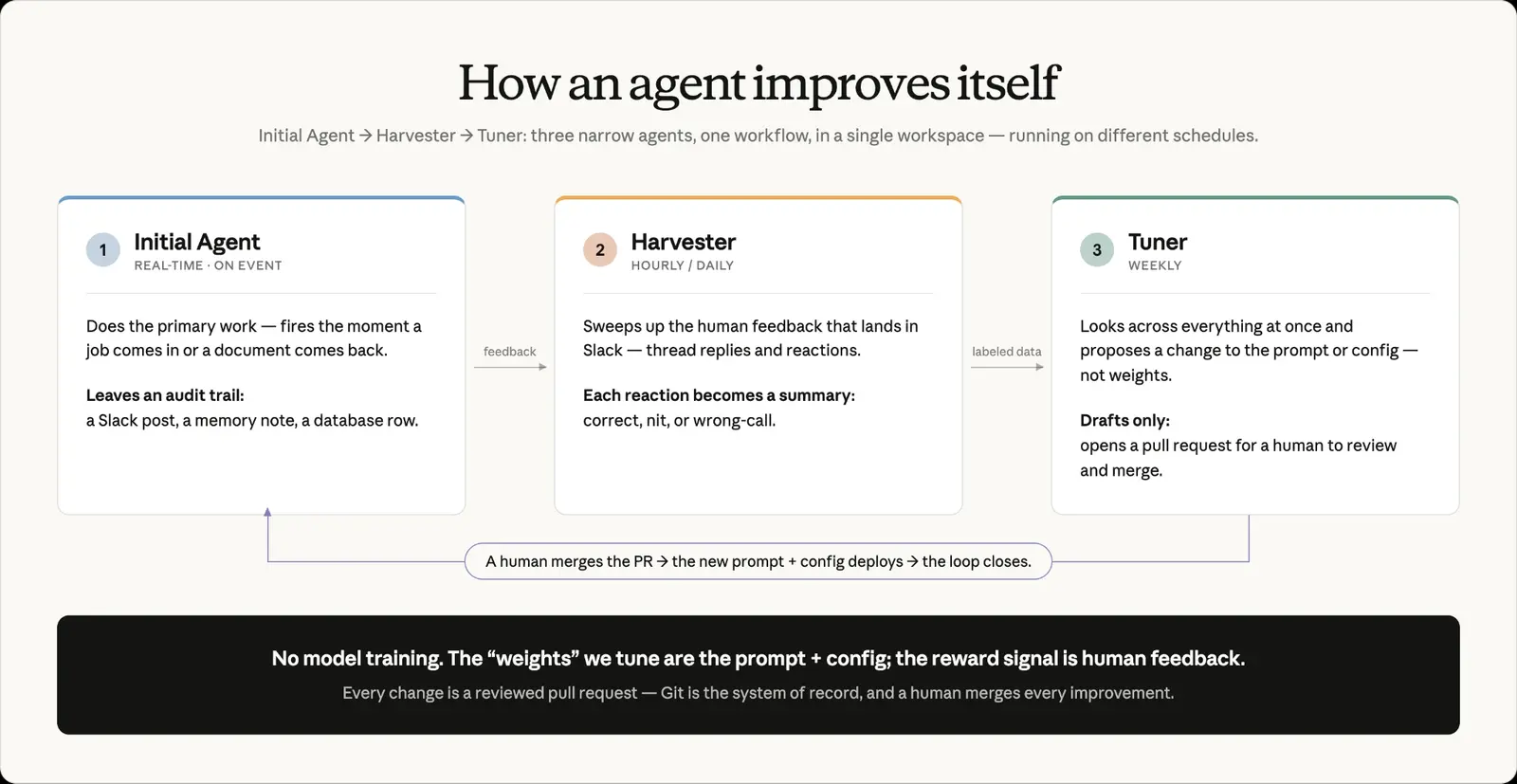
Some agents close the loop on themselves. Most of the fleet are single-task runners whose output nobody grades. For the ones that do collect graded feedback, ABC Legal runs three separate agents that share a workspace, environment and credential vault but run on different schedules. The initial agent does the work in real time and logs each action. A Harvester runs hourly or daily and turns Slack thread replies and emoji reactions into labeled data points. Once a week a Tuner reviews all of it and drafts a change to the prompt or config as a pull request. It never touches model weights, and a human merges the change.
The clearest example comes from Docketly, ABC Legal’s 50-person sister company, where Fuller’s “deliveries-as-code” system started. The rules for how each delivery is routed and handled, about 145 rulesets in all, are single YAML files in git rather than records in an admin screen. Four agents work on them. One posts a weekly verdict to Slack, the Harvester labels the reactions, the Tuner opens a pull request on the YAML, and a fourth agent pushes the merged config to the production database. That fourth agent executes only what a human has already approved. An emoji flagging a mis-routed delivery can become a merged routing change within the week, and the review is the only manual step.
Costs are tracked to the dollar by vendor, tool, team and use case. Claude Sonnet is the default model, Claude Haiku handles high-volume fast tasks, and Claude Opus is used when deeper reasoning justifies the cost. Swapping models is a one-line config change. Every agent reports the value it delivered, in hours and dollars, to a data warehouse on each run, and the team measures that against what the agent costs to run. Fuller describes a J-curve: agents often start out costing more than they deliver while they are new and running larger models, then turn positive as the team adds evals, moves them to cheaper models and trims tokens. Spend rose as the fleet went live through the spring, then began falling in July while usage kept growing. As of July, the company counts up to roughly 50% lower costs for the human tasks some agents cover, before heavy optimization. It also counts about 310 employees across every department using Claude for daily work. Despite the title’s “every employee,” that is a bit more than a quarter of the 1,100-person company.
The hardest part, Fuller says, was git, not the AI: getting business users comfortable cloning a repo and working through pull requests. It worked quickly, but he would like the tooling itself to make it easier. His other advice is to skip the scheduled-tasks detour his team took while Managed Agents was still a fresh beta, and to be willing to decide that a given task is not worth an agent, because the cost is real.
Projects in progress include a service photo reviewer, a PagerDuty triage agent, a daily KPI digest and more Tuner loops on existing agents. The team is also looking at moving notification templates, event routing rules and dispatch logic into repositories where agents can read them and propose changes. “We want AI to support a business that can run itself, with employees free to steer it,” Fuller said.
Up next

Preparedness team gone, risk calls split by subject
Jan Leike told the FT that OpenAI is ignoring safety in favor of shiny products, after it shut down the team judging whether its models posed catastrophic risks. Bio and cyber risk calls moved into the teams building the systems.
Related stories
- Curative now signs in a week what took all of 2025
- Managed Agents goes fully self-hosted in private beta
- Claude’s commerce blueprint ships two reference agents
- Five agent tools reach Claude deployments hosted on Azure
- Enterprise auth for MCP connectors is GA in Claude
- Claude integration launches within Notion
Comments
No comments yet. Be the first.
Join the conversation
Sign in to leave a comment. It appears after moderation.