
Five agent tools reach Claude deployments hosted on Azure

Microsoft has added structured outputs, web search, web fetch, the MCP connector and tool search to Claude deployments hosted on Azure in Foundry. Until now these agent features only existed on Hosted on Anthropic deployments. The changes are described in an August 29 post on Microsoft’s Foundry blog, written by a Foundry product manager. The post also lists the production constraints, and those are what a team actually has to plan around.
The hosting choice used to force a trade-off. A team that had committed to keeping prompts and completions inside Azure could drop that commitment, or it could rebuild search, fetch, MCP and tool routing on the client side. Hosted on Azure deployments send only usage metadata and content flagged by Anthropic’s safety systems to Anthropic. A US Data Zone Standard deployment keeps inference in the United States, which matches setting inference_geo: "us" on the Claude API. Claude became generally available in Foundry in June 2026, and Anthropic has said it wants feature and model parity between the two hosting options over time. Several things are still missing on Foundry: the Message Batches, Admin, Models and Compliance APIs, Claude Managed Agents, server-side fallback and the Advisor tool.
A grammar replaces the retry loop
Structured outputs work at decoding time. Foundry compiles your JSON Schema into a grammar and limits generation to tokens that fit it, so the model cannot return malformed JSON. There are two independent switches. output_config.format controls the shape of the response text, and strict: true on a tool guarantees that tool inputs match their schema. The post’s case for dropping retry loops is a nightly batch: at a 0.3% failure rate, 400,000 documents leave 1,200 rows in a dead-letter queue for someone to triage on Monday.
There is one data-handling catch. Structured outputs are processed under zero data retention, but schemas are cached for 24 hours, so the post warns against putting protected health information in a schema.
Search that filters its own results
The basic search tool, web_search_20250305, loads every result into context in full, navigation and boilerplate included. The post says that can waste tens of thousands of input tokens per turn on a research-heavy request. From web_search_20260209 onward, Claude writes and runs code that filters results before they reach context. Search runs inside the code execution tool: allowed_callers defaults to ["code_execution_20260120"], Foundry provisions the sandbox automatically, and those calls cost nothing beyond standard tokens. Models that don’t support programmatic tool calling need allowed_callers: ["direct"]. Without it they return a 400.
Web fetch reads the documents that search finds. It returns full page text, and PDFs come back as base64 that is processed like an attached PDF. Citations are on by default for search but off by default for fetch, so a team that wants sourced findings has to turn them on. max_content_tokens truncates oversized text before it enters context. The post’s budget figures: roughly 2,500 tokens for a 10 kB page, 25,000 for a 100 kB documentation page and 125,000 for a 500 kB PDF. Enable both tools and Claude can find a document the user named without a URL, then read it in full. Search costs $10 per 1,000 searches. Fetch and tool search have no per-call charge, and everything bills as Claude Consumption Units through Azure Marketplace.
Domain lists are where requests go wrong. allowed_domains and blocked_domains are mutually exclusive, and sending both returns a 400. The post recommends treating allowed_domains on fetch as a security control against prompt injection.
MCP without writing a client
The MCP connector, which is in beta on Foundry just as on the Claude API, lets the Messages API call remote MCP servers directly. The service handles the connection, sessions and tool calls. There are two parts to the request. mcp_servers declares the connections, and an mcp_toolset entry in tools sets which tools from each server are enabled. The post describes three governance patterns. A denylist enables everything and switches off destructive operations. An allowlist sets default_config: {enabled: false} and names the permitted tools, which the post recommends for anything touching identity, endpoints or money. The deferred pattern hands a server’s tools to tool search. Per-tool configs override the set-level default, which overrides system defaults.
The denylist pattern can fail quietly. An unknown tool name in a config produces a warning, not an error, so a misspelled delete_incident leaves the destructive tool enabled, and the post advises checking denylists in CI. The connector’s exchange with your MCP server is also not covered by zero data retention. MCP calls come back as mcp_tool_use and mcp_tool_result blocks with a server_name, which is enough for per-server audit logs.
When the tool list gets too long
The post describes two problems that show up together. Definitions for a modest multi-server setup (GitHub, Slack, Sentry, Grafana, Splunk) take up roughly 55,000 tokens before any work begins. And Claude’s tool selection degrades once more than about 30 to 50 tools are available. Tool search changes how tools load. Claude searches the catalogue and loads only what a request needs, usually 3 to 5 tools, which cuts definition tokens by over 85%. It comes in two variants: a regex variant with patterns up to 200 characters and a BM25 variant that takes natural-language queries up to 500 characters. Both search names, descriptions and argument details.
defer_loading only controls what enters the context window. The full tools array is still sent on every request, because the API runs the search server-side and expands tool_reference blocks into full definitions itself. At least one tool must stay non-deferred, usually the search tool, and deferring everything returns a 400. For MCP servers, the flag goes on the toolset once, and the few highest-frequency tools stay loaded. The post also says a system prompt that lists the available tool categories measurably improves search quality.
Operations have their own gotchas. Foundry doesn’t pass through Anthropic’s rate-limit headers, so the post recommends exponential backoff. Entra ID tokens expire after about an hour. And when tool search runs, the client must never return a tool_result for a srvtoolu_ ID. The API rejects it. Instead, pass the assistant’s content back unchanged, with the same full tools array, and Claude can reuse tools it already found without searching again.
Up next
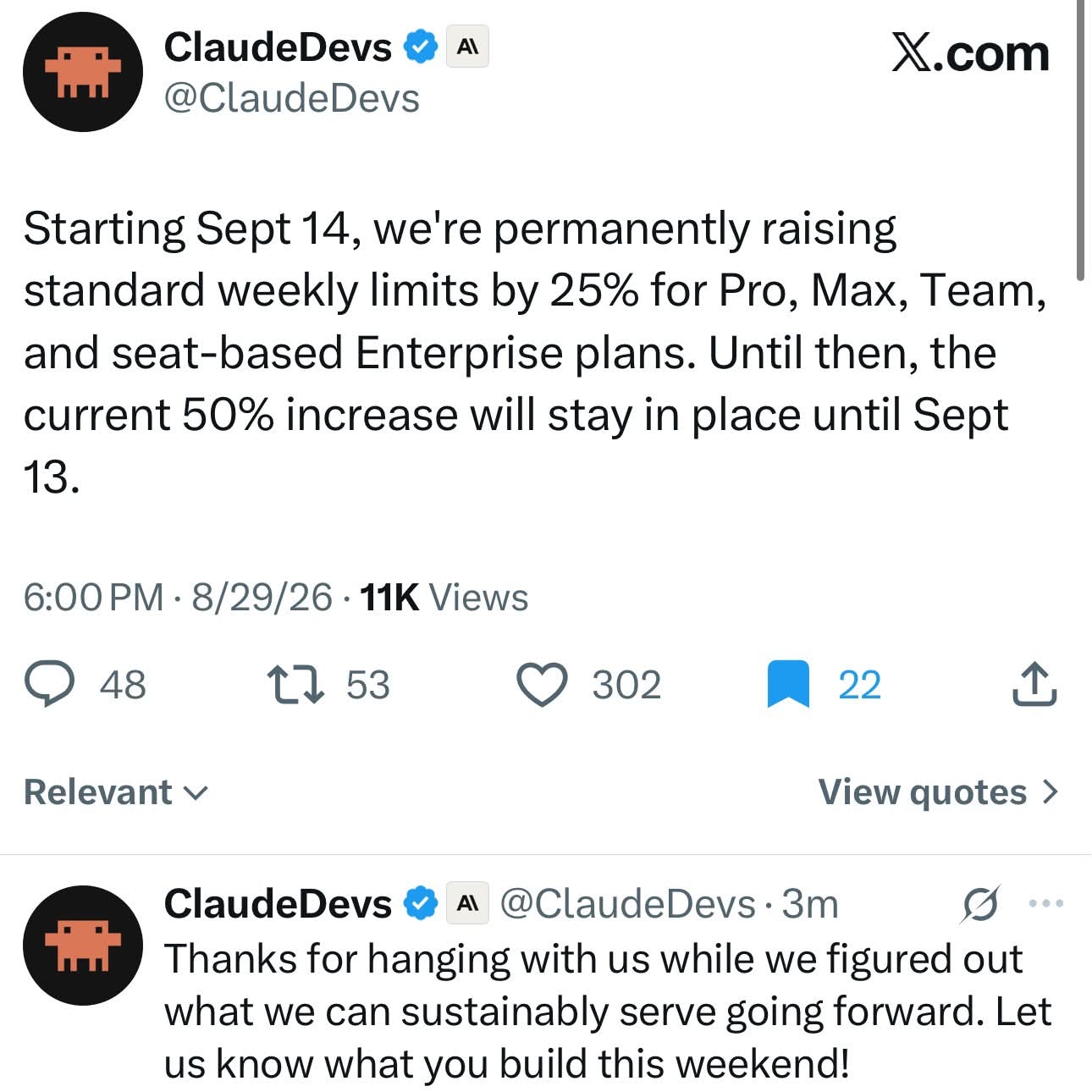
Claude’s weekly limits go up 25% permanently on Sept 14
Anyone burning through Claude Max weekly limits on the current 50% boost has until September 13. After that the increase becomes permanent at 25%, about 17% less headroom than today, per Testing Catalog.
Related stories
- Computer use goes GA on the Claude Platform
- Managed Agents goes fully self-hosted in private beta
- Curative now signs in a week what took all of 2025
- Claude’s commerce blueprint ships two reference agents
- Enterprise auth for MCP connectors is GA in Claude
- ABC Legal runs 50+ Claude agents built by non-developers
Comments
No comments yet. Be the first.
Join the conversation
Sign in to leave a comment. It appears after moderation.