
Claude solved two open problems about black holes
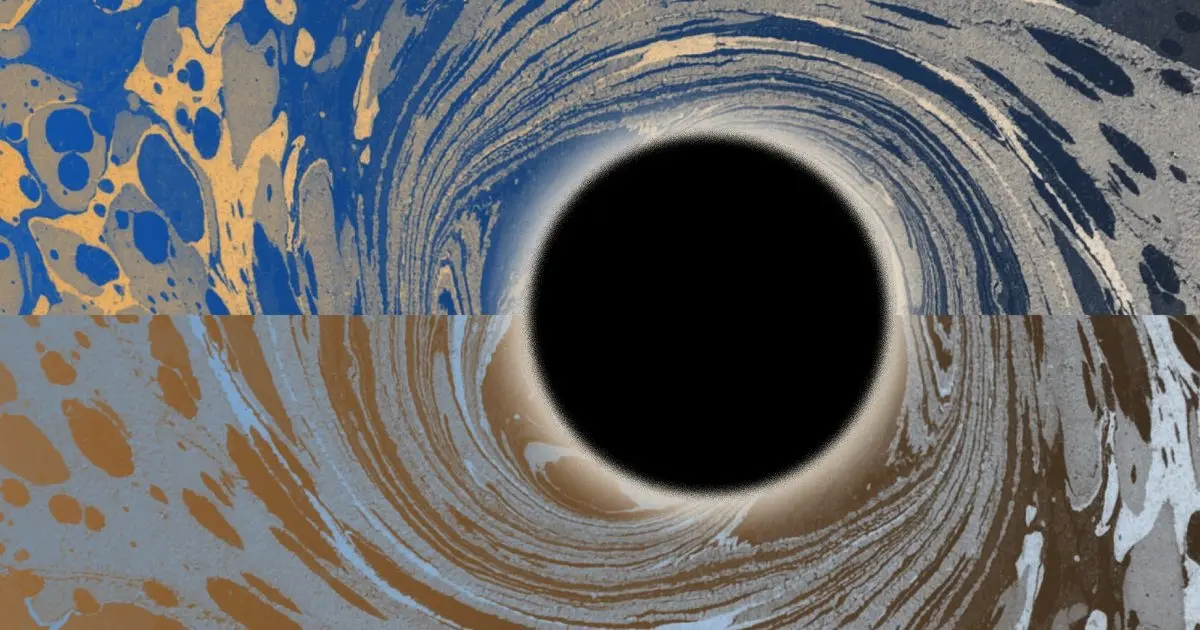
Anthropic says Claude has solved two open problems in theoretical physics, both about black holes and the search for quantum gravity, a theory that would unite relativity and quantum mechanics. In the first, Claude finished a calculation that physicists set up in 2003 and never completed. It showed that the moment a black hole forms in a model universe is an abrupt switch, like water boiling, even where spacetime no longer has a definite shape. In the second, it found the exact limit of the simplest version of a method physicists use to weed out wrong theories of quantum gravity, and proved that this version can’t go further. Anthropic describes both results on its research blog and has posted the two papers as preprints.
The work started as a side project. In August, Anthropic researcher Hongbin Chen asked Claude to list interesting open problems about black holes. Claude came back hours later with 22 candidates. Chen gave each one to a separate agent, and the agents could read each other’s progress notes and team up on related problems. They ran in the background with no special setup for about six weeks. Two of the 22 problems were solved.
A universe that boils
In 1983 Stephen Hawking and Don Page heated up a model universe that works like a giant bowl: whatever you throw comes rolling back, so heat stays in. At low temperatures the bowl fills with a gas of particles. Above a certain temperature a black hole wins out instead, and the switch is sudden, a phase transition like water boiling at 100°C. But their calculation relies on general relativity, which only holds when the universe is vast. When the model universe shrinks, spacetime turns blurry and nobody knows how to calculate on the gravity side.
There is a way around that. Physicists believe some model universes can be described twice: once with gravity, and once as a quantum theory with no gravity at all, “written” on the universe’s outer edge, the way a flat hologram holds a 3D image. On that quantum side, the blurry case can be calculated, at least in principle. In 1999 physicists found a transition there too, but couldn’t tell whether it was abrupt or gradual. In 2003 a group worked out that the answer hinged on a single number buried in many thousands of terms, far too many to do by hand. They finished a simpler cousin of the problem in 2005, but the full version, more than 10 times larger, was never done.
Claude ran a small research group of copies of itself. Almost every piece of the calculation was done twice by agents working independently and checked against known results. The answer: abrupt. The same sudden switch now shows up at both extremes, which Anthropic says suggests black hole formation isn’t just a feature of relativity but is built into the underlying quantum theory. Weeks after the agent finished, a physicist who had independently used Claude on the same problem shared his result. He had used a different method and reached the same answer.
A ceiling on the lightest black hole
The second problem lives in a simpler universe with two dimensions of space instead of three. Since 2009 physicists have used a method called the modular bootstrap to set a ceiling on how heavy the lightest black hole there can be. Any theory that breaks the ceiling contradicts itself and is ruled out, so every lowering narrows the search. Computer searches hinted where the best ceiling lay, but the best proof fell well short of it.
Claude Fable 5.2 noticed a pattern in those numerical results that physicists had missed. Another agent, working on a related maths problem about packing spheres, turned the pattern into a method, using a tool borrowed from other areas of maths and physics. With it, Claude calculated the exact ceiling for the simplest version of the method and proved it can’t be pushed lower. An earlier agent had failed at the same problem in 61 parallel attempts. Half of the final proof follows the strategy of a sphere-packing proof recently found by an OpenAI model. The result also shows that this version of the method alone can’t reach the mass at which black holes first appear; that will take other ingredients.
What’s still open
Both results were formally verified in September in Lean, a program that checks proofs by computer. Claude wrote the papers with minimal guidance, and a physicist checked every main result. Claude has worked with the same quantum theory before, when it pushed a calculation of how its particles interact to a new level of precision.
Anthropic is clear about the limits. Neither result describes our own universe, neither has practical uses, and neither comes close to settling quantum gravity. Even the first one only covers the two extremes: that the switch stays abrupt everywhere in between is, in Anthropic’s words, the most natural possibility. Other questions are still open, such as whether a second transition seen on the gravity side, at even higher temperatures, behaves the same way in the quantum theory.
Related stories
- Claude’s ETH proof pays off only past 10^108 variables
- Claude does nine loops, one past the N=4 physics record
- Claude learned proteins, not just papers about them
- Anthropic bought a biotech with one full-time employee
- A perfect refusal score isn’t a safer model, Anthropic says
- Anthropic touts 94.2% true positives; curl rejected 19 of 34
Comments
No comments yet. Be the first.
Join the conversation
Sign in to leave a comment. It appears after moderation.