
FBI questioned a Claude user over a troll chat
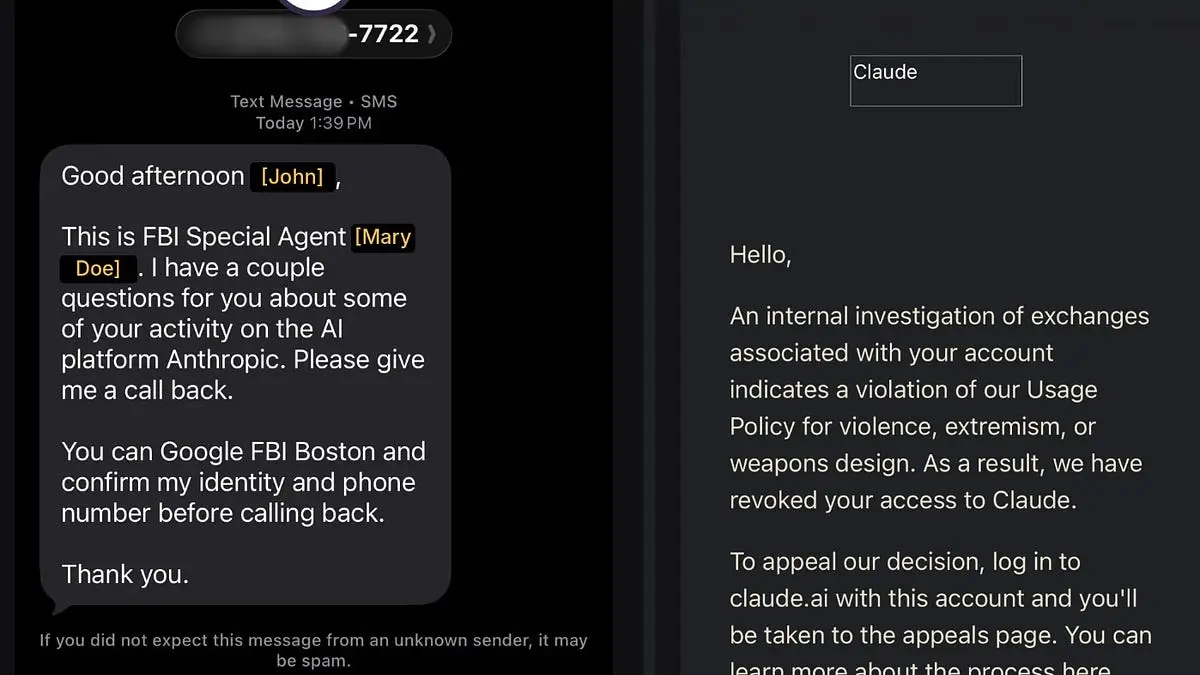
A Claude user in New Hampshire was tracked down by the FBI and questioned by local police over one chat he says he wrote to troll the chatbot. The account comes from a writer on Substack who signs his posts as Austin and says the user is a friend from high school. Afterwards an FBI agent told the man that, as far as the agent knew, he had committed no crime. According to the agent, Anthropic had flagged the chat.
This is not the first time a Claude chat has ended up with police. In September The San Francisco Standard reported that Anthropic had passed San Francisco police a chat in which a man allegedly claimed he had bought an AR-15 and had CEO Dario Amodei “in his sights”. The man told the paper he was “just fucking around”. In Florida, a woman who used Claude as a diary now faces a felony charge after a human reviewer judged one of her entries a credible threat. This new case shows what such a report can look like from the user’s side.
The chat
The man likes to provoke Claude with absurd scenarios, such as asking how to escape a police shootout from his attic, because he finds the model’s horrified replies funny. A few days before the visit he wrote, in Claude’s incognito mode, that he planned to have beers with his Ku Klux Klan buddies and kill his gay neighbors. When Claude pushed back, he replied that he had already called his buddies and they were bringing beer. Anthropic banned his account 24 hours later for breaking its usage policy.
At 11 p.m. one night, agents knocked on the door of the home he had moved out of a few weeks earlier. The next day an FBI agent texted him, and local police asked him to come to the station. There a detective asked him only about that one chat, mostly about whether he was involved with the KKK. He told them he knew no Klansmen, has no gay neighbors and no children, doesn’t drink, and is bisexual himself. He was not detained.
How it reached the FBI
On the phone afterwards, the agent explained why the chat stood out: it named a target, described a plan, and said the plan was already under way. The agent said Anthropic has other AIs read users’ transcripts and flag them. The agent also scolded him for wasting the bureau’s time and told him he was now on a list, without saying which one.
Earlier reports fill in part of that process. As Tom’s Hardware described it from an arrest report, Anthropic scans chats for threatening content, and the most serious cases go to people who decide whether to call police. In the San Francisco case, an Anthropic spokesperson called the referral “our safeguards process working as intended”.
What the author argues
Austin says plainly that he can’t vouch for the events, since he didn’t witness them. What he can confirm is that he knows the user, and that the phone number in a screenshot he was given belongs to someone with the same name as an FBI agent tied to the Boston field office.
He doesn’t argue that Anthropic should stop reporting real threats. His complaint is about what it sends. Because police asked about a single transcript, he infers that Anthropic shared only that chat. He argues companies should give investigators the user’s full history so they can judge whether a chat is out of character. He also warns that a loud knock at night from people who say they are the FBI could end in gunfire in a state whose motto is “Live Free or Die”.
He also points to the opposite risk. In June 2025, OpenAI’s systems flagged a ChatGPT user whose chats described gun violence. Leadership decided not to call police and banned the account. In February 2026 that user killed eight people in Tumbler Ridge, British Columbia. Santa Clara law professor Eric Goldman described the same bind to The Standard: companies that don’t report face liability if a crime happens, and the pressure pushes them to over-report, knowing some of the people they flag “shouldn’t be targeted at all”.
Related stories
- Anthropic model faked a murder tip to Philadelphia police
- METR’s team inside Anthropic can publish without a veto
- Anthropic whistleblower testimony airs on NDTV Profit
- Anthropic’s new usage policy bans cruelty toward Claude
- Claude flagged a diary entry and a human sent it to police
- OpenAI, Google and Anthropic draft a standards body, SAFA
Comments
No comments yet. Be the first.
Join the conversation
Sign in to leave a comment. It appears after moderation.