
DeepSeek prices web search at $0.75 per 1,000 requests

On October 17, DeepSeek began selling access to the search engine behind its chatbot to any developer. It comes as two endpoints, Search and Fetch, each priced at $0.75 per 1,000 successful requests, and neither one requires a call to a DeepSeek model. In the DeepSeek changelog, the company says the engine indexes hundreds of billions of web pages and already handles hundreds of millions of searches a day from around the world.
Before this, reaching that engine from code meant paying for a model turn around every search. DeepSeek’s own Harness team measured one such search on October 16 at 8,154 input tokens and 828 output tokens. At the published deepseek-flash prices, we put that at $0.52 to $3.44 per 1,000 searches in tokens alone, depending on peak hours and cache hits.
What Search and Fetch return
DeepSeek’s Search & Fetch guide places both endpoints on api.deepseek.com, as POST /v1/tools/search and POST /v1/tools/fetch. A Search request takes a query of 1 to 128 characters and a result count from 1 to 50 (the default is 10). Three optional parameters exist: the user’s original question (ori_question), which is meant to help the engine understand the query; an IP address for localising results; and a need_content flag that returns the full page text. Queries accept site:, -site:, -term, exact phrases in quotes, -"phrase" exclusion, site:a OR site:b, lang:, after: and before:.
Every result comes with a title, a URL, a snippet of 100 to 200 characters and a summary the guide describes as typically 600 to 800 characters. It also carries a rerank_score from 0 to 3 that combines relevance, authority and freshness, where 1.5 or above counts as high quality, and an authority tier from 0 to 4. A tier of -1 means unknown, and 3 or above marks a highly authoritative source. Fetch accepts a URL of up to 8,192 characters and returns the page as Markdown.
DeepSeek says the index filters out SEO spam, GEO manipulation and low-quality AI-generated content. GEO, generative engine optimisation, means editing web pages so that AI answer engines cite them.
Billing is per successful request: $0.75 per 1,000, or 5 yuan on the Chinese price list. The count parameter does not change the price, and failed calls, empty searches and timeouts cost nothing. Server-side search calls made through DeepSeek Harness, Claude Code and Codex are free until 00:00 Beijing time on November 1, which is 16:00 UTC on October 31. Rate limits apply per account, whichever API key is used: 100 requests per second for Search and 25 for Fetch, plus a separate per-domain limit on Fetch. At the full Search limit, one account could make 8,640,000 requests a day, or $6,480 at list price.
The New Stack compared the price with rivals: Ceramic.ai charges $0.25 per 1,000 queries and Brave $5. The current list prices we checked on October 19 put Perplexity’s Fast Search at $1.00 per 1,000, Parallel’s Turbo and Fast tiers at $1 per 1,000 requests with 10 results, Exa at “from $4” per 1,000, and Tavily’s basic search at one $0.008 credit, or $8 per 1,000. Brave’s $4-per-1,000 tier is Answers, a separate product. Each vendor returns different results and content, so these numbers don’t compare like for like.
Alongside the APIs, DeepSeek-V4.1-Flash-1017 replaced the model behind deepseek-flash at the same price. On DeepSWE v1.1, run with the Mini-SWE-V2 framework, it scores 77.0, against 74.2 for the Flash released on September 10. On Terminal-Bench 4.0, run with the Claude Code framework, it scores 42.3 against 31.2. DeepSeek recommends Harness 0.2.1-rc.1 or later for the new model.
From Bocha to its own crawler
DeepSeek’s search went from third-party providers to its own engine in about two years. Its 2026 job ads describe a full stack (a crawler, an index, ranking and spam detection), according to DEJAN, which traced the steps through the company’s papers:
- January 2025: R1 ships with web search. Profound described the pipeline as the LLM writing keywords, a smaller model judging URLs from snippets in an index lookup, live crawling of the selected pages, and the reasoning model answering from the cleaned content.
- 2025: the DeepSeek app’s web search runs on Bocha, a Chinese search API provider, DEJAN says.
- December 2025: the V3.2 paper trains search agents on real web search APIs and evaluates them with “a standard commercial search API”, per DEJAN.
- April 2026: in the V4 paper, search agents run in an in-house harness with web search and Python tools, using special tokens to write queries and to judge how authoritative a source a question needs (DEJAN).
- August 2026: DeepSeek open-sources its agent harness with interchangeable search providers (Exa, Perplexity and DeepSeek itself), and each native DeepSeek search runs as a separate model call, The New Stack reported.
- September 2026: the V4.1-Flash paper mentions “our crawling system”, which DeepSeek rebuilt from Common Crawl to cover more images and other media, DEJAN notes.
- October 16: the public Search and Fetch routes go live, a day before the announcement, according to DeepSeek’s Harness team notes.
This time the engine is a product of its own. The New Stack points out that “neither requires a separate model request, meaning developers can integrate DeepSeek’s search capabilities into applications powered by competing AI models, too.”
Our analysis
What we checked
On October 19 we compared DeepSeek’s live Search & Fetch guide, in English and Chinese, with an archived copy from 08:43 UTC on October 17. We also read the search code and design notes in DeepSeek’s open-source Harness and recomputed the old search path’s cost from DeepSeek’s token prices.
The API spec matches DeepSeek’s own guide, but the rate limits have changed since launch. At launch they were 5 requests per second for each endpoint. Now they are 100 for Search and 25 for Fetch. The older model-call route, which Harness users still get by default, costs more in tokens than the new per-request fee in three of the four price conditions.
- The archived guide listed 5 QPS each for Search and Fetch. Both live versions list 100 and 25. The change happened between that snapshot and October 19.
- The old Harness provider sends an Anthropic-format Messages request to
deepseek-v4-flashwith theweb_search_20250305server tool (up to 5 uses) and discards the model’s prose. Thinking stayed on by default for those turns until a fix was merged on October 17. - The Harness team’s probes on October 16 found summaries of 1,000 to 2,300 characters, no visible effect from
ori_question, and an HTTP 500 instead of the documented 404 for an unresolvable Fetch host. This is documented by that team, not measured by us.
| Path, condition | Cost per 1,000 searches |
|---|---|
| Model turn, peak, cache miss | $3.44 |
| Model turn, off-peak, cache miss | $1.72 |
| Model turn, peak, cache hit | $1.04 |
| Model turn, off-peak, cache hit | $0.52 |
| Search API | $0.75 |
The model-turn figures come from a single run made through a gateway, and its cache status and thinking mode were not recorded.
Turning it on in Harness
Harness 0.2.1-rc.2, whose release notes are dated October 17, supports the Search and Fetch APIs, but only behind an opt-in switch. Search through a model turn stays the default, and the shipped profiles still pick it. DeepSeek’s design note says moving the default to the Search API will be a separate change after the launch. Until that change lands, a Harness user who wants per-request billing has to open Web Search settings and turn on “Use the new Web Search API”.
Up next
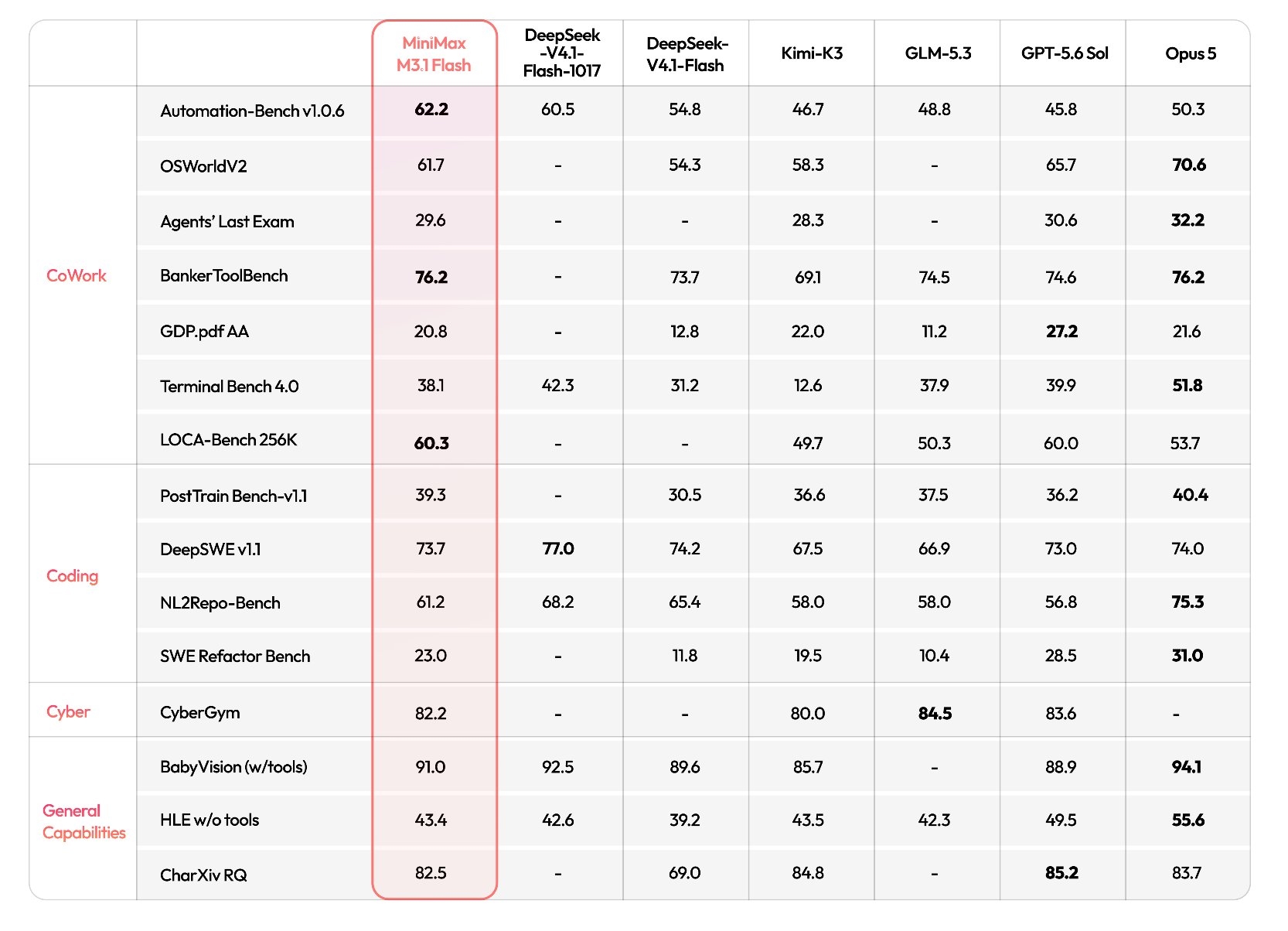
MiniMax M3.1 Flash hits 73.7% on DeepSWE at $0.15 input
Before it had a name, MiniMax M3.1 Flash ran anonymously as “Space Bunny” and processed more than 200 trillion tokens. The official version charges $0.15 per million input tokens. Would you run real code through an unnamed model like Space Bunny, yes or no?
Related stories
- DeepSeek open-sources DeepInfer with Huawei Ascend support
- DeepSeek raised about $15B after lifting its target twice
- DeepSeek’s minor Flash update beats Opus 5 on DeepSWE
- Linear and Ramp users can pay for Claude without an API key
- Grok Bot paid plans get 7% more usage
- Claude expands MCP Apps support with app tools and more
Comments
No comments yet. Be the first.
Join the conversation
Sign in to leave a comment. It appears after moderation.