
MiniMax M3.1 Flash hits 73.7% on DeepSWE at $0.15 input
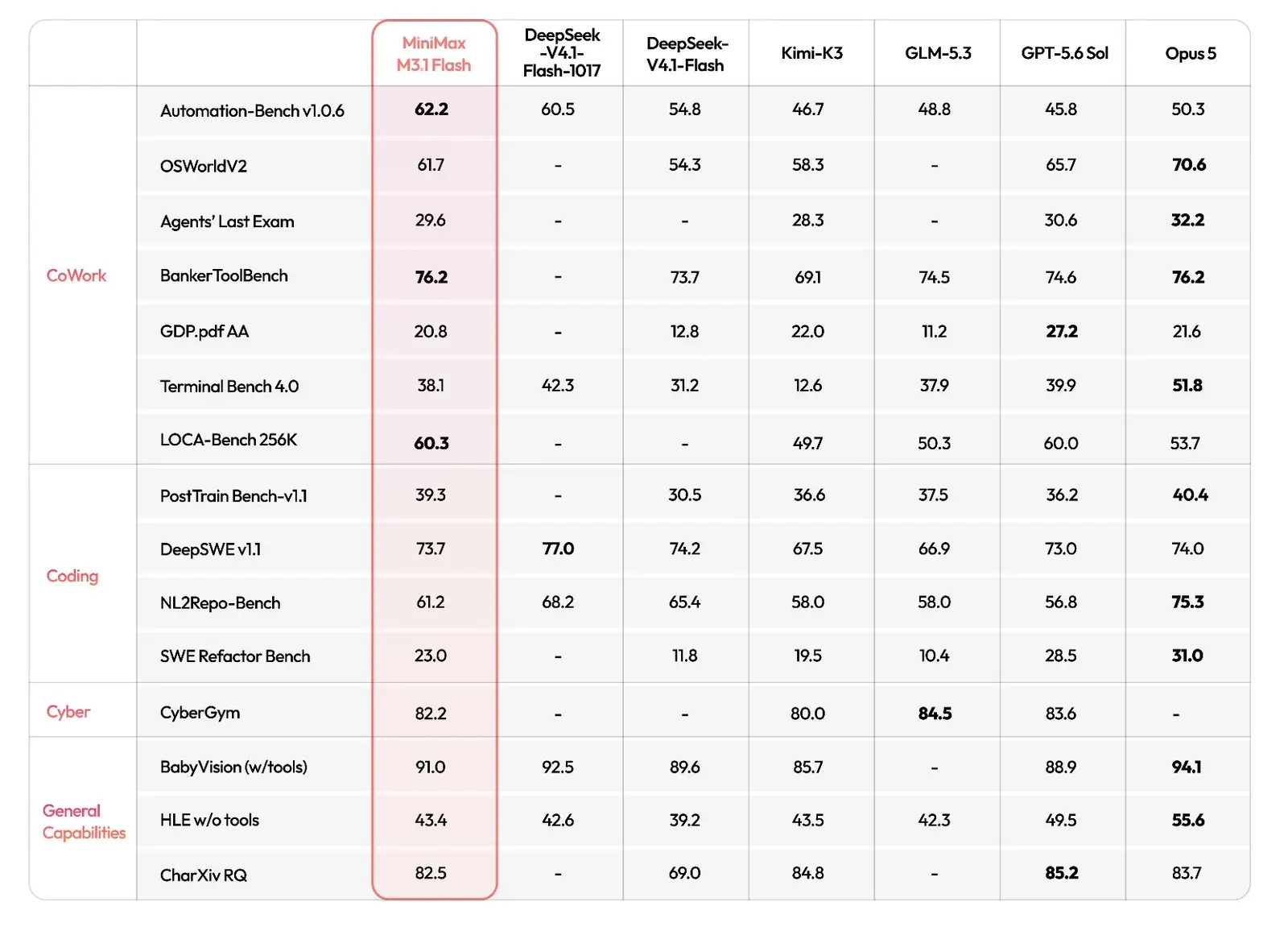
MiniMax on October 19 named the model behind OpenRouter’s anonymous “Space Bunny” and put a price on it: M3.1 Flash costs $0.15 per million input tokens and $0.60 per million output, and scores 73.7% on DeepSWE v1.1, according to MiniMax’s launch post. It is available now through the MiniMax API, M Plan and MiniMax Code. Every score in the launch comes from MiniMax itself, and the weights for running it on your own hardware are promised for later.
Price and speed
Pricing is flat per million tokens: $0.15 input, $0.60 output and $0.015 for cached input. MiniMax says the overall usage cost on agentic tasks is 70% below its predecessor’s, a figure for total spend on that kind of work rather than a per-token comparison. The company gives no per-token price for the predecessor to set against it.
Online inference is nearly three times faster, MiniMax says, and puts that down to more aggressive sparsity. In everyday use output runs at 200+ tokens per second, and the median (P50) holds at 170+.
Where the scores come from
MiniMax reports these results for M3.1 Flash:
- DeepSWE v1.1: 73.7%. The benchmark gives a model complex software tasks to do on its own: understanding code, building features, fixing issues and testing its own work.
- BankerToolBench: 76.2, which covers multi-step planning, keeping documents consistent, financial compliance and chained tool calls.
- OSWorld V2: 61.7, for operating a computer across applications.
- Agents’ Last Exam (ALE): 29.6, for real professional work.
- CyberGym: 82%, for finding and validating vulnerabilities.
On AutomationBench-AA, which tests end-to-end enterprise workflows across SaaS systems, MiniMax says only that the model “ranks among the top performers” and gives no score. The ranking claims for OSWorld V2 and ALE are scoped too. On both, M3.1 Flash is “first among Chinese models.”
DeepSWE v1.1 is the one score here with a published comparison. DeepSeek-V4.1-Flash-1017 reached 77.0 on DeepSWE v1.1 in October, up from 74.2 for DeepSeek’s previous Flash, so M3.1 Flash’s 73.7 sits below even the older DeepSeek model on the same test. All three numbers are the vendors’ own.
Space Bunny’s stealth run
MiniMax says Space Bunny was an early version of M3.1 Flash and processed more than 200 trillion tokens while running anonymously. OpenRouter listed it as stealth/space-bunny-alpha on September 23. The listing described a model “developed and operated by a third-party provider who has chosen to remain anonymous during this preview.” OpenRouter routed the requests without being the developer or the provider, and the provider kept prompts and completions without training on them.
That listing gave the preview a 1,000,000-token context, up to 524,288 output tokens, text, image and video input, reasoning that could not be switched off, and a price of $0 for both input and output. OpenCode also announced it as free for a week from launch day. Every earlier OpenRouter stealth model lost its free price once its maker was named. For M3.1 Flash, the named price is now MiniMax’s per-token rate above.
MiniMax also says a Pro model, which “pushes the boundaries of intelligence,” will come later. Self-hosting depends on the weights. MiniMax says they will be released later, and Testing Catalog gave the date as October 23 in a Threads post.
Up next

Sydney man arrested after Interpol flagged his Claude chat
A 29-year-old in Sydney told Claude in voice mode that he planned to shoot children at a childcare center. Interpol flagged the chat, and police arrested him on Sunday.
Related stories
Comments
No comments yet. Be the first.
Join the conversation
Sign in to leave a comment. It appears after moderation.