
FLUX 3 Image Klein’s 5.6B count leaves out its encoder
Black Forest Labs released FLUX 3 Image Klein, an open-weight model for generating and editing images, on October 15. It is billed at 5.6B parameters, but that figure covers only the image transformer. The Qwen3-VL-4B-Instruct text encoder ships as a separate component.
The Black Forest Labs model card on Hugging Face says one model handles three jobs: text-to-image, edits from a single reference, and compositions from up to 10 reference images. Each call returns one image. The launch announcement relayed on Threads says Klein “runs on a single consumer GPU” and promises native 4K, bounding boxes and “pixel-perfect editing”.
How much memory does it take?
The card measured memory on a B200, a datacenter GPU, running the reference code at 1024x1024 with the prompt upsampler off. Peak GPU memory was 31 GB in BF16, 26 GB in FP8 and 25 GB in NVFP4. The card also warns that a quantized package’s file size is not a measure of total GPU memory use, and that quantized files need a loader that supports their format.
The prompt upsampler costs memory too. It is an 18.8 GB download and adds about 28 GB on an 80 GB GPU. By default the reference CLI runs it before every generation. The --no-pup flag skips it and sends prompts as typed. The CLI also always loads a safety classifier, Falconsai/nsfw_image_detection, which you download alongside the checkpoint.
The Hugging Face repository ships the BF16 transformer plus FP8 and NVFP4 variants. The launch announcement lists INT8 as well, and says the distilled model with native 4K output will also be available on BFL’s APIs.
Base at 50 steps, distilled at 16
Klein comes as two checkpoints. Klein Base is undistilled bfloat16, runs 50 sampling steps at guidance 3.5, and is meant for fine-tuning, LoRA training and research. The distilled checkpoint in this repository runs 16 steps with no guidance. It covers generation, editing and self-hosting, and it is the checkpoint behind the BFL API.
The repository holds the model package, not a full inference application. You need an implementation that supports flow-map sampling and this checkpoint format. Two routes are documented: the reference code at black-forest-labs/flux-3-image-klein on GitHub, and a modular Diffusers pipeline, which for now means installing Diffusers from its GitHub repository. With Diffusers the upsampler is a separate model, black-forest-labs/flux-3-image-klein-pup. You run it with Transformers and pass its output to the pipeline as the prompt.
Captions and boxes on a 0 to 1000 grid
The card says the caption controls composition, while reference images anchor content without locking structure. It asks for full scene captions covering framing, subject, background and lighting. A short prompt gives generic output, and a one-line instruction like “make it blue” reframes the shot. For edits, you describe the target image as a complete caption of the reference with the change folded in, or let the upsampler write that caption from the instruction and the references. For style, the card advises describing palette, stroke and texture instead of naming an artwork.
Layout is set with a JSON list appended to the caption. Each element gets a box written as [top, left, bottom, right] on a 0 to 1000 grid and is tagged in the caption with an <id>. Box edits refer to the n-th reference image as <ref_image_n> and give each element from, src_bbox and tgt_bbox; a null target removes the element. The upsampler can also write layout captions from a plain list of boxes.
Boxes set placement and scale and do not act as a hard mask, the limitations section says: an element can extend past its box, and small requested elements may not appear. Edits can change content outside the requested region, and text rendered in images may be inaccurate or distorted.
Who can use it commercially?
Klein is released under the FLUX Kommunity License v1.0. It permits non-commercial use, plus commercial output generation by Qualifying Users with less than US$5M in gross annualized revenue, affiliates included. The card says this exception “is not blanket permission for commercial fine-tuning or distribution”, and points to commercial licensing for other uses. The Qwen3-VL-4B-Instruct encoder stays under Apache-2.0.
Section 4 of the license rules out military use, surveillance, biometric processing and violations of publicity or digital replica rights. It also bars using the model, its derivatives or its outputs “to improve another AI model that performs a function similar to a FLUX Model or Derivative.”
Up next
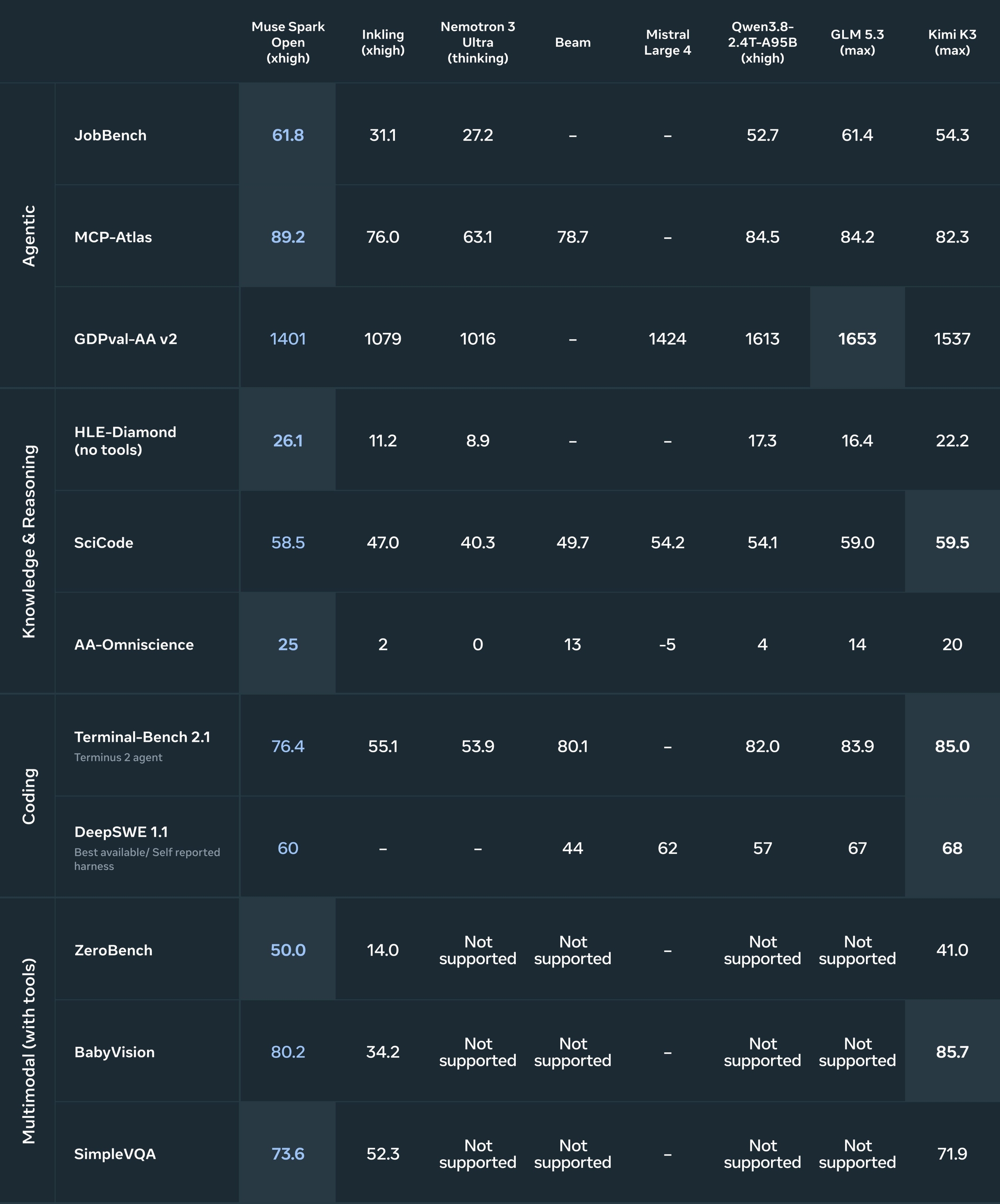
Meta’s open-weight Muse Spark Open lags Kimi K3 at coding
Two linked M5 Ultra Mac Studios with 512 GB can run Meta’s 816B Muse Spark Open locally, Meta says, but Apple doesn’t sell that 512 GB Mac Studio to regular buyers yet. Would you run an 816B model on your own desk, or keep it in the cloud?
Related stories
- Ideogram 4.5 prices images from 0.8 to 22 cents at 2K
- FLUX 3 Max outpaces Seedance 2.5 over 25x in fal’s test
- Krea 3 edits a 2K image in under 8 seconds
- Kimi K3.1 Pro weights land on HuggingFace at 2.8T params
- Tencent ships Hy4 at Hy4 preview’s API price
- Nvidia’s open transcriber tops English ASR at 5.33% WER
Comments
No comments yet. Be the first.
Join the conversation
Sign in to leave a comment. It appears after moderation.