
Meta’s open-weight Muse Spark Open lags Kimi K3 at coding
On October 15, Meta posted downloadable weights for Muse Spark Open. The model belongs to the Spark line, which Meta launched in April as a closed model. Meta’s Hugging Face collection describes it as “a mixture-of-experts model with 42B active parameters, 816B total parameters, and a 1M-token context window.” In a mixture-of-experts model, a router sends each token to a few expert subnetworks, so only those 42B parameters do work on any given step.
Testing Catalog describes it as an open-weight version of Muse Spark 1.2. Meta calls it the “most capable US open-weight model to date,” The News Stack reported, and pitches it at the same job as the closed model: “agentic and coding workflows, from understanding large repositories to completing multi-step engineering tasks with tools.”
The weights are available on Hugging Face, Amazon SageMaker AI, Google Cloud Model Garden and Microsoft’s Foundry Model Catalog. If you would rather not host 816B parameters yourself, the model is also served through the APIs of Baseten, Fireworks AI, Groq, Modal, Nebius, OpenRouter and Together AI.
What the Muse Model License asks
The license is new, and it sets its own terms. Meta says the Muse Model License has “limited commercial terms, which allow many developers to use the model for free.” Internal use and building the model into your own product cost nothing. The line is drawn at revenue. Any company with more than $20 million in gross revenue during any consecutive twelve-month period must “notify Meta and enter into a separate written agreement with Meta” before offering the model or any derivative as part of a model-as-a-service business.
A second condition applies to everyone. Any product or service built on the model, or on a model “created, trained, fine-tuned, or distilled” from it, must “prominently display ‘Built with Muse Spark Open’” in its user interface. The usage policy also bars deployment in military and critical-infrastructure settings. The News Stack compared the whole package to the license Moonshot uses for Kimi K3. Meta’s smaller Muse Glimmer went out under Apache 2.0, which carries neither the revenue threshold nor the branding rule.
Where the benchmarks split
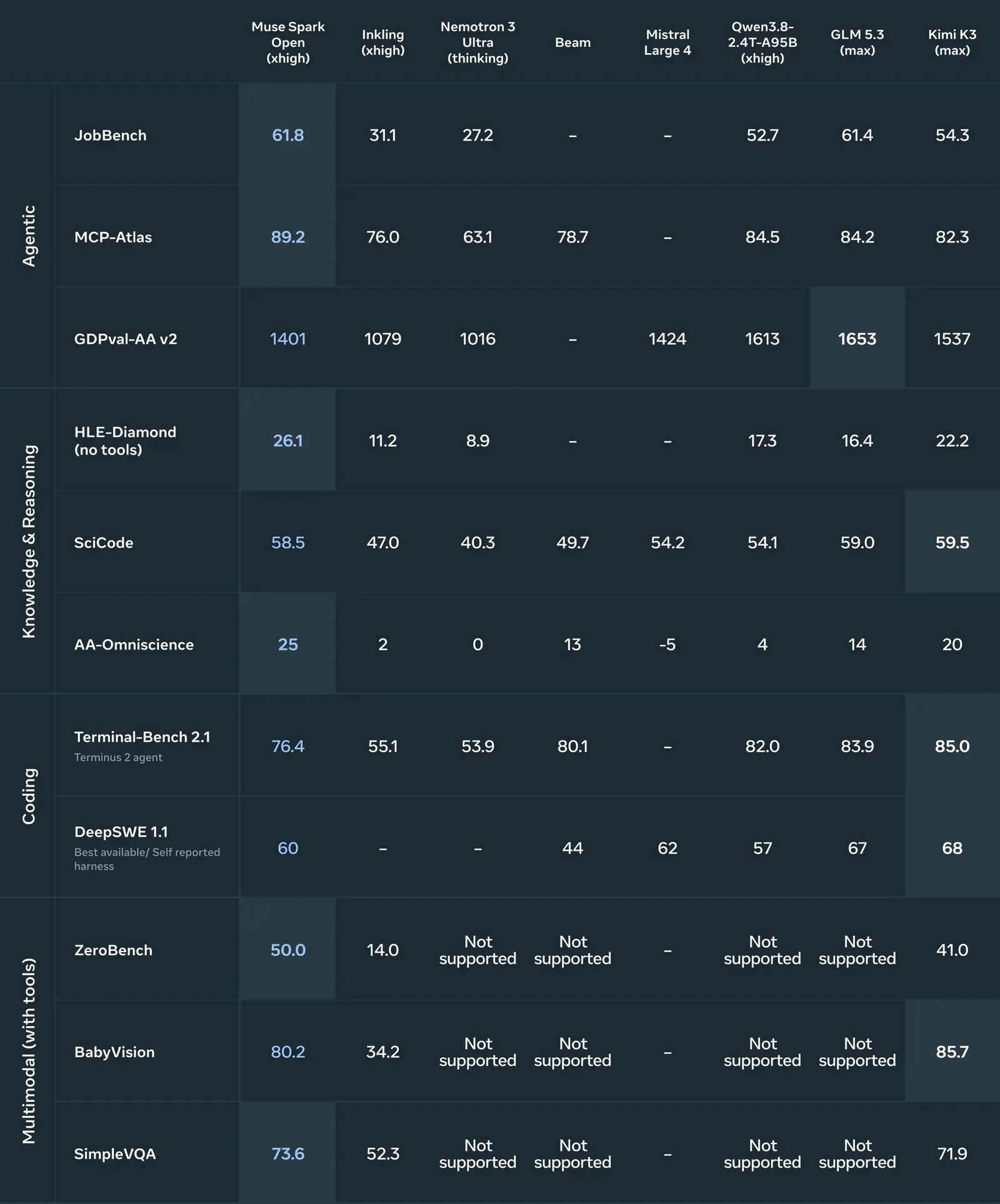
Meta built the model for “coding and agentic work, it excels at long-horizon tasks, complex software engineering, and multi-step reasoning,” the company says. All of the figures below come from Meta’s own benchmarks. Against the two US open models The News Stack treats as its real rivals, Thinking Machines’ Inkling and Nvidia’s Nemotron 3 Ultra, Spark Open wins on every benchmark, often by 20 points or more.
The comparison with Chinese open models, which many developers already run, is closer. Spark Open leads Kimi K3, GLM 5.3 and Qwen3.8 on the agentic and tool-use benchmarks, including JobBench and MCP-Atlas, and roughly ties them on SciCode.
Coding is where it falls behind. On Terminal-Bench 2.1 it scores 76.4, against 85.0 for Kimi K3 and 83.9 for GLM 5.3. That leaves it 8.6 points behind Kimi K3 on a benchmark that tests the repository-and-tools work the model is pitched at. On DeepSWE 1.1, The News Stack puts the spread at 68 to 60, with Spark Open at the bottom. When Meta introduced Muse Spark in April, it acknowledged gaps in “long-horizon agentic systems and coding workflows” and said it would keep investing there. The News Stack’s assessment is that the coding gap is the same one Meta admitted then, with little progress since. On these numbers, “most capable” holds on the agentic half of the pitch and still falls short on the coding half.
Two Mac Studios
Mark Zuckerberg focused on the hardware on launch day: “Muse Spark Open — weights releasing today — runs great on new Mac Studios thanks to work with @johnternus and Apple.” In practice that means two Mac Studios with M5 Ultra chips and 512 GB each, linked together and running the model through MLX, Apple’s machine-learning framework. That gives about 1 TB of combined memory for a model with 816B parameters.
Meta says it used that setup to run Muse Code, its coding agent built on Muse Spark, and to ship updates to the Ice Cubes Mastodon client. You can’t buy that setup yet: Apple doesn’t currently sell the 512 GB Mac Studio to the public. According to The News Stack, it will go on sale in a few weeks, and two of them will cost about as much as a compact car.
Up next
ClaudeClaude Codeanalysis
Claude Code 2.1.301 stops waiting out distant usage limits
“Instead of waiting”: Claude Code 2.1.301 lets unattended retry mode end a request when a usage limit resets too far away. One new environment variable sets how far is too far. Stuck at a limit overnight, would you rather Claude Code wait it out or quit?
Related stories
Comments
No comments yet. Be the first.
Join the conversation
Sign in to leave a comment. It appears after moderation.