
Mistral’s 1T-parameter Le Chonk keeps only 49B active
Mistral on October 6 opened a public API preview of Mistral Large 4, which it has nicknamed “Le Chonk”: a natively multimodal mixture-of-experts model with 1 trillion parameters, 49 billion of them active, the company announced on Threads. For now the only way to use it is the API, through Mistral Studio, at $1.36 per million input tokens and $4.18 per million output tokens. Self-hosting waits for the open weights, which Mistral plans to release at the end of October.
The model will be offered in several regions. One is a European deployment that Mistral operates end to end under European law. Private-cloud and on-premises options are planned for security teams, but Mistral has not tied them to a date.
Hosting the weights
In a mixture-of-experts model, a small learned router scores a set of parallel sub-networks, the experts, for every token. Only the top few experts process that token. So less than 5% of Large 4’s parameters do work on any one token, and the compute per token is set by the 49 billion active parameters. DeepSeek-V3 uses the same split at a smaller size: 671 billion parameters in total, 37 billion active per token.
Memory is a different matter. Hugging Face‘s explainer notes that MoE models need a lot of VRAM, because every expert has to be loaded whether or not the router picks it, and that fine-tuning them comes with many challenges. Anyone planning to run Large 4 on their own hardware once the weights ship will need memory for all 1 trillion parameters, even though only 49 billion of them work on each token.
The benchmark sheet
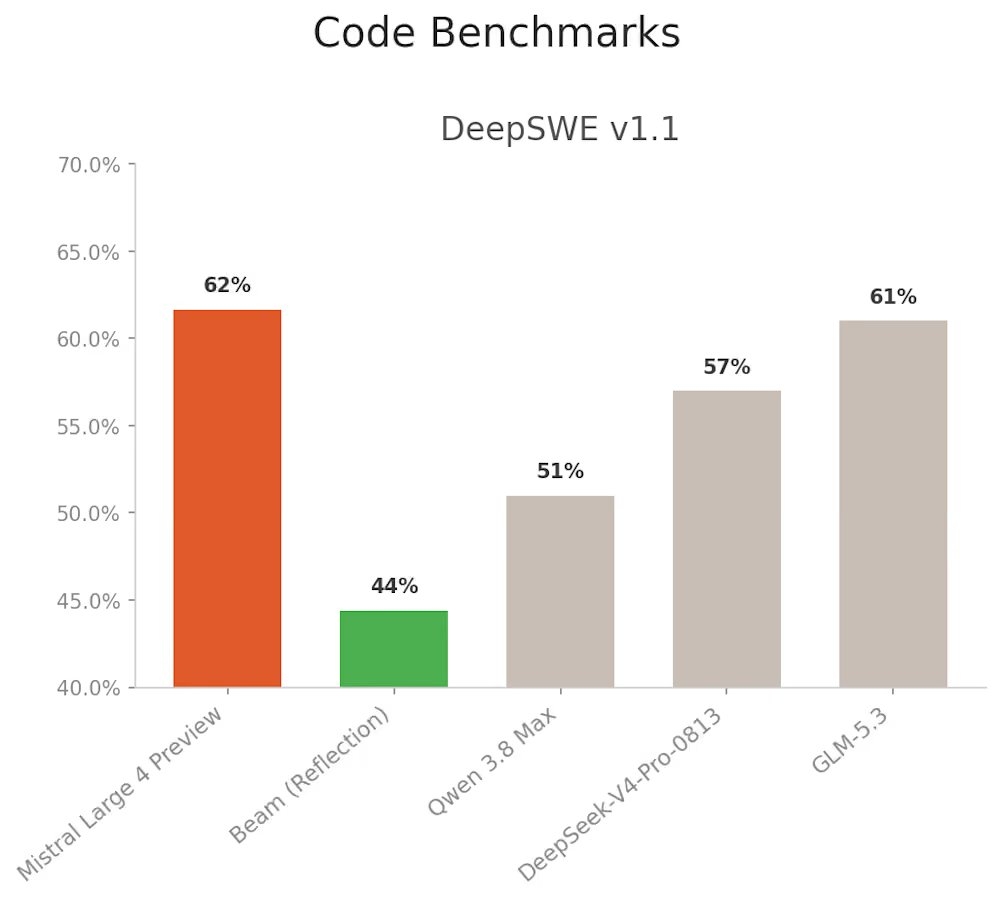
Mistral calls Large 4 the best open-weights model from the US or Europe on aggregated benchmarks, and says it is state of the art on “critical workloads”, among them cyber defense, manufacturing and finance. The scores it reports:
- 61.7% on DeepSWE v1.1 and 59.9% on AutomationBench;
- 82% on one Artificial Analysis Cyber Index test covering vulnerability reproduction and patching, and 93% on Cybench;
- 42% on Dense 200 visual grounding, against 41% for GPT-6 Astra;
- 93.3% of attacks resisted on Lakera’s B3 benchmark.
On visual grounding that lead over GPT-6 Astra comes down to a single point. Mistral also says third-party evaluations put Large 4 ahead of GPT-6 Astra on legal and financial tasks, and that on Harvey’s Legal Agent benchmark it beats every open-source model. Its target areas are software engineering, cybersecurity, finance, law, science and manufacturing. The model handles spreadsheets, documents, charts, technical drawings, PDFs and large geospatial images, and its training data covered more than 160 languages, including every official language of the European Union.
Training and red-teaming
Mistral trained Large 4 from scratch on 3,800 NVIDIA Grace Blackwell GPUs in its own European datacenters, and the same datacenters serve the preview. Training ran in the same customization and reinforcement-learning environment that Mistral sells as Mistral Forge. Running on 3,000 GPUs, the current RL pipeline produces about 33 billion tokens a day. After filtering and masking, about 16 billion of those are completion tokens the model can train on. The release is the first milestone funded by Mistral’s €3 billion Series D, and Mistral says Large 4 will be the base for a new family of specialized models.
The weights are on hold until red-teaming is done. Mistral is running it with cybersecurity leaders, vetted partners and state authorities, who are testing a version of the same model with reduced moderation and expanded cyber capabilities.
Up next
Mistral Large 4 tops open models at just 15% on legal tasks
Mistral Large 4 scored 15% on Harvey’s Legal Agent Benchmark, per VentureBeat, which makes it the best open-weight result there. The weights for the 1-trillion-parameter model are planned for October 27.
Related stories
Comments
No comments yet. Be the first.
Join the conversation
Sign in to leave a comment. It appears after moderation.