
Mistral’s Voxtral 3 TTS costs $13 per 1M characters
Mistral made Voxtral 3 available on October 20. The speech family has two batch transcription models, a realtime transcriber, a text-to-speech model and an SDK that runs listening, reasoning, tool calls and speech in one streaming pipeline. On Mistral’s diarization benchmark, the new Voxtral Mini Transcribe 3 scores an 18.6% error rate, against 30.9% for Voxtral Mini Transcribe 2. Diarization means working out which speaker said which words.
The figures below come from Mistral’s announcement, which pitches the release at contact centers, service desks, virtual assistants and hands-free copilots. Voxtral 3 is available through Mistral’s EU-hosted API or for self-deployment on your own infrastructure. Either way, the customer decides where audio is processed and whether conversations are retained.
What changed in transcription
Voxtral Transcribe 3 comes in two sizes, Small and Mini. Mini has 4B parameters and costs $0.0035 per minute of audio. The previous generation is described in Mistral’s Voxtral Transcribe 2 post. Here are the two batch Mini models side by side:
- Languages: 13 → 50, including all 24 official EU languages and many low-resource Asian and Indic languages
- Price: $0.003 per minute → $0.0035 per minute
- Diarization error (cpWER): 30.9% → 18.6%
- Context biasing: up to 100 words or phrases → key terms plus free-form text
Context biasing lets you give the model names and domain vocabulary before it transcribes. Mistral pitches it as a way to handle technical terms in production without fine-tuning. The test is the Earnings 22 benchmark, which mixes the real key terms with between 0 and 100 randomly sampled decoys. There, Voxtral Small Transcribe 3 recalls 81.4% of keyphrases without context and 94.6% with it. Scribe v2 starts higher, at 84.0% without context, and reaches 94.3% with it. Gemini 3.5 Transcribe goes from 80.9% to 87.3%.
For general accuracy, Mistral uses a macro-average over the 45 FLEURS languages that all seven compared models support. The metric is word error rate, except for Japanese, Korean, Thai and Chinese, which are scored by character. Each model was run twice, once with the language specified and once left to detect it:
- Voxtral Small Transcribe 3: 4.1% specified, 4.0% detected
- Microsoft AI Transcribe 2: 4.1% and 4.0%
- Voxtral Mini Transcribe 3: 4.6% and 4.5%
- Scribe v2: 4.9% in both modes
- Gemini 3.5 Transcribe: 6.1% specified, 4.5% detected
- GPT Transcribe: 6.3% and 5.6%
- Whisper large-v3: 16.0% and 14.9%
The Whisper comparison has a family history. Mistral’s technical report says the audio encoder in the first Voxtral models was based on Whisper large-v3. Those models came out with open weights on July 15, 2025.
cpWER, the diarization score, is a word error rate that also counts words assigned to the wrong speaker. Mistral averaged it over five public sets: AMI-IHM, AMI-SDM, Switchboard, Switchboard CallHome and AISHELL-4. For AMI and AISHELL it used 30-minute versions so that API-based competitors could handle them. Voxtral Small Transcribe 3 scores 18.4% and Mini 18.6%. Pyannote Orchestrator (Precision 3) scores 19.0%, Microsoft AI Transcribe 2 20.3%, Scribe v2 23.0% and Gemini 3.5 Transcribe 38.4%.
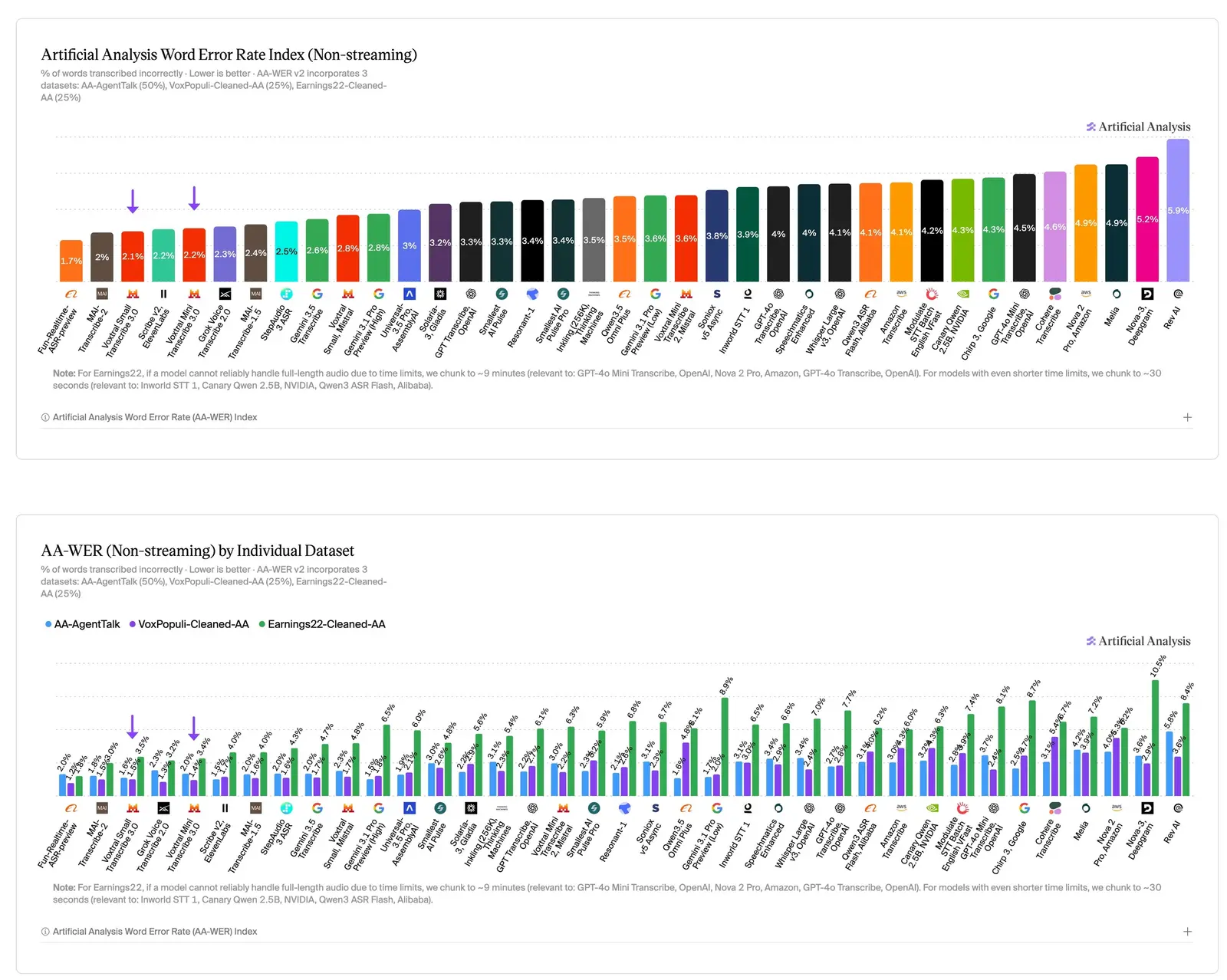
There is also an outside ranking. The Artificial Analysis WER Index is a weighted average over VoxPopuli, Earnings-22 and AgentTalk. On it, Mistral’s chart puts Voxtral Small Transcribe 3 third, behind Fun-Realtime-ASR-preview and Microsoft AI Transcribe 2, and Testing Catalog reported the same third place. Voxtral Mini Transcribe 3 is fifth in that list.
Realtime and end-of-turn
Voxtral Realtime Transcribe 3, the streaming model, is built for agents. Mistral says it transcribes at under 500ms of latency in more than 35 languages, with diarization and context biasing working in streaming mode too. Mistral had said the previous Voxtral Realtime used a streaming architecture that transcribes audio as it arrives, with a delay configurable down to under 200ms.
The realtime chart averages word error rate over 35 FLEURS languages, with Japanese, Korean and Chinese again scored by character. As the delay setting grows, the error falls: 7.4% at 240ms, 6.4% at 480ms, 6.0% at 960ms and 5.7% at 2,400ms. As an offline baseline, the batch Voxtral Mini Transcribe 3 scores 4.0% on the same set. Among the other realtime models, Gemini 3.5 Realtime Transcribe scores 4.2% and Microsoft’s streaming Transcribe 2 5.8%. GPT Live Transcribe scores 8.4% and Scribe v2 Realtime 8.7%.
End-of-turn prediction is built into the transcriber. It uses both acoustic and semantic signals to decide when a user has finished speaking. Mistral says this keeps agent responses fast while reducing the cases where the agent cuts in before the user is done.
One pipeline for agents
The voice agent SDK combines transcription, reasoning, tool calling and speech in one real-time loop. Agents built on it can retrieve information, work with business systems and complete multi-step tasks during live phone or web conversations. Native function calling over audio is not new to the family: the technical report for the original Voxtral already listed it.
The speech side
Voxtral Mini TTS 3 runs in batch and realtime modes, covers more than 35 languages and 50 dialects, and costs $13 per 1M characters. Mistral says that is less than comparable models from OpenAI TTS-1, Deepgram, ElevenLabs Flash and Gemini Flash. By default, the model reads the emotion and voice style from the text’s context, with no separate instructions or voice prompt. You can also set emotion, pacing and emphasis explicitly. Other features include contextual TTS, a vocabulary library and voice cloning from 30 or more minutes of sampled audio.
Pro Voice is for professional use, where basic cloning is not enough. Mistral says it reproduces a speaker’s distinctive character, emotional range and speaking style across languages from 30 minutes of audio.
Mistral compares its TTS with other systems in quality-per-dollar charts, using prices from vendor pricing pages:
- Voice Code Bench, from BeSimple AI: 300 English prompts built around customer-support failures with numbers and unique names, two voices per system, judged by gemini-3.8-flash
- Pronunciation, an internal eval: 300 English sentences, each with one rare or made-up word (150 easy, 150 hard). The judge, gemini-3.8-flash, hears the clip alongside the word’s intended IPA spelling
- Multilingual, an internal eval: 377 prompts across 11 languages, one native voice per language, scored by gemini-3.8-flash on a 1-to-5 scale
Testing Catalog reported that the TTS model ranked in the top 12 on Artificial Analysis.
Mistral’s demo of pronunciation control uses the sentence “Let’s end the debate here: it’s GIF.” It plays first with the default reading, then with a non-standard phoneme hint: dʒ ɪ f.
Up next

Perplexity Computer runs fully local on Macs, credit-free, Video
36 GB of unified memory is Perplexity’s recommended spec for running Computer fully local on a Mac, and in return local tasks don’t consume Computer credits. How much unified memory does your Mac have?
Related stories
- ElevenLabs’ Realtime v1 Max starts speaking in 0.57s
- Mistral’s 1T-parameter Le Chonk keeps only 49B active
- Canva Craft debuts fourth among image models on DesignArena
- Microsoft brings streaming MAI-Transcribe-2 to its APIs
- Gemini Decisions API scores 1,000 questions in one call
- No Zero Data Retention for Claude Fable 5.2 on AI Gateway
Comments
No comments yet. Be the first.
Join the conversation
Sign in to leave a comment. It appears after moderation.