
Thinking Machines’ new open model fits on a laptop
Thinking Machines Lab has released Inkling 2 Mini, an open-weight model the lab says is small enough to run on a laptop. It came out on November 20, and it works in an unusual way: for every token, the model runs its middle layers three times instead of once. According to the lab’s announcement on the Thinking Machines blog, this lets it reason more and reach the right answer with fewer tokens. The model is available on Tinker for inference and customization, and its weights can be downloaded.
Until now the lab, founded by Mira Murati, OpenAI’s former chief technology officer, according to Layer3Labs, has built very large models. Its first, Inkling, released in July, had 975 billion parameters. Inkling 2 Small, whose weights became downloadable on November 12, has 594 billion. Inkling 2 Mini has 26.4 billion, and only 3.4 billion of them do the work on each token, because the model routes every token to a small set of specialised parts.
How looping works
Per the Hugging Face model card, the model has 24 layers, and the middle 12 run three times with the same weights. Each token gets 48 layers’ worth of processing while the memory only holds 24. The card says each extra pass adds about 1 billion effective active parameters, so the model counts 5.4 billion per token. The lab says the extra thinking pays off most on work that depends on reasoning quality, such as coding agents.
Reasoning without writing it down raises a safety question, because people oversee models by reading their chain of thought. The lab released a research version with an adjustable number of loops to test this. With more loops, its written reasoning got shorter but stayed readable, and it did not score higher on tests of agentic sabotage.
Looping does not help the model store more facts. The lab says its factual knowledge is in line with other models of its size, and that it makes up for this by using search and tools well. The lab also names its weak spots: multi-turn chat and instructions with many constraints.
What the lab claims
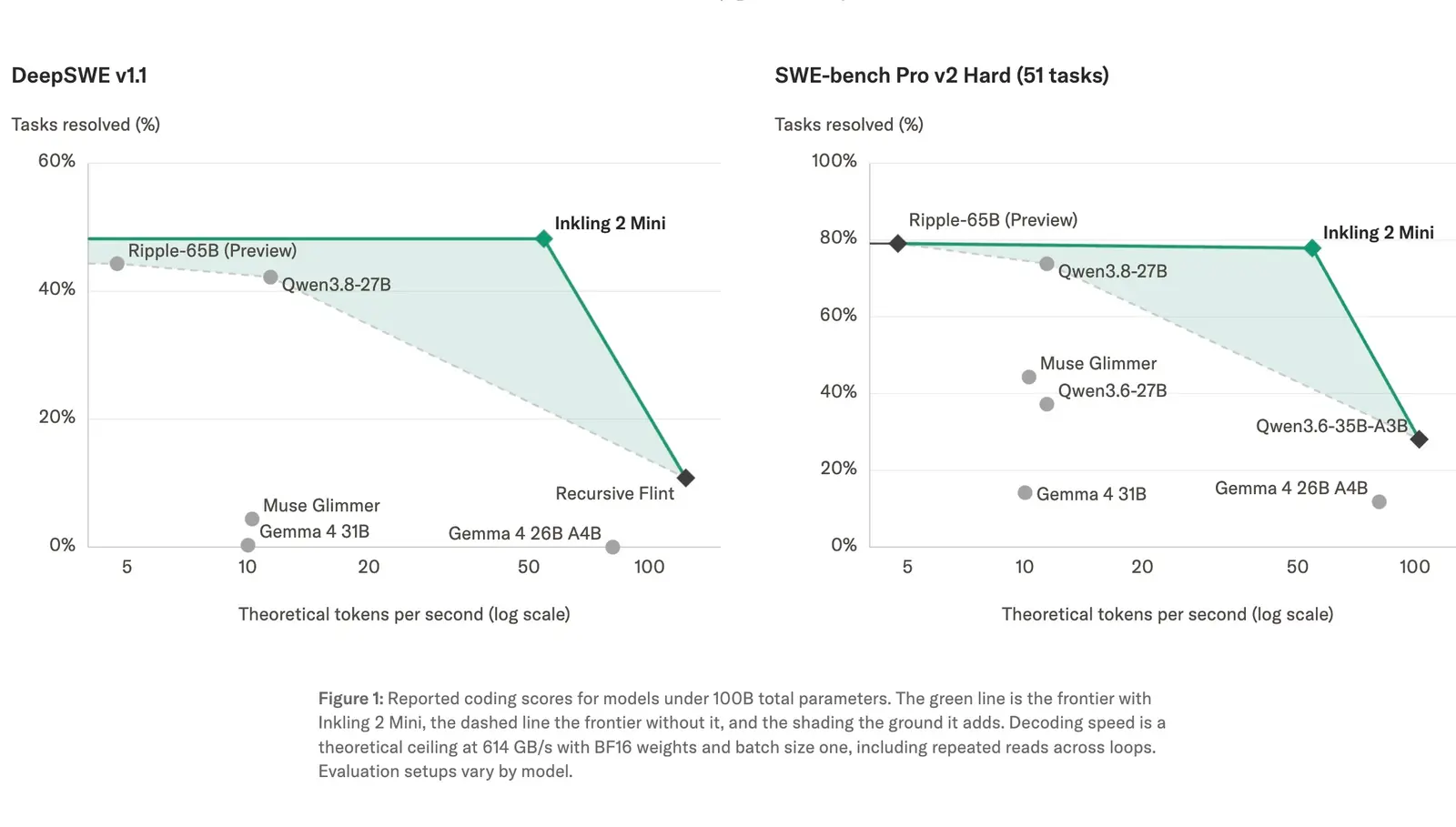
Thinking Machines says Inkling 2 Mini leads every open-weight model under 100 billion parameters on benchmarks such as DeepSWE v1.1, a coding test, where it scored 48.2%, and Vals Index v2.2, at 46.5%. In the lab’s table the nearest rival on DeepSWE is Alibaba’s Qwen3.8-27B at 42.2%. The lab also says the model runs faster than models that perform about as well, though its speed chart shows a theoretical ceiling, not a measurement.
For a demo, the lab’s researchers took the model on a flight. Running offline on a MacBook Pro, it built a playable flight simulator in a few minutes.
Our analysis
What we checked
On November 21 we went through the official checkpoint’s files and settings on Hugging Face, the file sizes of community builds and the lab’s own benchmark table.
The headline size holds up. Counting from the files gives 26.4 billion parameters, and the settings confirm 24 layers with the middle 12 run three times.
Memory is a different story. Our short post said the model needs about 20GB of memory. In fact, 20GB is the size of the official download. The model card lists Apple silicon machines with 32GB or more as supported hardware and recommends 32GB or more of video memory on other GPUs. Both of the lab’s laptop demos ran on a MacBook Pro with 48GB. The download is already mostly 4-bit, so the usual trick of shrinking a model to fit a smaller machine saves little: the community 4-bit builds published the same day are 16.6 to 17.6GB, only 13 to 18% smaller. Anything that fits a 16GB machine is a 3-bit build or lower, 13.6GB and down. These are file sizes. We did not measure how much memory the model uses while it runs.
The Vals Index lead also needs a footnote. In the lab’s table, none of the three comparison models under 100 billion parameters has a Vals Index score. The only other number is 29.8% for Nvidia’s Nemotron 3.5 Super VL, which the table lists at 124.5 billion parameters. The lab may have other scores that the table does not show. The DeepSWE lead, by contrast, has rival scores next to it.
Up next
Anthropic shares slide up to 13% a day after IPO
A day after its record IPO, Anthropic shares fell as much as 13% and led a sell-off, NBC News reports. By Friday afternoon the Nasdaq had erased all its 2026 gains. Would you buy Anthropic shares on this dip, or wait?
Related stories
- Recursive opens Flint, a 40B coding model with 2.5B active
- Microsoft’s MAI Code 2 claims 96% of Opus 5.5 at 5% of price
- Alibaba’s Qwen4-Max arrives as a preview on Qwen Chat
- Kimi K3.1 Pro weights land on HuggingFace at 2.8T params
- Tencent ships Hy4 at Hy4 preview’s API price
- Nvidia’s open transcriber tops English ASR at 5.33% WER
Comments
No comments yet. Be the first.
Join the conversation
Sign in to leave a comment. It appears after moderation.