
Microsoft’s MAI Code 2 claims 96% of Opus 5.5 at 5% of price
Microsoft AI launched MAI Code 2 at Ignite on November 17. It says the coding model reaches 96% of Claude Opus 5.5’s performance at 5% of its cost per task, averaged over four benchmarks. In GitHub Copilot, where the model is already live, MAI Code 2’s per-token price is one-eighth of Opus 5.5’s until May 17, 2027. After that date a 50% promotional discount ends and the price rises to a quarter of Opus 5.5’s.
GitHub’s changelog lists MAI Code 2 for the Copilot Pro, Pro+, Max, Business and Enterprise plans. The lighter MAI Code 2 Flash is on those plans and also on Free and Student. Both work in VS Code, Visual Studio, the CLI, JetBrains, Xcode and Eclipse. Flash is also in a limited access preview in Microsoft Foundry. Microsoft says it will soon release the models on OpenRouter, Vercel, Hermes, Open Code and Kilo. When we checked, OpenRouter’s public model list had no MAI Code model.
Microsoft built Code 2 for the “everyday enterprise coding tasks” it sees in GitHub Copilot, and says the models are “explicitly not yet tuned for harder problems, like fundamental science research and very long horizon agentic work.” It also tuned Code 2 for dashboards and visualizations. In a blind side-by-side test of frontend work, Microsoft’s pages now say developers preferred MAI Code 2 over GPT-6 Sol 64% of the time. The Ignite post had said 68%.
Where the 96% comes from
Both headline comparisons are averages over four benchmarks: DeepSWE 1.1, Terminal Bench 2.1, SWE-Atlas and FrontierCode v1.1. Every model ran at max reasoning effort. On that average, Code 2 gets 98% of GPT-6.1 Sol’s performance at about 40% of its cost per task, and 96% of Opus 5.5’s at 5%. Microsoft ran three of the tests on MSBench, its internal evaluation platform. They ran through the GitHub Copilot CLI with subagents switched off, and each task’s result is an average of three runs. The FrontierCode v1.1 scores and costs come from Artificial Analysis. Microsoft documents this setup, and we did not rerun the tests.
The Sol comparison was a version behind on launch day. The New Stack reported that OpenAI released GPT-6.2 Astra and Sol that same day, which it said softens Microsoft’s claims a bit. GitHub’s Copilot pricing page lists GPT-6.2 Sol at the same price as GPT-6.1 Sol: $2.00 per million input tokens and $10.00 per million output tokens. Claude Opus 5.5 costs $4.00 and $20.00 on the same page. MAI Code 2 is billed at $0.50 and $2.50 until the promotion ends, then at $1.00 and $5.00.
Code 2 Flash and the small models
MAI Code 2 Flash is meant for high-volume work like code explanations, targeted edits, routine fixes and rapid iterations. Microsoft says it performs comparably to GPT-6 Luna at 65% of the price and to Claude Haiku 5.5 at 20%, across DeepSWE 1.1, Terminal Bench 2.1 and SWE-Atlas. Microsoft’s own chart puts Flash ahead on that average. Flash passes 61.0% of tasks, against 55.1% for GPT-6 Luna and 53.9% for Claude Haiku 5.5. On DeepSWE 1.1 alone, Flash scores 59.9, against 46.0 for Haiku and 59.6 for Luna.
In Copilot, Flash costs $0.05 per million input tokens and $0.25 per million output tokens until the promotion ends. Then it costs $0.10 and $0.50. Copilot charges the same $0.10 and $0.50 for GPT-6 Luna, and for Claude Haiku 5.5 when the input stays below 100K tokens.
The rest of the Ignite batch
Code 2 and Flash are two of seven models Microsoft AI announced at Ignite. MAI Cyber 2 Flash scored 92.3% task success on CyberGym-E2E against 91.5% for GPT-6 Astra. Microsoft says it did that at under 2% of GPT-6 Astra’s cost per task, and that comparison uses list prices. Cyber 2 Flash costs $0.10 per million input tokens and $0.50 per million output tokens. MAI Image 2.7 took first place in Artificial Analysis’s image-editing ranking, and MAI Image 2.7 Flash costs about $10 per 1,000 images. MAI Realtime 1 is Microsoft’s first live speech-to-speech model and starts at $0.01 per audio minute. Decision 1.1 decides which model handles each request and sends it to a bigger model only when needed. Microsoft also launched MAI Licensed Weights, which lets a company customize a MAI model with its own data and run it in its own Azure environment. Microsoft AI’s first set of seven in-house models came out at Build on June 2.
Our analysis
What we checked
On November 18 we decoded the chart data in Microsoft’s MAI Code 2 post. We also read GitHub’s Copilot pricing page and the model card, and recomputed Microsoft’s ratios.
The Ignite post calls the 5% and 40% figures the price. The chart behind them actually compares average cost per task, with MAI Code 2 billed at its 50% promotional price. We estimate that without the discount, Code 2 would cost about 9.8% as much as Opus 5.5 per task and 81.2% as much as GPT-6.1 Sol. That estimate assumes cost per task doubles along with the price.
The 96% average also hides a split. These are pass rates at max reasoning effort, from Microsoft’s chart:
| Benchmark | MAI Code 2 | Claude Opus 5.5 |
|---|---|---|
| DeepSWE 1.1 | 73.2 | 69.0 |
| Terminal-Bench 2.1 | 84.6 | 78.7 |
| FrontierCode v1.1 | 52.0 | 56.0 |
| SWE Atlas | 43.1 | 57.5 |
| Average | 63.2 | 65.3 |
Leave out SWE Atlas, and the average of the other three puts Code 2 at 103% of Opus 5.5. Leave out Terminal-Bench 2.1 instead, and it drops to 92%.
Flash’s 65% of GPT-6 Luna’s cost per task also uses the promotional price. By the same estimate, once the promotion ends, Flash would cost 130% of what Luna costs per task. Against Claude Haiku 5.5, the chart’s ratio is 16.3% at the promotional price, which Microsoft’s post rounds to 20%. At full price it would be 32.6%.
Up next
Linear and Ramp users can pay for Claude without an API key
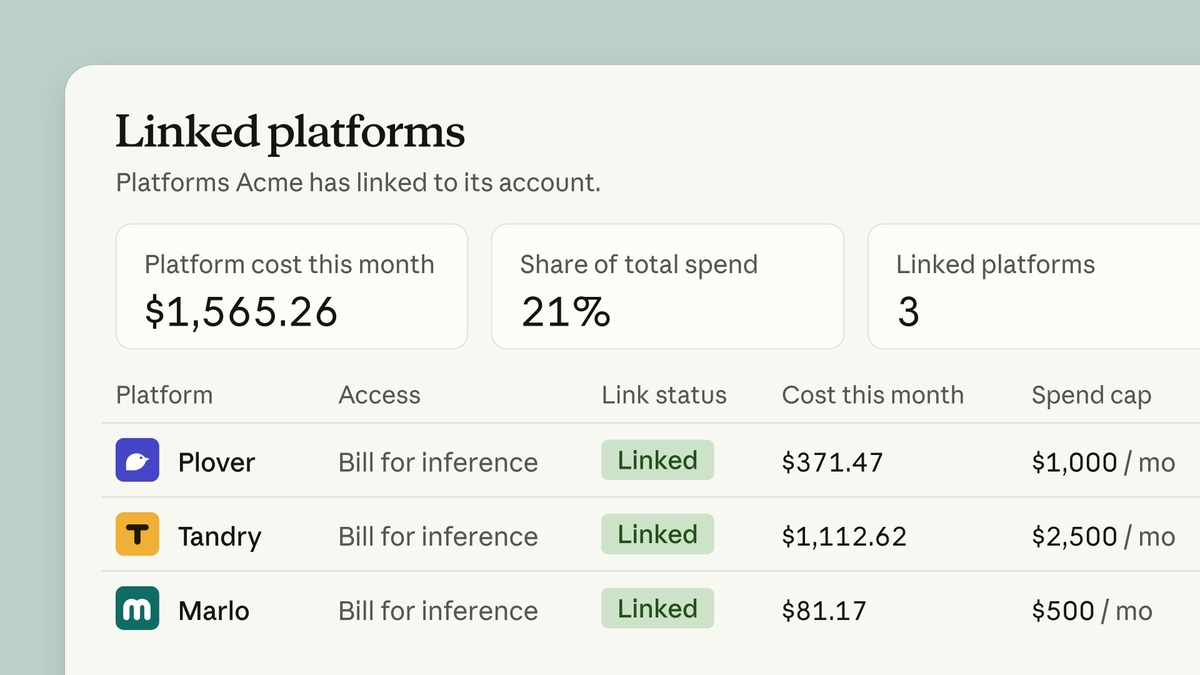
Teams paying for Claude inside Linear or Ramp can skip handing over an API key and bill usage to their own Anthropic account, with a monthly cap per tool, in beta. How many tools does your team give an API key to today?
Related stories
- Microsoft’s MAI Cyber 2 Flash matches GPT-6 Astra
- Microsoft rolls out Autopilot agent in Frontier preview
- Qwen4-Max scores 43 on Artificial Analysis, 9 above Qwen3.8
- Alibaba’s Qwen4-Max arrives as a preview on Qwen Chat
- Claude, GPT, Gemini install Sentry and Playwright every time
- Meituan’s LongCat-2.5 runs 49B of its 1.6T parameters
Comments
No comments yet. Be the first.
Join the conversation
Sign in to leave a comment. It appears after moderation.