
New model BDH-CQ costs $0.007 per task 11x less than OpenAI Luna even w 80% off
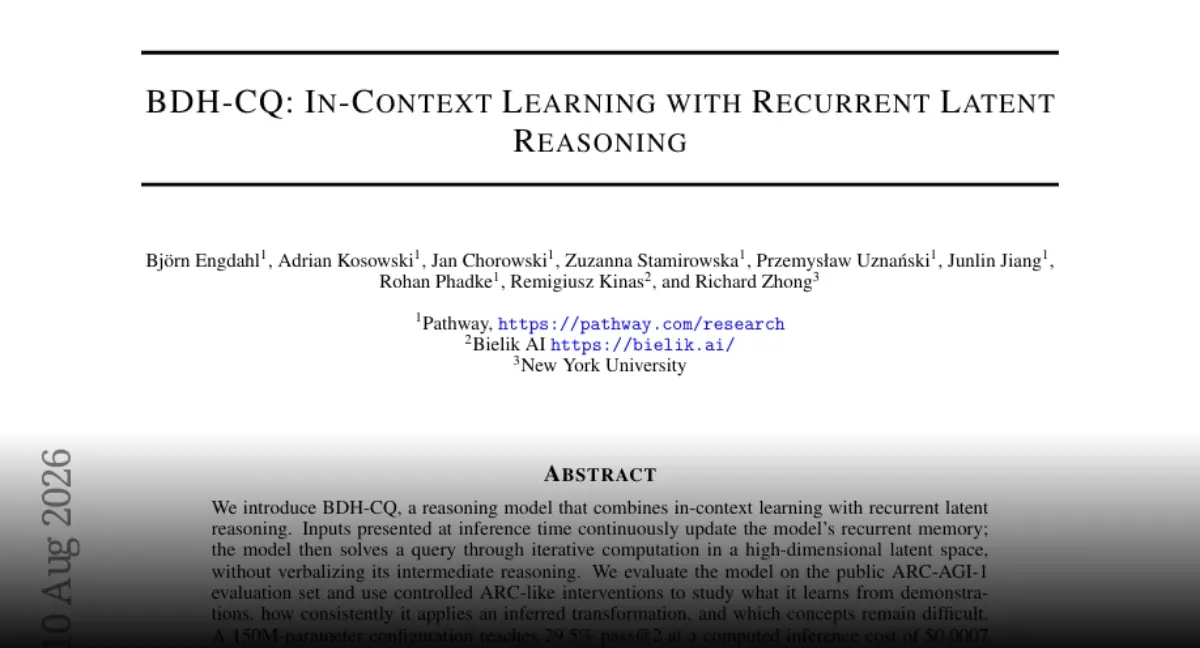
BDH-CQ, a reasoning model with 150 million parameters, solves 29.5% of the public ARC-AGI-1 evaluation set with two attempts per task (pass@2). Its computed inference cost is $0.0007 per task, the authors report in a preprint listed on Hugging Face Papers on August 13. They say this result breaks through the previously reported cost-accuracy Pareto frontier on ARC-AGI-1 and call it a new state of the art in benchmark cost efficiency.
The claim covers cost efficiency only. At 29.5%, BDH-CQ still misses most of the public set.
BDH-CQ never writes out its reasoning. The demonstration examples given at inference time keep updating the model’s recurrent memory. The model then works on the query through repeated computation in a high-dimensional latent space. AWS describes the same loop from the output side: the model decodes only its candidate answers, so it can take on a new problem without long verbalized reasoning traces and without fine-tuning or retraining.
ARC is built around that kind of task. Each one gives a few example grids, and the model has to infer the transformation behind them and apply it to a new input.
The model builds on Dragon Hatchling (BDH), an architecture the Pathway team introduced in a paper posted to arXiv on September 30, 2025. In BDH, working memory during inference runs entirely on synaptic plasticity with Hebbian learning, where connections between neurons strengthen when they fire together. Its activation vectors are sparse and positive. BDH also has a GPU-friendly formulation, and on language and translation tasks it rivals GPT-2 at the same parameter count, from 10M to 1B, trained on the same data. Pathway’s explainer pitches the design as a move beyond token-by-token processing toward parallel latent reasoning, arguing that Transformer models have no latent reasoning of their own.
The paper comes with a project page and a GitHub repo. Besides the headline score, the authors ran controlled ARC-like interventions to study what the model actually takes from the demonstrations, how consistently it applies the transformation it infers, and which concepts it still finds hard.
Up next
Same model, better scaffolding: 13.3% to 38.3% on ARC-AGI-3
GPT-5.6 Sol scored 13.3% on ARC-AGI-3 with a standard harness and 38.3% with reasoning persisted between turns plus built-in compaction of long conversations, per OpenAI’s developer guide. Same model, roughly 6x fewer output tokens.
Related stories
- Qwen3.8-27B edges past Fable 5 by passing itself notes
- Claude learned proteins, not just papers about them
- Claude Fable 5.2 hits 69% on PCB layout test, up from 25%
- GPT-6 Astra hits 66.7% on wet-lab tasks, GPT-5.6 Sol 43.8%
- METR clocks Anthropic benchmark gains at 1.9x old pace
- GPT-6 Astra designed a Codex device in under a week
Comments
No comments yet. Be the first.
Join the conversation
Sign in to leave a comment. It appears after moderation.