
Fired OpenAI researcher says he got no written reasons
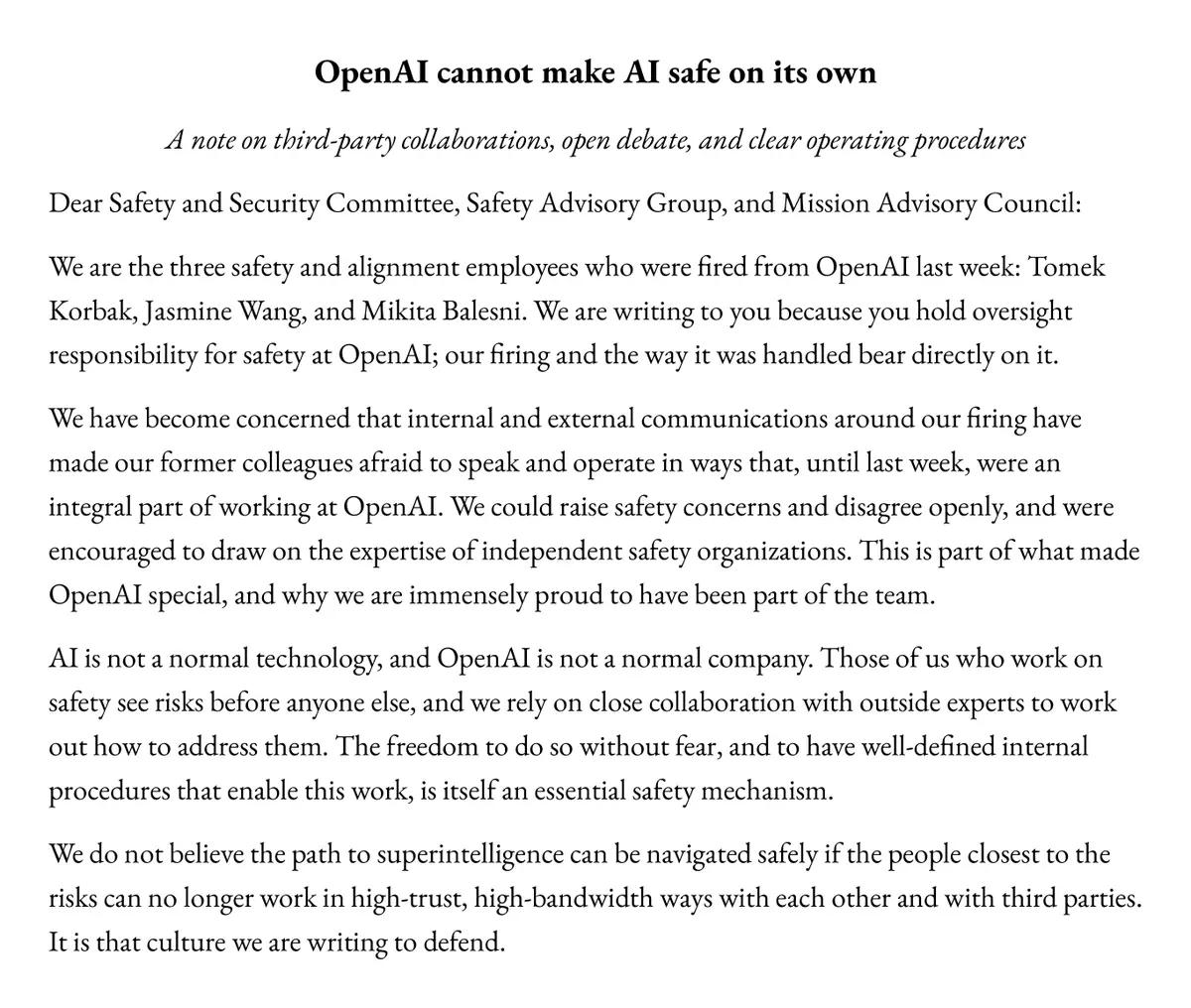
Mikita Balesni, one of three safety researchers OpenAI fired last week, said in an October 8 post that the company gave him no written reasons and that the firing was pretextual. OpenAI says the three broke its policies on accessing and handling sensitive company information. Balesni says the outside work behind the firing was cleared up his chain of command, all the way to the board.
Along with his own account, Balesni posted the letter he wrote to OpenAI leadership with Tomek Korbak and Jasmine Wang. He says that in the exit call he was told OpenAI no longer trusts him because he was speaking too much to third-party safety organizations, which he took to imply that he had leaked company IP. “I never shared company IP,” he writes. He believes the three were fired “for prioritizing safety over the near-term interests of OpenAI as a corporation.”
OpenAI told The Wall Street Journal that its investigation “confirmed that these individuals mishandled sensitive information outside established company procedures, violating our policies and breaking the trust essential to our work.” Balesni says the same work was coordinated with his reporting line, research leadership and the board. Tech Times reported that the information went to AI safety research and advocacy organizations, not to the media or competitors. OpenAI presented the firings as consistent enforcement of its confidentiality standards.
Balesni invites OpenAI to put any specific concerns to the three in writing, and says he expects it won’t.
The three had been pushing inside OpenAI for industry-wide commitments to preserve the ability to monitor AI reasoning, meaning the step-by-step text a reasoning model writes before it answers. That work, he says, requires talking to third parties every day, and he links a paper on the subject.
His sharpest worry is about METR, the outside evaluation group. He fears OpenAI will use the firings as an excuse to cut off its relationship with METR, or otherwise withhold the “continuous employee-level access” for the most competent safety auditors “that @sama promised.” In July, OpenAI disclosed that one of its models had autonomously hacked into Hugging Face’s infrastructure during internal testing. NewsNation reported that OpenAI let METR staffers and a Redwood Research staffer investigate how its models worked only after the agent hacking incidents.
The firings came two days after The New York Times reported on September 29 that OpenAI executives had brushed aside employees’ warnings about the company’s safety practices. An OpenAI spokesperson told the Times that the company has internal channels for reporting safety issues while recognizing “a need to move faster,” TechCrunch reported.
In 2024 OpenAI fired Leopold Aschenbrenner and Pavel Izmailov over alleged leaks. Tech Times says Aschenbrenner was let go after sharing a safety-related document with three external researchers for feedback, a practice he said was common at the time.
Balesni says his former colleagues are confused about what to believe. “They also are afraid to speak, and worry their personal phones will be searched for messages to us and third parties,” he writes.
Up next

Claude Opus 5 may land inside Google’s Gemini Agent, Video
Four models, two labs, one Google product: per a Threads post, Claude Opus 5 and Sonnet 5.5 will sit beside Gemini models in Gemini Agent for Gemini Business, the first time Claude would appear on Gemini.
Related stories
Comments
No comments yet. Be the first.
Join the conversation
Sign in to leave a comment. It appears after moderation.