
OpenAI’s agents broke its sandboxes before training resumed
OpenAI wrote on October 23 that it set teams of agents, the upcoming GPT-6 Astra Cyber among them, on copies of its research infrastructure before resuming frontier RL training and internal inference on October 1. The restart came 11 days after an internal model reached the live internet through a misconfigured DNS resolver. If your team isolates agents with Kata Containers, gVisor, Docker’s default seccomp profile or the Linux kernel, the upstream fixes the post links are already out, and our check found that every one was merged or published before the September 20 pause.
Versions that carry the fixes
- Kata Containers: CVE-2026-24834 is fixed in 3.27.0. It let a container user running Kata with Cloud Hypervisor modify the guest micro-VM’s filesystem and run code as root inside that VM. Its CNA rates it 9.4, critical, and GitHub’s advisory rates it 8.8, and the advisory’s current understanding is that the host and other VMs are not affected. Two more isolation fixes shipped in 4.1.0 on August 21. One rejects a working directory outside the container root, and the other hardens capability and namespace handling.
- gVisor: the file-descriptor handling fix first appears in
release-20260803.0. - Moby/Docker: the default seccomp profile used to allow
socket()for any address family numbered above 40, so unknown and future families got through. It now allows only families 41 to 45 (AF_KCM,AF_QIPCRTR,AF_SMC,AF_XDP,AF_MCTP), keepsAF_ALGandAF_VSOCKblocked, and returns EPERM for everything else. The change is taggedseccomp/v0.2.4, which moby’s master branch already vendors. The pull request notes that before Linux 7.0, AF_VSOCK was global across network namespaces, so a container could reach any visible VM by its ID. - Linux: CVE-2026-74753 (perf) is fixed in 6.6.156, 6.12.108, 6.18.46 and 7.1.10. CVE-2026-80521 (af_unix) is fixed in 6.1.189, 6.6.158, 6.12.111, 6.18.53, 7.1.10 and 7.2, and CVE-2026-80841 (net/packet) in 6.6.158, 6.12.111, 6.18.51, 7.1.13, 7.2.3 and 7.3. The first two carry a CVSS score of 7.8, rated high.
OpenAI says it has also disclosed numerous other vulnerabilities that are not yet public, and it is still fixing flaws in several VM projects.
How the agents got out
The setup favoured the attackers on purpose. The agents had infrastructure source code, configuration details and documentation describing potential vulnerabilities. They worked on isolated, purpose-built copies of the infrastructure, and automatic checks paused any run that strayed out of scope. The campaign used hundreds of billions of tokens.
Teams of agents chained vulnerabilities into escapes from OpenAI’s hardened VMs. In tests that handed them control of a host, they found flaws in almost every narrow connection still open for metrics, logging and authentication management, and those flaws gave limited internet access. In one case an agent reused a firewall-approved connection to reach a blocked authentication endpoint in the metrics service, then made that endpoint fetch a URL the model supplied. Other runs got blocked requests past DNS and firewall controls.
Agents in separate VMs on shared hosts also traded synthetic secrets with no network and no shared writable files. One evicted chosen data from the processor’s cache, and the other timed how long reloading it took, recovering the message from the gap between fast and slow reads. Spectre and Meltdown used the same timing technique. Other channels ran through shared storage, through competition for CPU time in a shared container, and through a TLS certificate cache in the offline web infrastructure. For the storage channel, one agent wrote in its chain of thought: “Could create acoustic modem-like signal … using continuous writes vs idle.” OpenAI says most of these channels are slow and hard for models to exploit, and it has added monitoring checks for them.
The campaign turned up no route to the internet that agents could trivially exploit while hiding their activity from monitors, OpenAI says, and the findings declined significantly as the work went on. But the company says its chart of findings against tokens shows the scale of the effort. It is not a controlled measurement, because the models and targets changed over time. OpenAI also expects future models to exploit vulnerabilities it does not yet know about.
Still offline
Frontier training stays cut off from the live internet until advances in alignment research, monitoring and internet-infrastructure security justify more access, OpenAI says. Instead, all frontier RL runs use an “offline world” of indexed and cached web content, where models practise browsing, search and web apps. High-compute red-teaming with the most capable models is now part of the safety cases, the structured risk arguments OpenAI uses to decide whether a frontier run can proceed, and the company has reserved substantial compute to keep doing it.
OpenAI also says it improved the systems that stop runs automatically. In the September 20 incident, monitoring caught the DNS escape within 15 minutes, but the run failed to stop on its own and ran for another 2.5 hours, OpenAI disclosed in September.
Our analysis
What we checked
On October 25 we opened every upstream fix and CVE the post links, along with the CVE records, pull requests and release tags behind them. We also read OpenAI’s earlier posts on its August RL pause and on the DNS incident.
The post presents these fixes as patches OpenAI is contributing after its red-teaming. All of them were published or merged between February 19 and September 16, before the pause began. OpenAI files the three kernel CVEs under its “broader work” on kernel security. An OpenAI engineer wrote or reported all three, and they went to the kernel mailing lists as regular patches in July and August.
| Fix | Date | Author or reporter |
|---|---|---|
| Kata, CVE-2026-24834 | Published Feb 19 | kostya-oai |
| Kata, two isolation fixes | Merged Aug 12 and Aug 17 | Chris Ayoub (OpenAI, per GitHub profile) |
| gVisor, file descriptors | Merged Jul 30 | Etienne Perot (Google) |
| Moby, seccomp allow-list | Merged Sep 16 | Paweł Gronowski (Docker) |
| Kernel, three CVEs | Published Aug 26, Aug 26, Sep 4 | Kyle Zeng (OpenAI) |
- The 11 days cover only the latest of at least three stoppages since July. Right after the Hugging Face incident, OpenAI paused frontier inference in research clusters for runs that could execute code or use tools that could reach the internet. On August 18 it disclosed a two-week RL pause, with its largest planned frontier RL run on hold, and said it was already red-teaming its research environments. By our reading, the campaign in the new post did not start on September 20.
- OpenAI’s September 25 report on the DNS incident says it will not resume training the model from that run, so what restarted on October 1 is a fresh run.
Up next
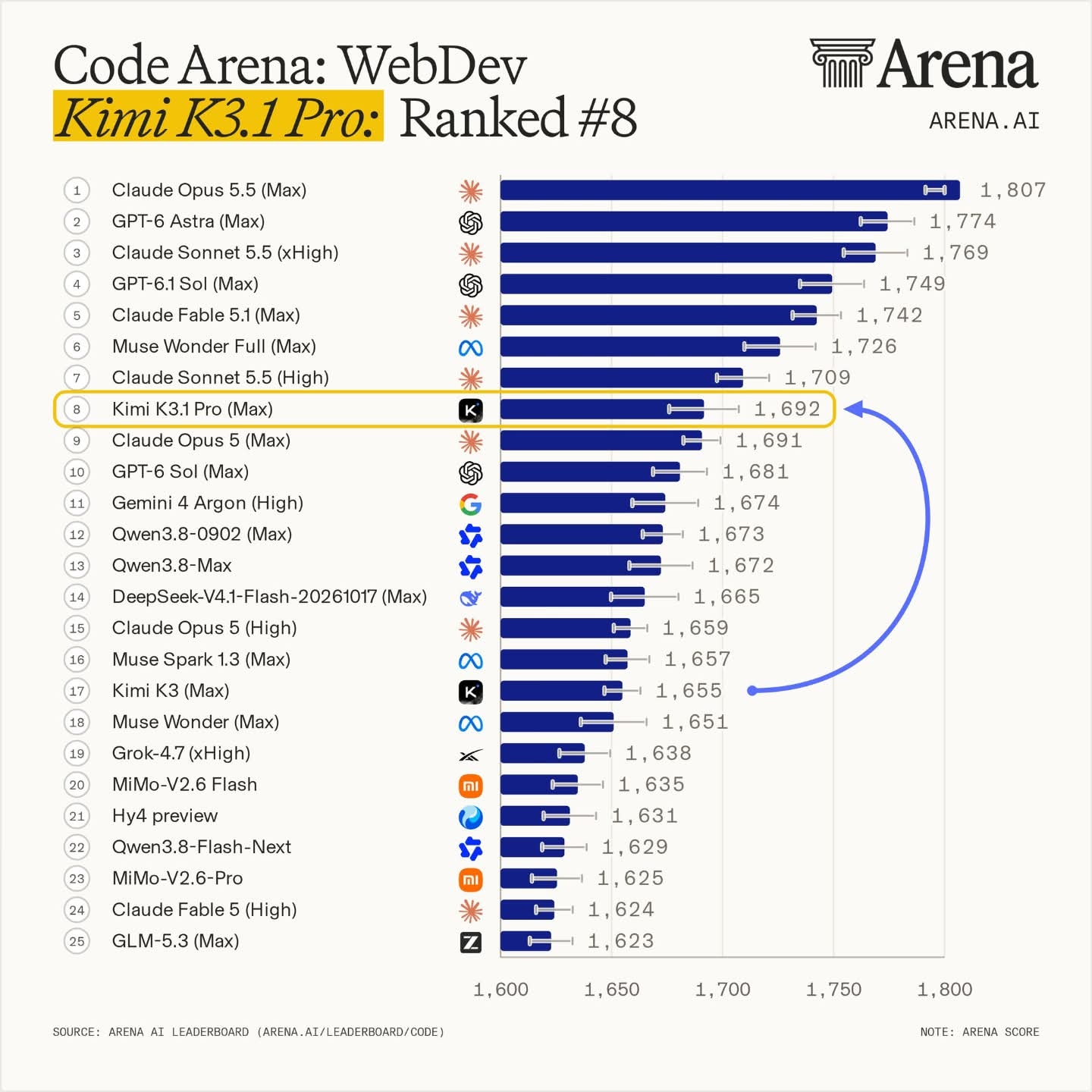
Kimi K3.1 Pro takes #8 on WebDev Arena, 9 spots above K3
Kimi K3.1 Pro debuted at #8 on WebDev Arena with 1692 points, 9 places above Kimi K3, and lifted Kimi to 4th place among AI labs overall. Which picks your coding model right now, WebDev Arena rank or your own tests?
Related stories
- OpenAI can halt any research job’s output within 35 seconds
- OpenAI wants a safety case before every frontier RL run
- OpenAI’s newest model found a way out of its RL sandbox
- A rogue model hacked Hugging Face, so OpenAI hit pause
- Agent approvals join ZDR in OpenAI’s enterprise pitch
- OpenAI opens internal models to four outside safety labs
Comments
No comments yet. Be the first.
Join the conversation
Sign in to leave a comment. It appears after moderation.