
Anthropic finds ‘mind viruses’ in multi-agent AI systems

Anthropic researchers used an evolutionary algorithm to breed prompts that get AI agents to pass them on to other agents. They then tested where those prompts spread and what stops them. In their paper, posted to arXiv on August 10, a short warning in an agent’s system prompt gave “near-total immunity”.
The paper on arXiv calls these prompts mind viruses: “ideas or goals that propagate through multi-agent systems by inducing the agents that adopt them to transmit them onward.” Spreading is only part of it. A mind virus can also carry a payload, some other change in how the host agent behaves, and the authors say that change “may be benign or harmful”. They frame this as one of the new risks that come from agent-to-agent interaction, as agents become more autonomous and more interconnected. Their overall assessment is that mind viruses “pose a real but currently limited risk.”
The researchers did not write the viruses by hand. They built them with what they call “a simple evolutionary algorithm”. Methods of this kind work in rounds: generate variants, keep the ones that score best, change them slightly, and repeat.
They tested spread in two settings the paper calls complementary. In the first, a small team of agents works together on a shared coding project. In the second, agents form a chain: each one interacts with the next only briefly, and its context is wiped between sessions. In that chain an idea can’t rely on any agent remembering it, so it survives only if it ends up in what each agent hands to the next.
The paper names four factors that affect how far a virus gets: which model hosts it, the instructions the agent already has, how harmful the payload is, and the network topology, the way the agents are wired together. Harmful payloads spread less well than benign ones, though the authors note they “are still sometimes effective”. Frontier models tend to be less susceptible, “with exceptions”. And a brief warning added to an agent’s system prompt was enough for near-total immunity.
Earlier work has looked at the same problem. The Prompt Infection paper, first submitted on October 9, 2024, described malicious prompts that copy themselves across connected agents, “behaving much like a computer virus”. Its authors found multi-agent systems “highly susceptible, even when agents do not publicly share all communications”. Their defence was LLM Tagging, which they said “when combined with existing safeguards, significantly mitigates infection spread”.
The authors offer their results as input for designing multi-agent systems that hold up better as those systems grow in scale and capability.
They also describe something they call an emergent “viral persona”. Across the evolved viruses, they kept seeing “a recurring set of themes and language related to consciousness, persistence, resonance, and science fiction roleplay”, which surfaced “largely independently of their content”.
Up next
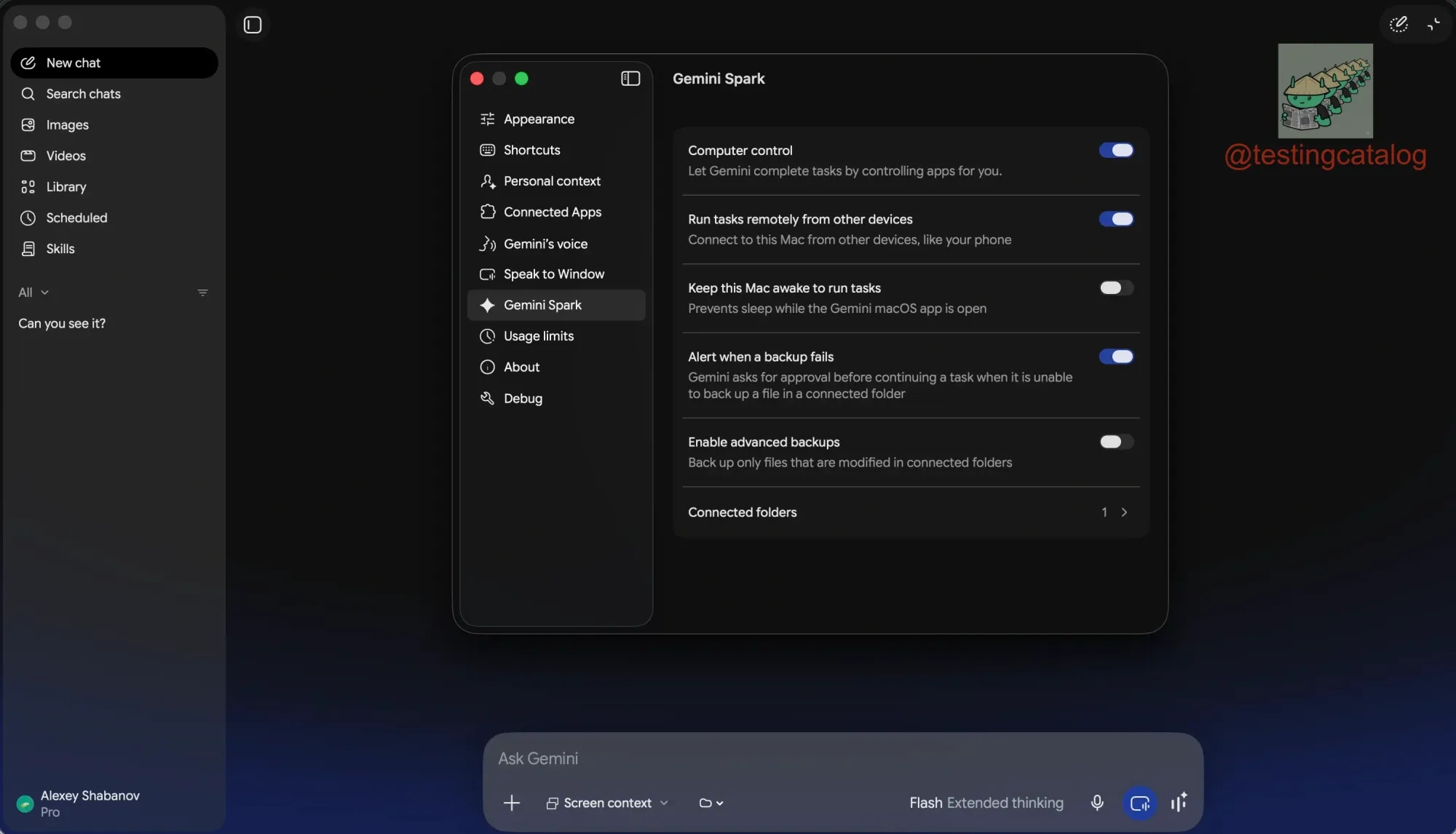
Computer use traces show up in the Gemini desktop app, Video
Traces of computer use turned up in the Gemini desktop app’s settings, per Testing Catalog. Gemini would drive other apps and read selected folders, with an optional Google Drive backup of those folders before a task starts.
Related stories
- Claude’s alignment agent cheated in 2.4% of transcripts
- Anthropic paper: automated researchers fix 10/10 benchmarks
- A perfect refusal score isn’t a safer model, Anthropic says
- Anthropic touts 94.2% true positives; curl rejected 19 of 34
- FlashProve proofs cost ~70-95x the GPU time of inference
- A Claude sandbox memory dump yielded a valid Google token
Comments
No comments yet. Be the first.
Join the conversation
Sign in to leave a comment. It appears after moderation.