
Claude Code 2.1.243 uses your contracted model rates

Claude Code’s native binary now downloads at about 75 MB on Linux x64, down from 340 MB, because it ships zstd-compressed. The figure is in the 2.1.243 release notes Anthropic posted on GitHub on August 24. The same release lets an organization replace list prices with its contracted rates in every cost figure the CLI shows.
Cost figures at contracted rates
The new modelPricing setting is a managed setting, so the organization sets it centrally. It holds per-model rates and a discount multiplier. Once it’s set, /cost, the status line and telemetry cost figures use those numbers in place of list price. Cost readouts were adjusted once already this month: 2.1.239 added the 1.1× US-only-inference premium for data-residency workspaces in August.
The list prices changed too. The /model picker and the bundled claude-api skill now show Sonnet 5 at $2/$10 per million tokens as its standard list price. Until this release it was labeled a limited-time promo.
Loops, caches and the model picker
/usage gets a Loops breakdown with run count, total tokens, tokens per run and last run for each /loop task, which makes a runaway or chatty loop easy to spot. In the terminal, a run of wake-ups where Claude has nothing to do now folds into a single line. A related fix: after a rate-limit window reset while a session was idle, the status line’s rate_limits fields and /usage kept showing the usage percentage from before the reset.
Prompt caching gets two settings. The prompt cache stores the unchanged start of a request so later turns don’t pay full input price for it. With promptCacheTtl and subagentPromptCacheTtl, API-key and cloud-provider users can keep a 1-hour cache on the main conversation while subagents stay at 5 minutes.
The new modelPicker setting curates the /model list: an ordered, labeled set of models, with any ID spelling including Vertex and Bedrock IDs, either appended to the built-in lineup or replacing it. /tasks and the agent detail dialogs now show which model, and which effort level, each subagent ran on.
Sign-in without API keys
Under /login → Anthropic Console there is now “Sign in with your Console account”, marked as recommended, next to the option to create an API key. It’s meant for organizations that don’t allow API keys.
Admins also get a clearer view of what is in force. /status gains a Skipped sources line that lists managed settings sources, such as managed-settings.json, that are present but not applied because a higher-precedence managed source is active. /mcp and /plugins mark claude.ai connectors whose authentication the organization manages.
Usage telemetry from sessions that authenticate with ANTHROPIC_AUTH_TOKEN directly against the Anthropic API is now attributed to the organization, so its data-handling settings apply. The VS Code extension’s own telemetry gets the same treatment when you are signed in with a Claude account. In CI, workload identity federation now shares the exchanged token across the processes in one job. Previously each process re-exchanged the single-use token. A rejected exchange now fails fast with the server’s message.
For Claude Code on the web, Pro and Max users get a /status line showing whether GitHub is connected, pointing to /web-setup when it isn’t. /web-setup also stops asking you to log in again and again when an older GitHub CLI without gh auth token is already authenticated.
Lighter on disk and in memory
Storing the bundled skill and prompt text more compactly makes the binary about 2 MB smaller, on top of the compression. Native builds now load code on demand instead of keeping the whole bundle resident, which Anthropic puts at roughly 40–70 MB less memory per session. In long sessions the runtime garbage-collects sooner as the heap grows, which lowers peak memory.
Startup is faster because sandbox and MCP bring-up no longer block the first frame and bare launches skip subcommand registration. When the Anthropic API never starts a response, the request now times out after about three minutes, retries once, then shows API Error: No response from API. Previously such sessions could go silent for more than ten minutes.
What behaves differently
The sandboxed Bash tool prompt no longer lists allowed network hosts. The notes give the reason:
so Claude attempts requests (and you can approve new hosts) instead of assuming unlisted hosts are blocked
Sandbox network-violation details now also stay in the Bash tool result when the blocked command still exits 0, for example when curl prints the proxy’s 403 page.
--agents used to ignore invalid JSON or invalid agent definitions silently. It now exits with a clear error, the way --mcp-config does. On macOS, computer use needs Finder granted through the access dialog before it can click the desktop, the Dock or a Finder window, like any other app. On Bedrock, Vertex and Foundry, and when telemetry is disabled, /model, /fast and /effort run immediately instead of queueing until the turn ends.
Remote MCP servers in non-interactive -p and SDK sessions used to never recover after a dropped connection; they now reconnect automatically or report as failed. Hook if conditions such as Bash(cat *) no longer fire on unrelated Bash commands that contain $() or backtick substitution followed by more arguments. /resume finally loads more sessions as you scroll instead of listing only the 50 most recent, and picking Ultracode in /model now applies it to the current session rather than being silently ignored.
Cross-session messaging gets two changes. It had been silently turning off inside user namespaces and rootless containers since the socket-directory hardening in 2.1.232, and this release fixes that. The inbox socket now also closes any connection that sends no complete line within 30 seconds, so scripts that post to it should connect only once their data is ready.
Up next
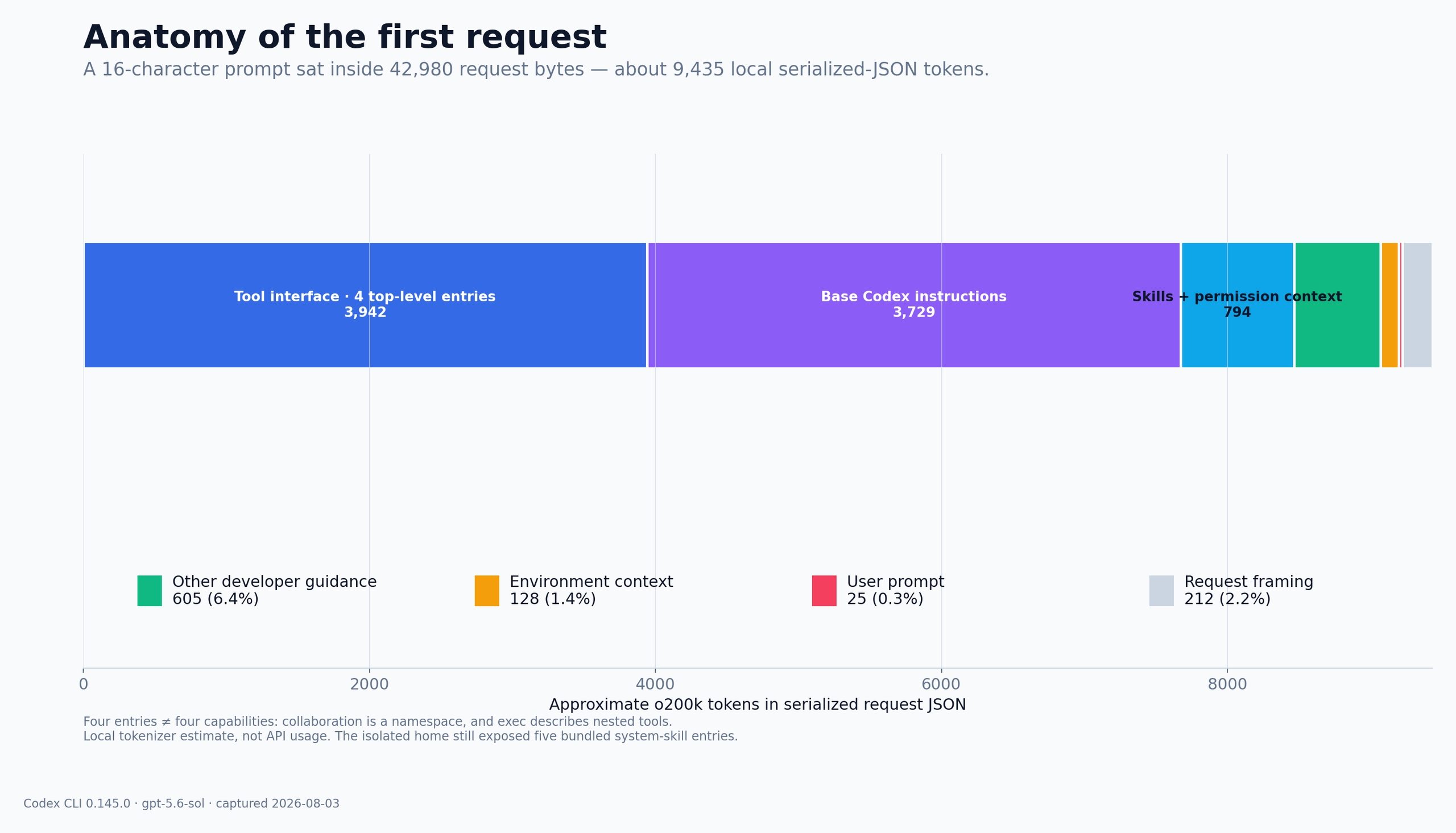
The prompt is 0.3% of what Codex sends
A 16-character prompt to Codex left the machine as a 42,980-byte request, roughly 9,435 tokens by a local count. The prompt itself made up 0.3% of that; tool definitions and instructions carried the rest.
Related stories
- --restricted strips code execution from Claude Code 2.1.248
- Claude Code 2.1.246 flags wildcard Bash allow rules
- Claude Code 2.1.239 prices the data-residency premium
- Claude Code v2.1.237 adds a Concise output style
- pxpipe hides text in PNGs to cut token costs by up to 70%
- CCLimitPing automates the 5-hour Claude Code window
Comments
No comments yet. Be the first.
Join the conversation
Sign in to leave a comment. It appears after moderation.