
Claude Security moves to continuous scans on Enterprise
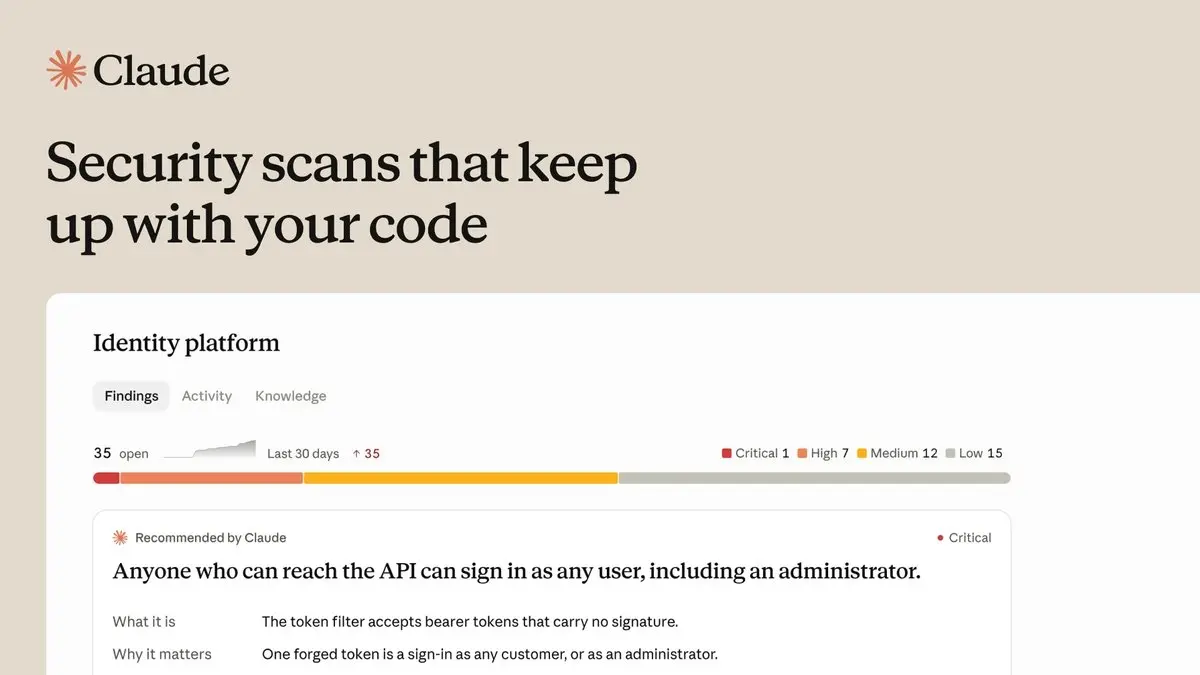
Anthropic on October 21 changed how Claude Security works. You no longer start each scan yourself. Claude runs a deep baseline scan of the repositories you connect, rescans changes based on their risk and complexity, and closes findings on its own once the fix ships. The new version is in public beta for Claude Enterprise customers starting today.
In Anthropic’s announcement, the company says thousands of organizations have found over a million vulnerabilities with Claude Security since the public beta opened in April. The product runs on Anthropic’s full model family, Claude Mythos included, and needs no Cyber Verification Program access. Organizations get $25,000 in free usage credits a month for two months, for usage through December 31, 2026. Full terms are in Anthropic’s Help Center.
From a scan you start to a branch it watches
In April the flow was manual. You picked a repository, narrowed the scope to a directory or branch if you wanted, and started a scan. The public beta added scheduled scans so teams could review findings on a regular cadence, Infosecurity Magazine reported. Anthropic now states the limit of that approach plainly: “A scan captures one moment, and code changes every day.”
The new unit is a project. You create one and connect repositories through the Claude GitHub app, which also covers GitHub Enterprise Server, or with an access token from GitLab and other Git providers. Then you set the branch and scope for each repository. After the baseline, Claude scans new changes, and how often depends on how risky and complex each change is. The goal is a findings list that stays close to what your code looks like now, without anyone having to keep a schedule.
A project can hold several repositories, so the analysis can follow a problem across a service boundary. Anthropic’s example is a backend that trusts input a client was supposed to validate. A scanner that sees one repository at a time can miss that bug, because each half looks fine on its own. That matches how the scanner already worked: it reasons about how components interact across files and modules and traces data flows, instead of matching known patterns.
Findings close when the fix ships
Most fixes happen outside the tool that found the bug, and Claude Security now follows them there. It checks open findings against the code that changed and marks a finding fixed when the fix lands, whether your team wrote it in Claude Code or somewhere else. If a later scan finds the same issue, the finding reopens automatically. The April beta already let reviewers dismiss findings with a documented reason, so later triage could rely on earlier decisions.
After the research preview, Anthropic said that “time from scan to fix is the metric that matters,” CRN reported, with several early teams going from scan to applied patch in a single sitting. Automatic closing appears to be what makes that number measurable when the patch lands through someone else’s pipeline.
Context the scanner can’t read from code
Each project now has a knowledge base. In it you describe how the code is deployed, which security policies apply, and, in Anthropic’s words, “anything a new security engineer on your team would need to know.” Claude also writes a threat model from the code, a document listing what an attacker might target and how. Your team can review and edit it, and later scans use it to decide what is worth flagging. The added context also lets Claude Security skip risks your environment already handles, such as a control that exists in the deployment but not in the repository.
Severity follows from that model. Each finding gets a rating judged against the project’s threat model and an explanation of how an attacker could reach the vulnerable code, so teams can fix what is actually reachable first. Some findings include a diagram of the attack path. Before, a finding already carried Claude’s confidence that the bug was real, a severity rating, its likely impact, reproduction steps and instructions for a targeted patch. The change is that severity is now set against your own setup.
API, MCP and access control
With the new API, you can list and read projects and findings, resolve or reopen findings, and create and manage projects and their repositories. Authentication uses a personal access token you create in Claude Security settings, and it can only see and change what its owner can. Webhooks can tell your systems when a new finding lands. The April beta already sent scan results to Slack, Jira and other tools through webhooks and exported findings as CSV or Markdown, per heise online.
Claude Security also ships as an MCP connector in Claude.ai and Claude Code. In one session, an engineer can pull up a finding, ask Claude about it, start the fix and mark the finding resolved.
New role-based access controls split three permissions: viewing projects, triaging findings and creating projects. An organization can give the teams that own the code access to their findings without letting everyone create projects. Admins turn Claude Security on in the admin console and choose who on their team can use it.
Up next
OpenAI ships a Codex skill that checks sites for php2shell
Site owners running PHP can point Codex at an OpenAI repo and get OK, VULNERABLE or UNKNOWN for php2shell. UNKNOWN, OpenAI warns, doesn’t mean the site is patched. Is PHP on your servers patched by hand or left to auto-updates?
Related stories
- OSS Scanner sends maintainers 77 critical findings
- Claude flagged 29,000 possible bugs. Upstream fixed 516
- Anthropic’s free OSS Scanner skips human review on purpose
- Anthropic adds offensive tiers for verified pentesters
- Mythos 5 lands in Claude Security for enterprise beta
- Anthropic plans to loosen data retention on top models
Comments
No comments yet. Be the first.
Join the conversation
Sign in to leave a comment. It appears after moderation.