
Mythos 5 lands in Claude Security for enterprise beta
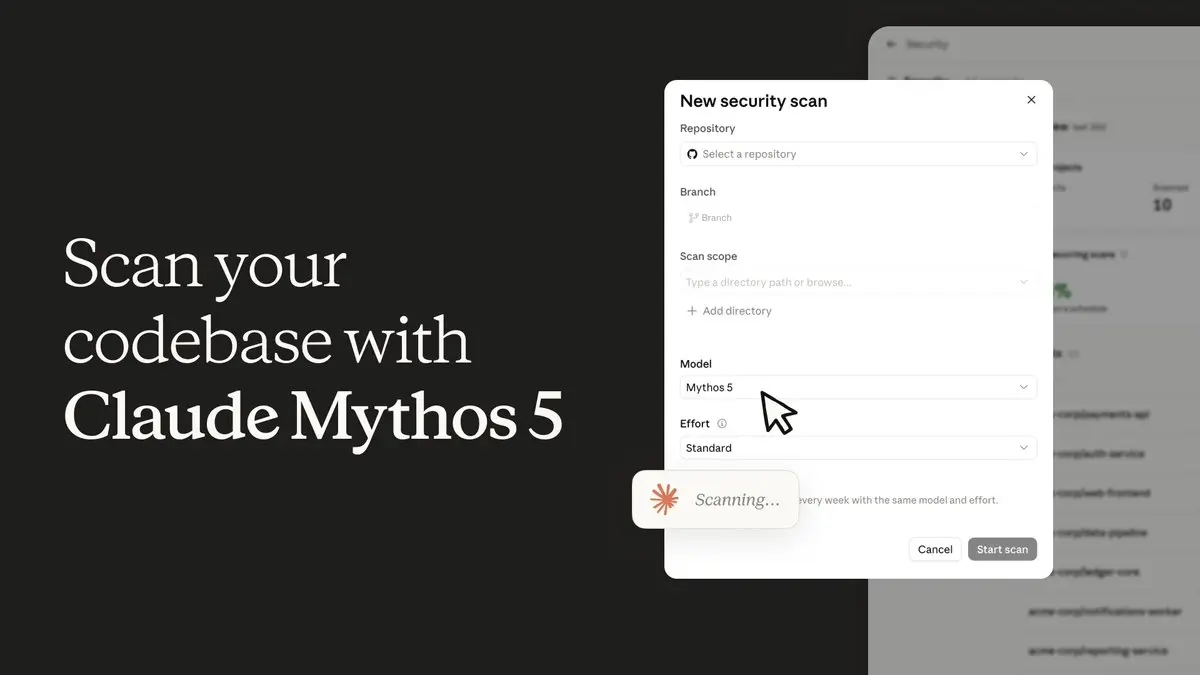
On August 21, Anthropic made Claude Mythos 5 the model behind every Claude Security scan, as a public beta for all Claude Enterprise customers. The model runs behind the scan and returns only findings, so teams get its output without needing separate access to the model, the company said on X.
Until now, Mythos 5 was off limits for nearly everyone. Anthropic kept it out of public release because of how it performed in high-risk domains, and The New Stack says only about 150 partners in Project Glasswing had access. Fable 5, released in June, is essentially Mythos 5 with very strict guardrails, the outlet says, and the US government banned it and then lifted the ban.
To get started, an admin enables the feature for the organisation. Developers and security teams can then point Claude Security at a GitHub repository, and Mythos 5 runs the scan.
Anthropic says the scan traces data across files and reasons about how components interact. Each finding includes a CWE category (CWE is the standard catalogue of software weakness types), confidence and severity ratings, and a suggested fix. That fix opens as a patch in Claude Code on the web and runs on the models the team already uses. Mythos writes the report, and the patching happens in the Claude Code setup the team already has.
Scans are billed as standard token usage under the existing plan. The New Stack gives the Mythos 5 rates as $10 per million input tokens and $50 per million output tokens.
Anthropic calls Claude Security one of several steps to give defenders access to Mythos. It is working with partners to build Mythos 5 into their security products and services. It is also launching the Defender Advantage Fund (0xDAF), with $35 million in credits for finding and patching vulnerabilities in open-source software. That sits alongside the up to $100 million in usage credits and $4 million in donations to open-source security organisations that Anthropic committed when it launched Project Glasswing on April 7. The Cyber Verification Program lets vetted defenders run dual-use security work on Opus and Sonnet with fewer blocks. It expands in the coming weeks, and Anthropic says its members will soon get safeguarded access to Mythos.
The company’s case for opening the model now rests on separating access to the model from access to its results:
The riskiest behavior occurs when a user has direct access to a model, where a malicious actor can try to steer it toward harmful uses. But if users can only receive specific outputs, such as a patch for a vulnerability or a security alert, that risk is much lower.
Anthropic also limits the scope: Claude Security “uses Mythos 5 to scan code you own.” The New Stack questions where that line falls. Many codebases include open-source libraries, it points out. A developer who clones a widely deployed library into a company repo and scans it would get the same findings an attacker is looking for, because the flaw exists everywhere that library ships.
Anthropic says it and its partners “have abuse prevention measures in place to verify the model stays within its intended scope.”
Up next

Grok Bot rollout widens to Cursor Pro+ and Teams, Video
“Good, but we still need a broader release”, reads the post announcing that Grok Bot now covers SuperGrok Plus, Cursor Pro+ and Cursor Teams, ten days after the beta opened to Grok Heavy and Cursor Ultra.
Related stories
- Six curl CVEs land after two AI scanners found none
- Anthropic’s automated reviews now flag 54% of PRs
- Claude Security moves to continuous scans on Enterprise
- Anthropic adds offensive tiers for verified pentesters
- Anthropic plans to loosen data retention on top models
- Rubrik found more bugs than its engineers could fix
Comments
No comments yet. Be the first.
Join the conversation
Sign in to leave a comment. It appears after moderation.