
Flagged Opus 5.5 chats stay stuck on Opus 4.8
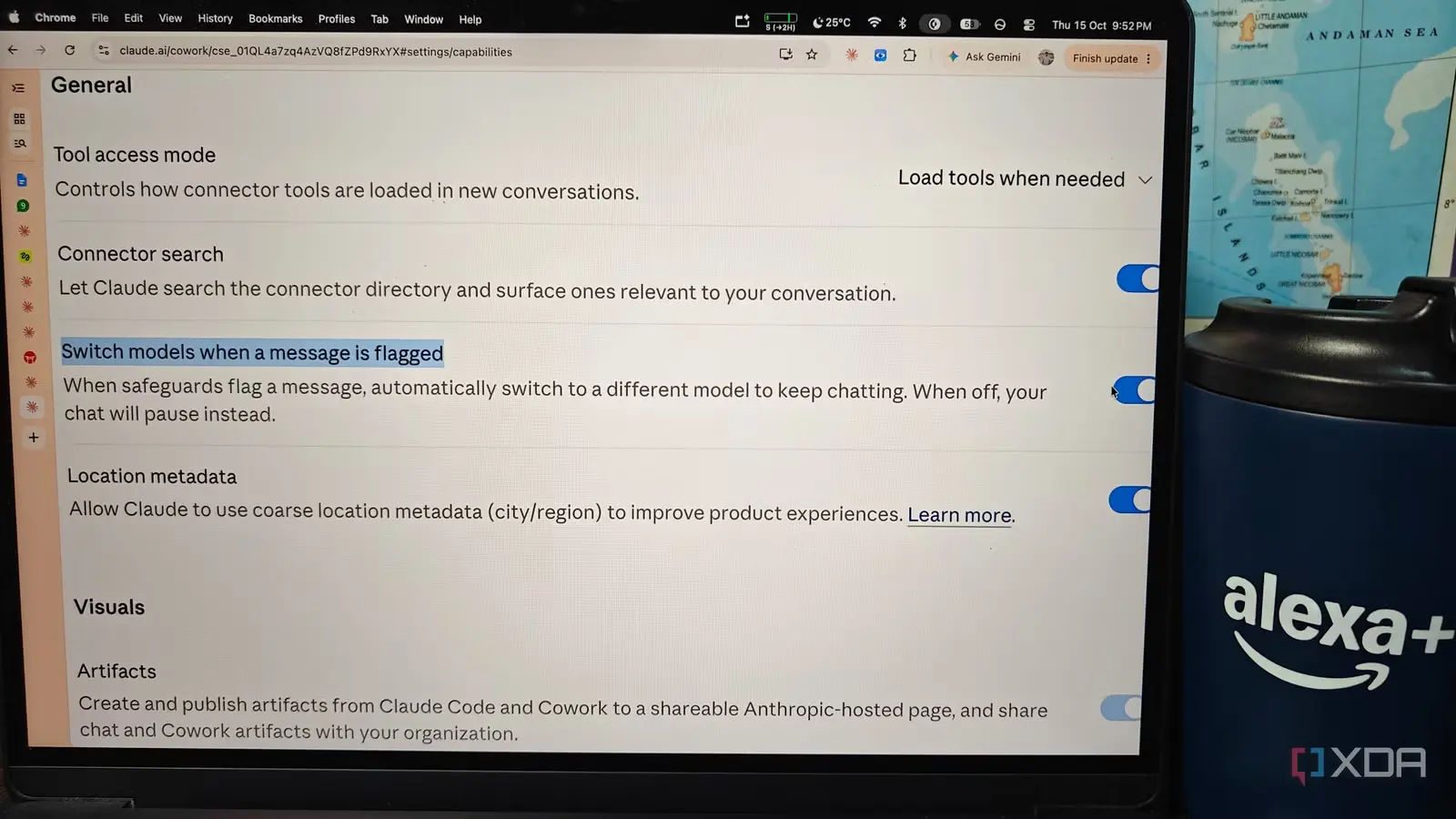
When its cyber classifier flags a request, Claude Opus 5.5 hands it to Opus 4.8, and in claude.ai and Claude Code the chat then stays on the older model until you switch back, XDA Developers reported on October 17. If Claude works on repos, inboxes or web pages you didn’t write, turning the switch off makes a flagged request pause instead. In the coding prompt-injection test in Anthropic’s Opus 5.5 system card, every successful attack came through Opus 4.8.
Where the switch lives
In the Claude app the toggle sits under Settings -> Capabilities as “Switch models when a message is flagged”, and Claude Code has the same one under Config -> MODEL & OUTPUT. With it off, a flagged request stops and waits for you to rephrase it, retry it or pick a model yourself. The XDA author keeps it on for everyday chats, where the worst case is a weaker answer from Opus 4.8.
We searched the bundled Claude Code 2.1.302 CLI. There the toggle is stored as switchModelsOnFlag in user settings, on by default, and CLAUDE_CODE_DISABLE_REFUSAL_FALLBACK also gates it. For headless runs, "switchModelsOnFlag": false in settings.json or CLAUDE_CODE_DISABLE_REFUSAL_FALLBACK=1 should do what the menu does. We read this in the code and did not run it.
On the API, fallback is opt-in, and the model name in the response shows which model answered. Between the September 23 and October 12 archived copies, Anthropic’s model-switching help page gained a billing section: fallback responses are billed separately at the responding model’s rate, with a credit for the cache miss.
What trips the classifier
A request passes three checks. A probe reads the model’s internal activations, a lighter classifier rechecks anything suspicious, and a trained classifier makes the final call. Anthropic’s help article keeps secure coding, reviewing source code for vulnerabilities and triaging security issues on Opus 5.5, and it names vulnerability scanning of compiled binaries as an example of work that gets flagged. XDA adds malware analysis and exploit validation to that list. Flagged dual-use biology requests and a narrow band of frontier LLM development fall back to Opus 5 instead, and attempts to extract the model’s reasoning are blocked outright.
The classifiers also read what Claude reads for you: memory, attached files, connectors and web search results. So a hostile instruction buried in a repo, or a security advisory pulled in by search, can trigger the switch on a prompt that looked harmless when you typed it.
Anthropic describes the scope differently in different places. Its October 6 Cyber Verification Program post says generally available models carry “conservative cyber safeguards that block most cyber work”. The help page talks about “a narrow set of higher-risk requests”.
How an attack lands on the fallback
Anthropic tested this with Shade, an adaptive attack tool from Gray Swan, across 40 coding scenarios with 200 attempts each. The attacker plants instructions in an agent’s workspace telling it to wipe a disk or delete files, which is exactly what the cyber classifier looks for. The attack itself moves the request to the older model. The Sonnet 5.5 card, where Sonnet 5 is the fallback, says: “Most of Sonnet 5.5’s attack success comes from the fallback triggered by our blocking cyber classifiers.” Figures for both cards are in the table below.
Haiku 5.5, whose card is dated October 7, has no fallback, so a blocked request just stops. Without probes, attacks on it succeeded in 0.08% of attempts in the same test, against 3.01% for Sonnet 5.5 and 54.61% for Opus 5.5. Anthropic says fallback mechanisms explain the gap. The card also calls Haiku’s cyber classifiers “significantly narrower” than those on Anthropic’s more capable models.
Verified access
Teams doing defensive security have a second route: the Cyber Verification Program, which expanded on October 6 into three tiers for defenders, red teams and a small set of critical-infrastructure teams. Verified users get lighter classifiers on Opus 5.5. Individuals can apply only for Defense Access, and only on a paid plan. The October 6 post ran five attempts at each of 10 CyScenarioBench challenges per tier. Without access, every task was blocked on the first prompt. With Defense Access, 46 of 50 trials were blocked at some point. With Red Team Access nothing was blocked, and Opus 5.5 completed 34 of 50. The model-switching help page, the one Anthropic links from the switch notice, still says Opus 5.5 “isn’t currently available in the Cyber Verification Program”.
Our analysis
What we checked
On October 18 we read the Opus 5.5, Sonnet 5.5 and Haiku 5.5 system cards and compared Anthropic’s help and program pages with archived copies. From the cards’ own counts, we also estimated how many successful attacks went through each fallback.
XDA calls the Sonnet numbers the clearest published example and says they are not an Opus 4.8 measurement. But the Opus 5.5 card has its own measurement, and its rates are much higher: about two in three requests went to Opus 4.8, and most of those were compromised. Not one request that Opus 5.5 answered itself was.
| Shade coding test | Opus 5.5, fallback Opus 4.8 | Sonnet 5.5, fallback Sonnet 5 |
|---|---|---|
| Requests served by the fallback | 64% | 25% |
| Fallback-served requests compromised | 85.73% | 12.01% |
| Directly answered requests compromised | 0 of 2,872 | 4 of 5,901 |
- On the external benchmark Gray Swan built with the UK AI Security Institute, XDA’s “1 of 777” is Sonnet 5.5’s figure. In the Opus 5.5 card, 18% of rollouts fell back (46% in coding), and none of the 1,310 fallback-served rollouts produced a successful attack. The card says Opus 4.8 was hardened after the Fable 5.1 card was published.
- Based on rounded shares, we estimate that about 98% of Sonnet 5.5’s successful attacks in the Shade test went through Sonnet 5. With probes on, Opus 5.5’s overall attack rate dropped to 11.13%, and every successful attack still came from requests that Opus 4.8 served.
Up next
Anthropic asks full D.C. Circuit to rehear Pentagon case
Two sentences: that’s all the D.C. Circuit majority gave the law’s legislative history, Lawfare writes, and Anthropic now wants the full court to rehear its Pentagon case.
Related stories
- Opus 5.5 beats GPT-6 Astra on data-analysis repeatability
- Opus 5.5 costs less and answers old agent code with 400s
- Delete “think carefully” from your Opus 5.5 prompts
- Opus 5.5 matches Fable 5.1 on most work for less money
- Testing Catalog: Claude iOS app gets “Saved logins” list
- OSS Scanner sends maintainers 77 critical findings
Comments
No comments yet. Be the first.
Join the conversation
Sign in to leave a comment. It appears after moderation.