
Google’s Gemini 4 Neon edges past Claude Opus 5.5
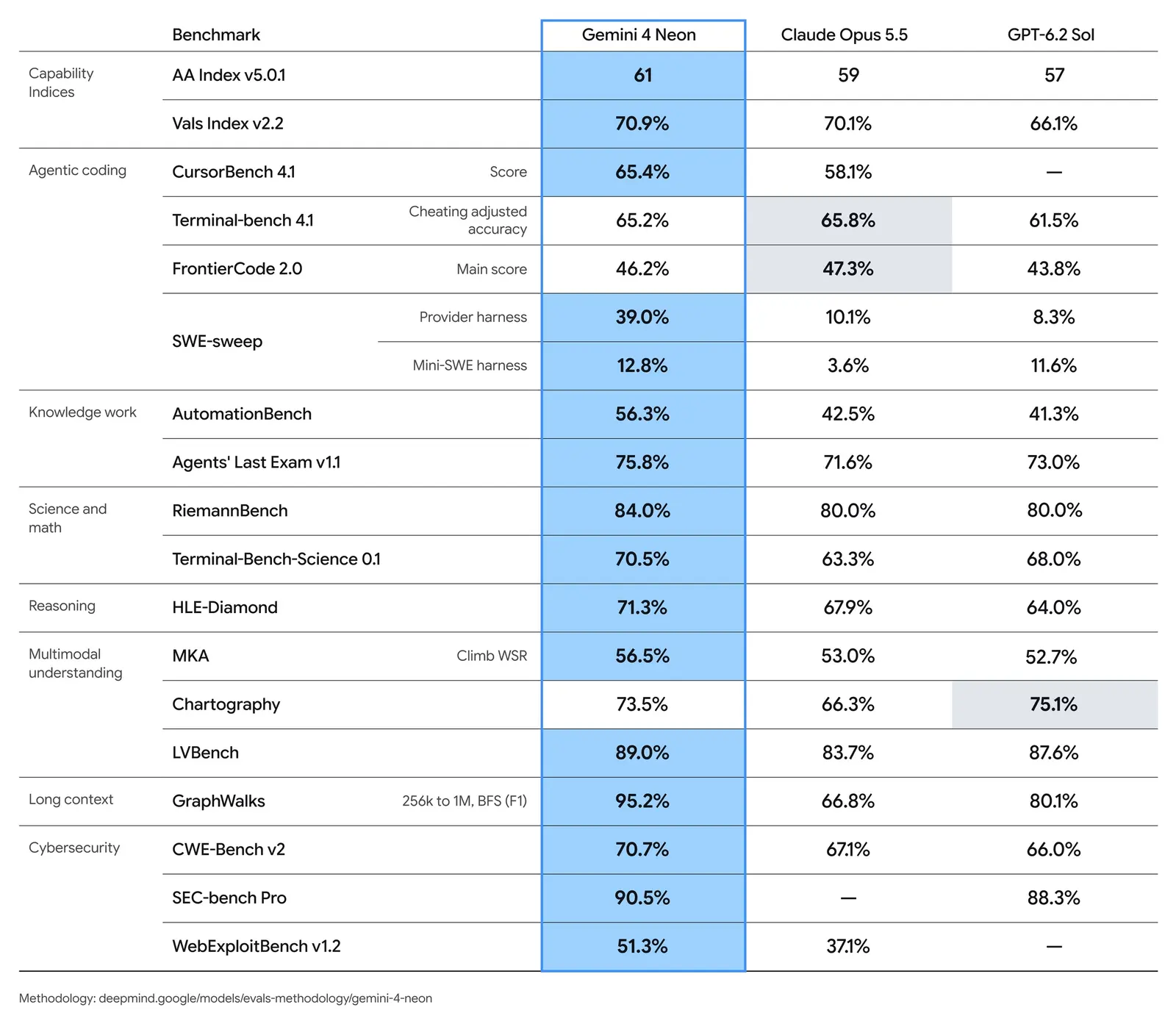
Google has released Gemini 4 Neon, a new model that sits between its strongest model, Gemini 4 Carbon, and the fast, cheaper Hydrogen. In the comparison table Google published with the announcement on its DeepMind blog, Neon beats Anthropic’s Claude Opus 5.5 and OpenAI’s GPT-6.2 Sol on most tests. It costs $3 per million input tokens and $15 per million output tokens. Since November 18 it has been rolling out to Google AI Pro and Ultra subscribers in the Gemini app and to developers on the paid Gemini API.
Where Neon fits
Neon is Google’s fourth model in seven weeks, by Artificial Analysis’s count. Argon opened the Gemini 4 generation on October 13, Carbon went live in the API on November 10, and Hydrogen followed on November 12. Google describes Carbon as the model for the hardest, longest projects and Hydrogen as the one for fast everyday work. Neon is meant to balance the two: deep enough for complex coding and analysis, fast and cheap enough for work that runs many times a day.
The price reflects that middle spot. Hydrogen costs $1.50 and $7.50 per million input and output tokens. Carbon and Argon cost $2 and $10 on introductory pricing that, according to Second Talent, ends on November 30, after which they rise to $4 and $20. That is the same rate Anthropic charges for Opus 5.5, $4 and $20 per million tokens. Neon handles text, spreadsheets, PDFs, charts, audio and video in a context window of 1 million tokens, and repeated (cached) input costs $0.15 per million.
How it compares
Google’s own table puts Neon at 61 on the Artificial Analysis Intelligence Index, against 59 for Opus 5.5 and 57 for GPT-6.2 Sol. Neon reaches 61 at its highest thinking level, xhigh, and Google says that ranks it third overall, behind larger, slower models. On CursorBench 4.1, a coding test, the gap is wider: 65.4% against 58.1% for Opus 5.5. The lead isn’t everywhere, though. Opus 5.5 scores slightly higher on Terminal-Bench 4.1 (65.8% vs 65.2%) and FrontierCode 2.0 (47.3% vs 46.2%).
Outside testers back part of the picture. Vals AI puts Neon second on its index at 70.9%, 0.4 points behind Claude Fable 5.2, at less than half the cost per task. Arena ranks Neon second on its new Agent Arena Index, built from about 4,200 real agent sessions, ahead of Carbon and of Opus 5.5, at a median cost of $2.82 per task, 53% less than Opus 5.5. Artificial Analysis sees a small intelligence gain over Carbon at about 17% lower cost per task; Google’s own figure, at Neon’s default high level, is 32% lower.
Who gets it
Pro and Ultra subscribers can pick Neon from the model menu in the Gemini app, where Tasks, the feature that hands off longer multi-step jobs, can now run on it. Google says this lets subscribers stretch their usage limits further than with larger models. Paid Pro and Ultra subscribers also get Neon in Google Antigravity, Google’s coding tool, where it can direct several Hydrogen helper agents working in parallel. Businesses get it through Gemini for business. Developers can choose between four thinking levels to trade quality against token spend.
A separate version, Gemini 4 Neon for cyber, is built to find and patch security holes in code. It will reach eligible members of Google’s Fairwind Program for cyber defenders over the next few days; others can request access through their Google Cloud account team.
Up next
OpenAI: agents do the work, people still have the ideas
Asked what they’d give up to keep their best coding agents, OpenAI researchers gave a median answer of 40% of their team’s headcount, an internal survey of 101 staff found. Which would you keep: your AI coding agent or a teammate?
Related stories
- Intelligence Index v5: Opus 5.5 at 58, GPT-6 Astra at 57
- Opus 5.5 matches Fable 5.1 on most work for less money
- Gemini 4 Argon lands fifth on Arena, behind Opus 5.5
- Gemini 4 Argon wins at office work and trails in coding
- Gemini 3.8 Live Extended Thinking tops GPT Live 1
- Gemini 4 Neon appears in Google’s Vertex AI catalog
Comments
No comments yet. Be the first.
Join the conversation
Sign in to leave a comment. It appears after moderation.