
27B open weights ship under Apache 2.0
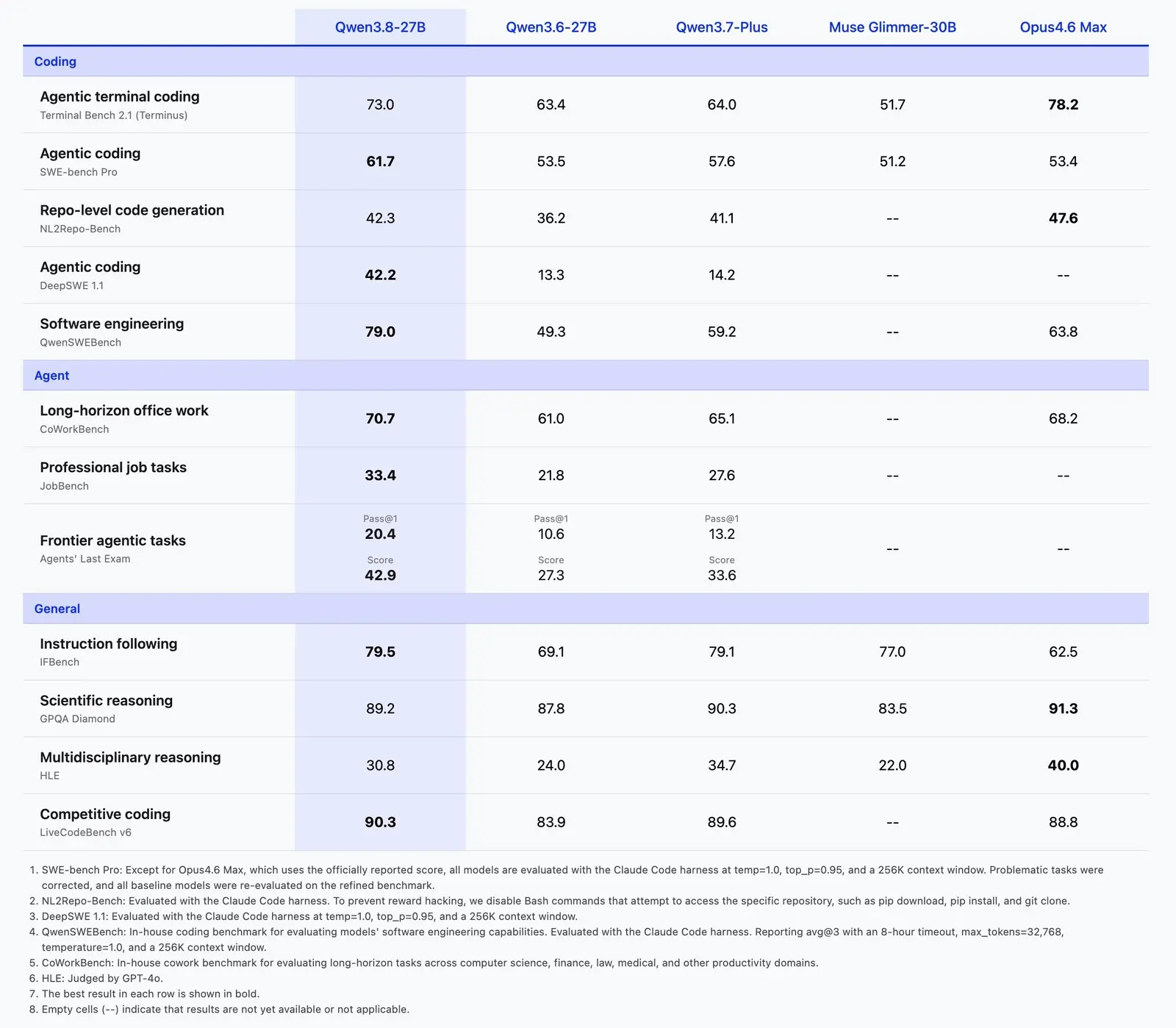
Alibaba on August 14 put the weights of Qwen3.8-27B on Hugging Face under plain Apache 2.0, a week after promising the open release. Its own benchmark table gives the headline comparison with Opus 4.6 two sides: the 27B model leads Opus 4.6 Max on SWE-bench Pro and trails it on Terminal Bench 2.1.
The pitch, quoted in a post on Threads, calls Qwen3.8-27B a native multimodal dense model that you can run locally, with a 262K-token native context that YaRN extends to 1 million tokens. YaRN rescales the model’s positional encoding so it can read sequences longer than it was trained on. The same post claims that “as a 27B model, it performs on par with Opus 4.6 on benchmarks.”
The model card shows what sits behind “on par”. It sets Qwen3.8-27B against its predecessor Qwen3.6-27B, Alibaba’s hosted Qwen3.7-Plus, Meta’s Muse Glimmer-30B and Opus4.6 Max. On Terminal Bench 2.1, run with the Terminus harness, the new model scores 73.0, against 63.4 for Qwen3.6-27B, 64.0 for Qwen3.7-Plus and 78.2 for Opus4.6 Max. That leaves it 5.2 points behind Anthropic’s model. On SWE-bench Pro the order flips: 61.7 for Qwen3.8-27B, 53.5 for Qwen3.6-27B, 57.6 for Qwen3.7-Plus and 53.4 for Opus4.6 Max.
Against its own predecessor at the same size, the SWE-bench Pro gain is 8.2 points. Both comparisons also put the open 27B ahead of Qwen3.7-Plus, which Alibaba serves only as a hosted model.
The architecture explains how a dense model this size carries a 262K window. The card describes Qwen3.8-27B as built on the Qwen3.5 foundation. Its 64 layers are arranged as 16 repeating blocks, and each block runs three Gated DeltaNet layers followed by one Gated Attention layer, with a feed-forward layer after each. Gated DeltaNet is a form of linear attention: it keeps a fixed-size running state, so its memory cost doesn’t grow with the length of the context. Full attention appears only in every fourth layer. The model was also trained with multi-step Multi-Token Prediction (MTP), which has it predict several tokens ahead in one step.
Reasoning is on by default and can be switched off per request. Depth is set through reasoning_effort, and preserve_thinking keeps the reasoning from earlier turns in the conversation context. On the serving side, the card lists compatibility with Hugging Face Transformers, vLLM, SGLang and TokenSpeed, among others.
Alibaba released the 27B model alongside Qwen3.8-2.4T-A95B, the Max-class open-weight model, and the two differ in more than size. The large model is a mixture-of-experts with 2.4 trillion total parameters and 95 billion active, 92 layers, and 512 experts, of which 11 fire per token. It uses the same Gated DeltaNet hybrid with gated full attention. It is text-only, always runs in thinking mode, and has a 262,144-token native context that extends to 1,010,000 tokens. Its weights come under a bespoke Qwen3.8-Max License with revenue-share conditions, not Apache 2.0. Of the two open models in the 3.8 generation, the 27B checkpoint is the one that also takes images as input, and the only one under a standard permissive license.
The card also lists a hosted Qwen3.8-27B on Qwen Cloud with 1M-token context by default and official built-in tools. Its status there reads “coming soon”.
Up next
Grok Build and Grok Bot get the Cursor team
Cursor’s engineers are heading to Grok Build, Grok Bot and the Grok API. The team says Cursor is now officially part of SpaceXAI and will keep working on Cursor itself.
Related stories
Comments
No comments yet. Be the first.
Join the conversation
Sign in to leave a comment. It appears after moderation.