
Claude now picks its own agent team in Managed Agents
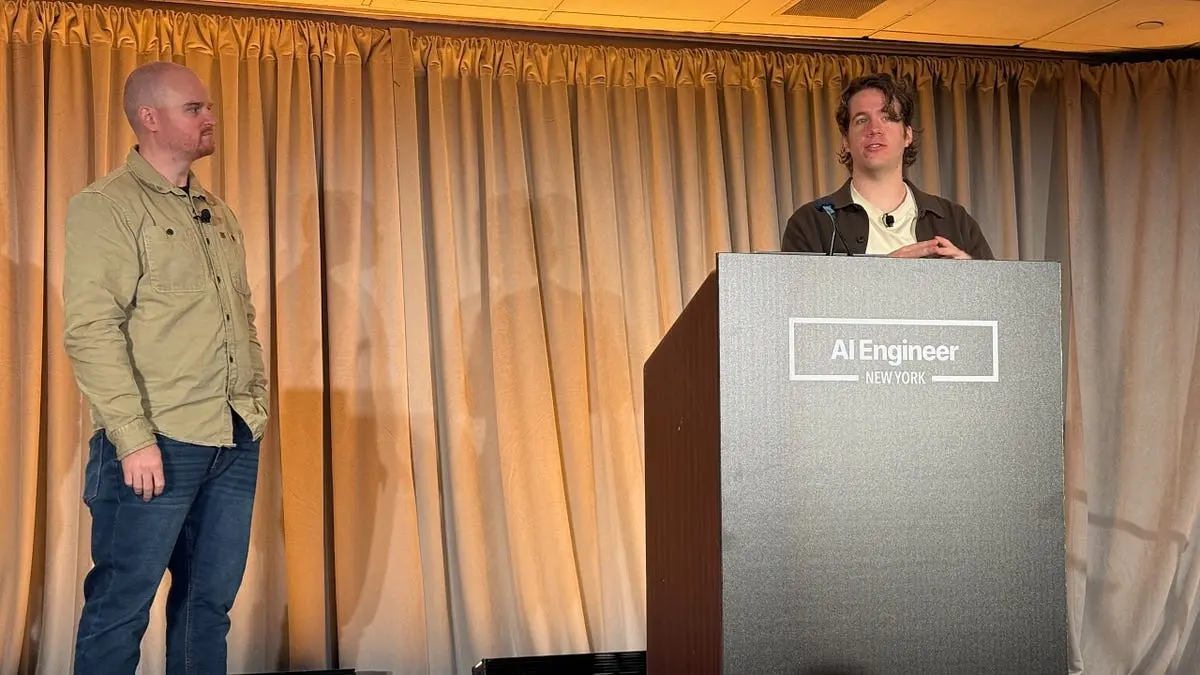
Anthropic’s CJ Avilla and Harrison Stall walked a room at AI Engineer New York through a stock watchlist scanner built on dynamic workflows, the Claude Managed Agents feature announced on October 9, and Avilla said the multi-agent version cost “much more” than a single agent but was “much more effective at finding all of the details.” If your team tries flows, set the session budget before the first run: Stall said the lead agent does not know its budget while it works.
The workshop took place on October 15, Latent reported. Flows, as the presenters kept calling them, hand the shape of the agent team to Claude. The lead agent drafts a plan, then Claude writes an orchestration program that launches agents, collects their results and moves information between them. Until now, Managed Agents required developers to configure a coordinator and a roster of subagents themselves. “Flows are essentially the next version of multi-agent orchestration, where you can let Claude fully orchestrate the entirety of its own multi-agent topology,” Stall said.
You can still pin some of the team. “It’s also possible in the agent config to pass in pre-configured sub-agents,” Avilla said. Everything sits in Claude Console, the interface for developers who reach Claude through the API.
The demo showed the basic pattern. A scan phase handed individual tickers to agents with isolated contexts, and a later review phase checked their findings before producing a report. The idea started in Claude Code under the label “a harness for every task.”
How many agents, and who pays
One audience member asked whether a simple ticker scan could trigger hundreds of sub-agents. The ceiling is high: the launch announcement put it at up to 1,000 agents in a run. “The answer really is evals and lower defaults,” Stall replied, adding that ambitious tasks generally need explicit encouragement to parallelize more.
So the agent that decides how wide to fan out still plans without seeing the bill. The model does not know its budget during a run, Stall said, but developers can set a session budget. Telling models their budget, he added, could make the agents “a little bit anxious.”
For repeated flows, Avilla suggested two ways to bring costs down: ask Claude to examine the costs a run incurred, and use dreaming. Anthropic’s documentation lists dreaming as a research preview: a dream “reads an existing memory store alongside past session transcripts, then produces a new, reorganized memory store,” merging duplicates, replacing “stale or contradicted entries” and surfacing new insights. In a flow, Avilla said, it can “crystallize and basically improve the memory store that is related to those sessions.”
A flow that rewrites itself is not built in. Asked whether the watchlist flow could notice its scanning model falls short and change the next scheduled run, Stall said no, and both presenters pointed to hill-climbing and dreaming as ways to improve the loop.
What you can inspect
Every hand-off between agents is visible in a graph inside Claude Console. “You can tell, what did the lead agent actually pass to the sub-agent? You can look at that payload here to deeply understand what is actually happening for every transition in this entire graph,” Avilla said.
Subagents share a filesystem and can exchange information through it. Developers cannot, however, instruct one workflow subagent to message another directly through the API, Stall said.
The last question went to scale: could flows power large scientific research, along the lines of OpenAI’s recently announced proof on the Navier–Stokes Millennium Prize problem? Stall gave no specifics on how Anthropic runs large scientific problems, but said the goal is for general users to tackle them too. “Flows are basically a way to throw test-time compute at hard problems and get more capability faster out of the models,” he said.
Up next

FTC’s demands to Anthropic run over 50 pages each
Per an Axios source, the FTC’s civil demands to Anthropic and OpenAI run more than 50 pages each, and they ask for marketing materials alongside safety incident files. How often do you double-check an AI lab’s safety claims yourself?
Related stories
- Claude API sends its traces to your observability tool
- Claude Code projects can burn your limits faster
- Claude expands MCP Apps support with app tools and more
- Anthropic hands Agent Skills to the foundation behind MCP
- Anthropic’s daily-brief agent treats a failed read as news
- Claude’s SDKs run the click loop, but the browser is yours
Comments
No comments yet. Be the first.
Join the conversation
Sign in to leave a comment. It appears after moderation.