
Coding agent clears all 183 ARC-AGI-3 levels

NVIDIA’s general purpose coding agent AVO scored 100.00 RHAE on ARC-AGI-3 and completed all 183 levels across its 25 environments, the company said on August 21 in a developer blog post. That is the maximum score on a benchmark where frontier models scored below 1% when it launched in March.
NVIDIA describes AVO as a working loop wrapped around a model. In the company’s words, quoted in a Threads post about the result, the agent “continuously inspects, plans, implements, and evaluates, using memory, tools, and execution feedback to build on what it learns along the way.” NVIDIA also says AVO needed 12% fewer environment actions than VISTA to get through the benchmark.
The action count matters because of how ARC-AGI-3 is graded. Each environment is a turn-based game built by human designers, with hidden rules, no instructions and no stated goal. The agent has to explore, work out the mechanics, find out what winning looks like and carry what it learned into harder levels. Scoring goes beyond pass/fail: it measures how efficiently the agent reaches the goal compared with human players, and agents that wander, backtrack or brute-force a level lose points. The human baseline came from more than 1,200 players across over 3,900 games during the preview period. So a full score means more than clearing the levels. The agent also has to clear them without spending more moves than the human runs did.
The benchmark’s short history so far:
- January 29: the ARC-AGI-3 developer toolkit ships. It is MIT-licensed, installs with pip as
arc-agi, needs an ARC API key and runs environments locally at up to 2,000 FPS. - March 24: the ARC-AGI-3 paper goes up on arXiv. It describes environments that rely only on Core Knowledge priors, the basic sense of objects, space and counting that people bring to any puzzle, with no language or outside knowledge, and difficulty calibrated on human testers. It says frontier AI systems score below 1% as of March 2026.
- March 25: ARC Prize launches ARC-AGI-3 and ARC Prize 2026 at Y Combinator HQ in San Francisco, with François Chollet and Sam Altman in a fireside conversation. The launch line: “Humans score 100%. Frontier AI scores 0.51%.”
- August 21: NVIDIA reports AVO at 100.00 RHAE on all 183 levels.
That puts the top of the scale less than five months after launch, and the earlier versions of the series went the same way. ARC-AGI-1 and ARC-AGI-2 were static grid puzzles: an image goes in, an image comes out. By 2025 frontier models were reportedly scoring above 90% on the first version, which led the ARC team to build the second with harder compositional puzzles. ARC-AGI-3 moved the series to interactive games, and a coding agent has already cleared every level of it.
The best single model is still far behind. NVIDIA’s post puts Claude Opus 5 at roughly 30% baseline on ARC-AGI-3, which suggests most of the remaining distance comes from the harness around the model: memory, tools and feedback from running its own code. OpenAI has also reported gains on ARC-AGI-3 after it turned on reasoning carry-over and compaction in its Responses API, two settings that control how an agent keeps its state from one step to the next.
The 100.00 comes from NVIDIA’s own report. ARC Prize 2026, which launched alongside the benchmark, offers over $2 million in prizes, including an ARC-AGI-3 competition on Kaggle where entrants build agents to play these same games.
Up next
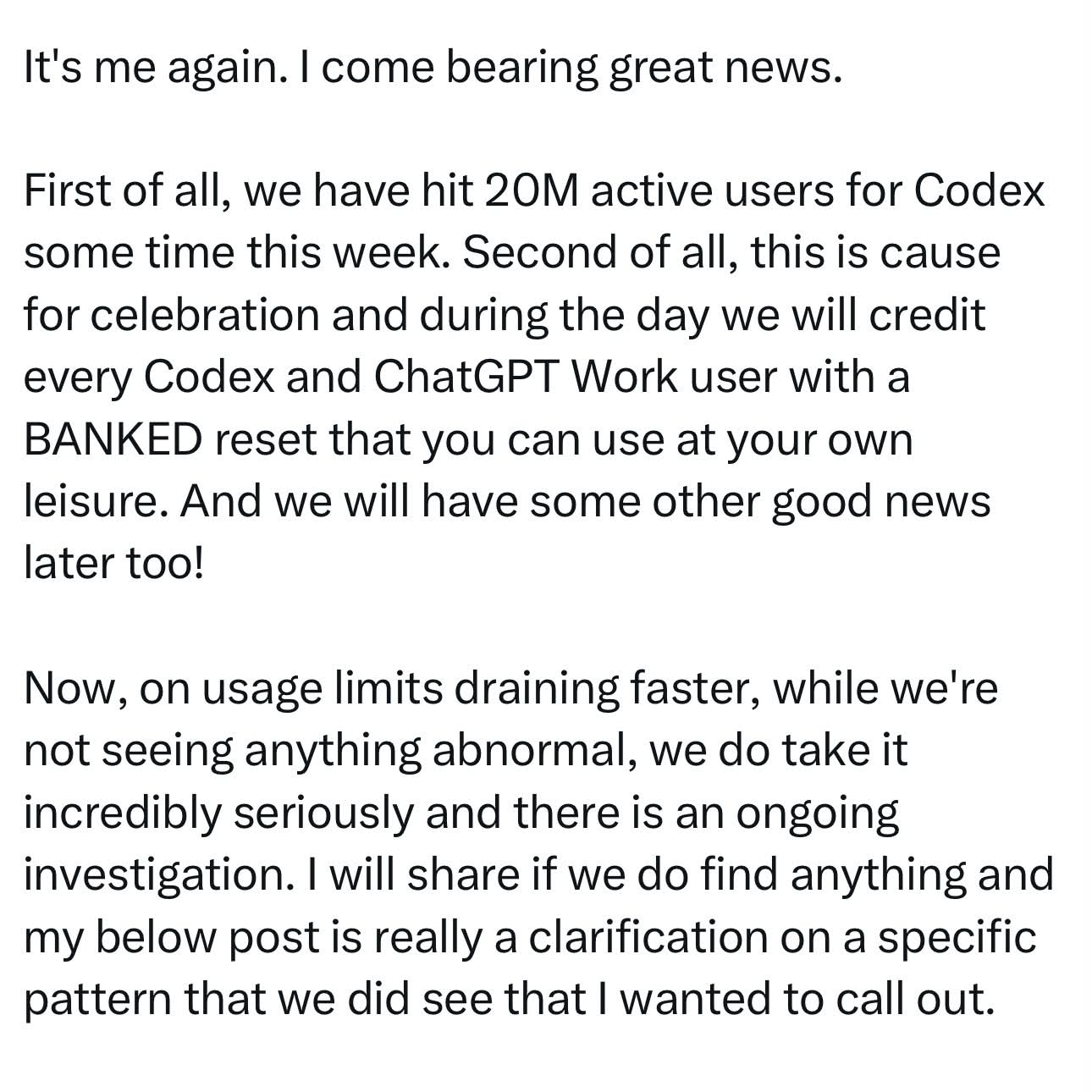
Banked reset claim arrives with an unverified 20M figure
“Low sleep weekend ahead,” says the post announcing a banked reset today for ChatGPT Work and Codex users, credited to a 20M active users milestone that no other source confirms.
Related stories
- Sai claims a top OSWorld 2.0 score at lower cost
- A harness pushes Claude Opus 5 past 30% on ARC-AGI-3
- Claude’s PRs merge at 84%, one point under humans
- Claude reviewing Codex: 71.6% to 89.7%. Codex reviewing Claude: 91.4% down to 82.8%.
- Microsoft’s MAI Code 2 claims 96% of Opus 5.5 at 5% of price
- Claude Fable 5.2 hits 69% on PCB layout test, up from 25%
Comments
No comments yet. Be the first.
Join the conversation
Sign in to leave a comment. It appears after moderation.