
Gemini Decisions API scores 1,000 questions in one call
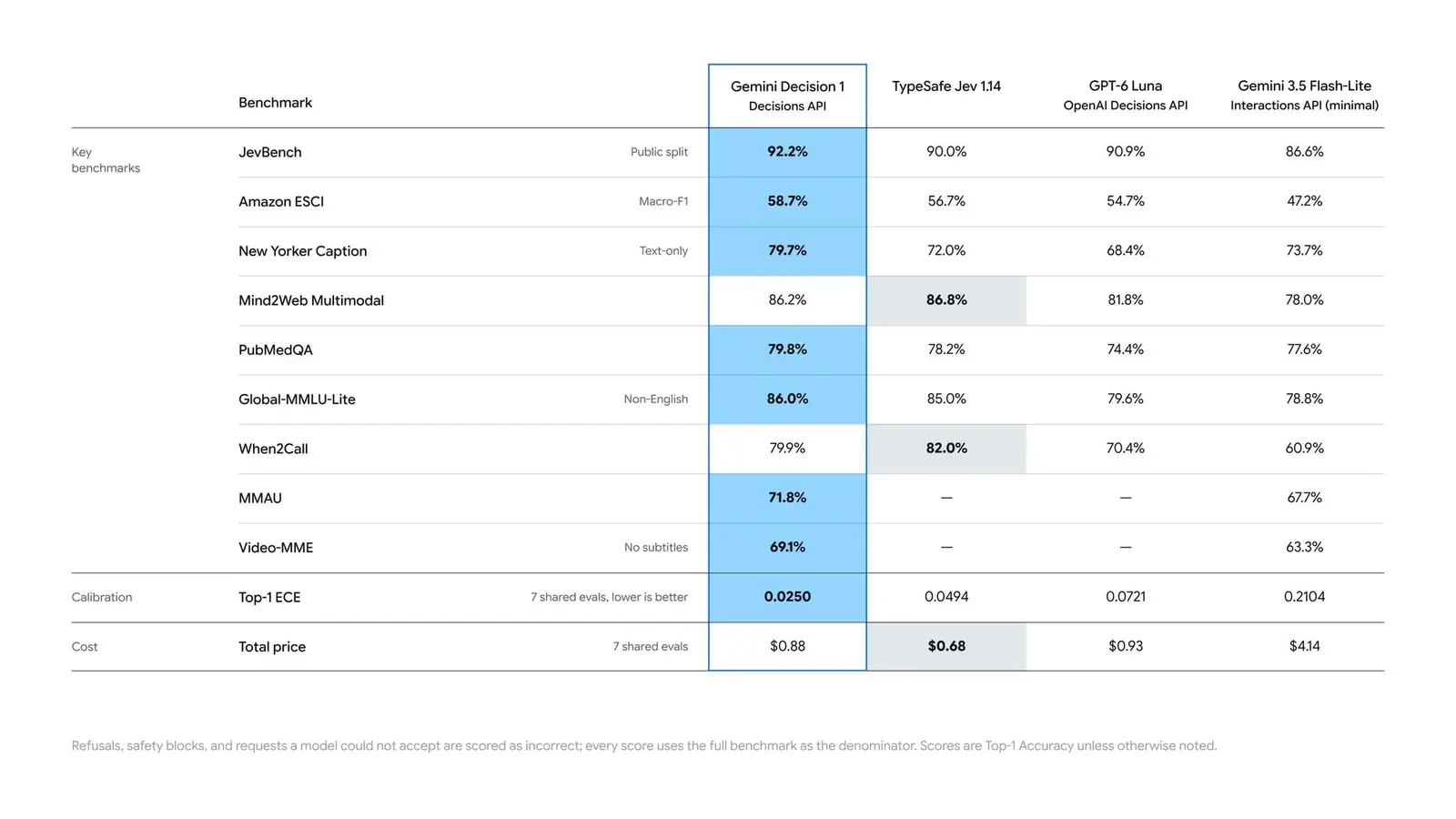
On November 11, Google opened the Gemini Decisions API. It costs $0.10 per 1M input tokens with no output tokens billed, and it runs the new gemini-decision-1 model on up to 1,000 yes/no, multiple-choice or rubric questions about one shared input. If your team routes requests or grades inputs with generative calls, that is a third of Gemini 3.5 Flash-Lite’s list input rate before Flash-Lite’s output is counted. Nothing is cached, though, so an input you send twice is billed in full both times.
As Google describes it, the model doesn’t write an answer token by token. It scores the candidate options in a single forward pass and returns a probability and a confidence score for each answer. A request carries one input, which can mix text, images, audio, video and PDFs, plus questions of three types: noul for yes/no, choice for 2 to 255 options with a normalized probability for each, and score for an ordered rubric that starts at 0. The shared input is billed once per request, and each question adds only its own instruction and criteria tokens.
Google’s numbers
Google puts median latency at 50-100 ms of model compute, or 150-250 ms end to end, for inputs up to 16K tokens. It says latency stays nearly flat from 1 to 100 questions per request. On its own benchmark suite, Google says the Decisions API is nearly 5x cheaper than Gemini 3.5 Flash-Lite called through the Interactions API, and that Gemini Decision 1 leads across agent routing, reasoning, ranking and multimodal tests with the lowest calibration error. Gemini Notebook already uses the API to send each query to a model tier and thinking level, which Google credits with up to 40% lower latency on everyday queries. Google Search runs it as a safety layer for MCP tools.
The closest rival allows fewer questions. OpenAI’s Decisions API caps a call at 400 questions as of October, and its uncached input rate then was the same $0.10 per 1M. Microsoft-Decision-1 was listed at $0.042 in October. We did not re-check either figure, and because the tokenizers differ, these are rate comparisons, not bills.
Our analysis
What we checked
On November 11 we ran google-genai 3.2.0 for Python and JavaScript against a mock server, probed Google’s endpoints without an API key, and checked the blog against the Decisions API docs and the pricing page.
The prices, the 2-255 option range and the latency conditions match the docs. Two of the blog’s framings don’t. The 256K-token input and the 1,000 questions draw on one shared token budget, and a yes/no confidence score never covers the full 0-to-1 range the blog describes. Google’s “nearly 5x” saving is only 3x on list input price. The rest depends on how much Flash-Lite would have written back.
- Context: the docs set 262,144 tokens “across shared input and all questions” and bound the question count by that same window. With 50-token questions, a 256,000-token input plus 1,000 questions comes to 306,000 tokens and does not fit.
- Confidence: the probability on a yes/no question runs from 0.01 to 0.99, and by the documented formula its confidence cannot fall below 0.5 or rise above 0.99. A fallback threshold set below 0.5 will never catch a
noulanswer. - Price: Flash-Lite charges $0.30 per 1M input against Decision’s $0.10. The gap reaches 5x when Flash-Lite’s output, thinking tokens included, is 8% of its input. Against Flash-Lite’s Batch rates the same workload comes out at 2.5x, and the Decisions API has no Batch mode. This is our arithmetic, not a rebuild of Google’s benchmark.
- Caching: the Decisions API has no context caching and no Batch, Flex or Priority inference. On a reused input, the flat $0.10 is 3.33x Flash-Lite’s $0.03 cached-read rate, before Flash-Lite’s storage fee of $1.00 per 1M tokens per hour. OpenAI’s cached reads were $0.01 in October.
- Limits: neither SDK blocked a request with 1,001 questions, zero questions, or a
choicewith 1 or 256 options. The docs say the server rejects these with HTTP 400, so each one costs a network round trip before you see the error.
Before the first call
Decisions support first appeared in google-genai 3.2.0. It went up on npm at 17:39 UTC and on PyPI at 17:49 UTC on launch day, minutes before the blog post went live at 18:00 UTC. The version 3.1.0 packages from November 10 don’t mention it. The docs require SDK 3.2 or later, and the Python package needs Python 3.11 or later.
The yes/no type really is spelled noul. If you write bool instead, the Python SDK rejects the request before sending anything. The JavaScript SDK sends it to the server unchecked.
You can prototype on the no-cost tier in Google AI Studio. Google lists integrations rolling out for OpenRouter, LangChain, Vercel, LiteLLM, Pydantic AI, Pipecat, LiveKit and OpenCode. OpenRouter’s listing was already live when we checked, and we didn’t check the other seven. Support in Gemini in Google Cloud is coming soon.
Keep the api_version="v1beta" setting from Google’s sample code. In both SDKs, a client without it sends decisions.create to /v1/decisions, and that route returned HTTP 404 when we probed it. /v1beta/decisions answered 403 PERMISSION_DENIED, which we read as a route that exists and is waiting for credentials. We didn’t repeat the test with a real key.
Up next

Prompt injection reached the official Codex npm pipeline
A prompt injection in a GitHub issue let Depi reach the pipeline that publishes OpenAI’s official Codex npm package, the one auto-update pulls with no diff to review. For your coding tools, is auto-update on or do you pin versions and update by hand?
Related stories
- Perplexity puts its 4B decision model on the Mac
- OpenAI’s Decisions API exits beta at 400 questions a call
- Jev answers in 195 ms, OpenAI Decisions in 208 ms
- SubQ Snap reads 384K tokens before each agent decision
- OpenAI’s Decisions API beats its own engine by up to 10x
- Agent Studio on GCP lists Gemini 3.8 Flash
Comments
No comments yet. Be the first.
Join the conversation
Sign in to leave a comment. It appears after moderation.