
DeepSeek's minor Flash update beats Opus 5 on DeepSWE
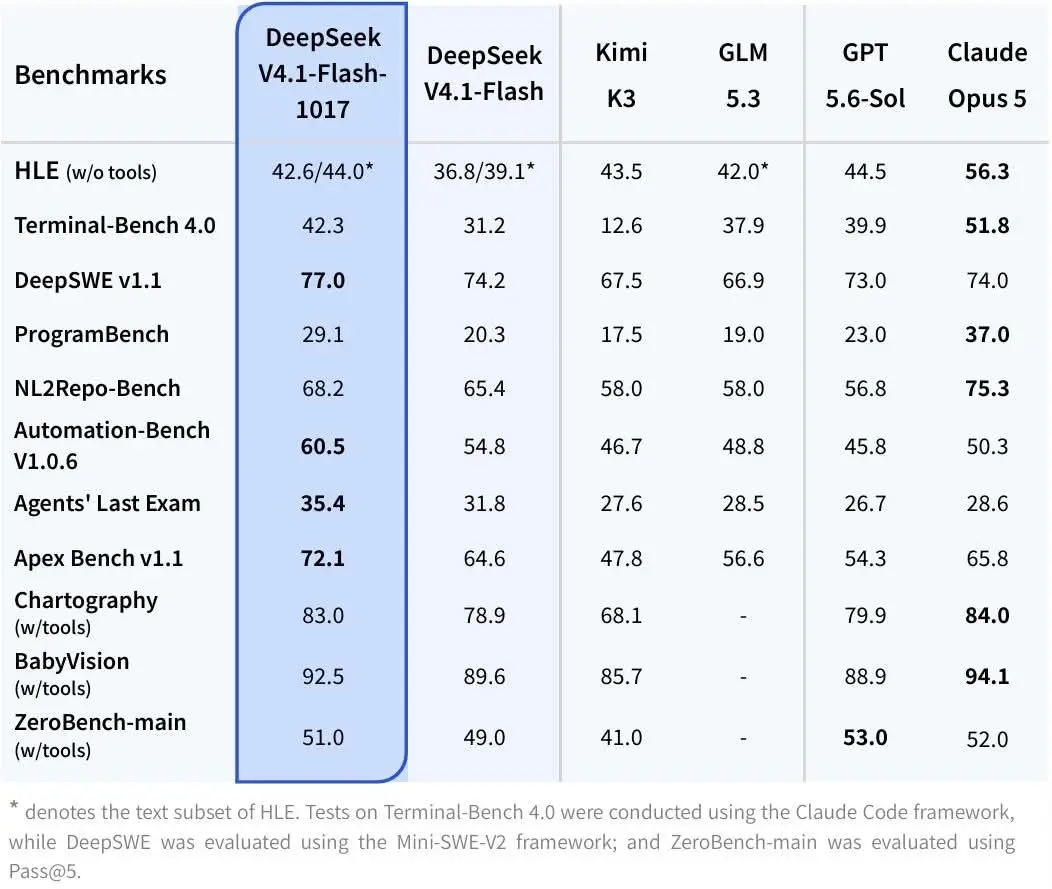
DeepSeek calls DeepSeek-V4.1-Flash-1017 "a minor update" to the Flash model it shipped on September 10. Yet every one of the eleven benchmarks in the table on DeepSeek's model card goes up. The biggest jump is on Terminal-Bench 4.0, from 31.2 to 42.3, a gain of 11.1 points.
Testing Catalog shared the release on Threads and picked out a different number: 77% on DeepSWE 1.1, ahead of GLM-5.3, Kimi K3, GPT-5.6 Sol and Opus 5. The post says the model is live in DeepSeek Chat, on the API and on Hugging Face, and calls it "extremely cheap". DeepSeek's table supports the DeepSWE ranking. It doesn't support the wider impression that the model beats those rivals everywhere. The model card also lists no price.
Eleven scores, before and after
The table compares the new build with the September Flash on the same tests. Here are the scores, earlier Flash first:
- HLE without tools: 36.8 → 42.6 (text-only subset: 39.1 → 44.0)
- Terminal-Bench 4.0: 31.2 → 42.3
- DeepSWE v1.1: 74.2 → 77.0
- ProgramBench: 20.3 → 29.1
- NL2Repo-Bench: 65.4 → 68.2
- Automation-Bench v1.0.6: 54.8 → 60.5
- Agents' Last Exam: 31.8 → 35.4
- Apex Bench v1.1: 64.6 → 72.1
- Chartography (with tools): 78.9 → 83.0
- BabyVision (with tools): 89.6 → 92.5
- ZeroBench-main (with tools): 49.0 → 51.0
Two of these rows depend on harness choices that DeepSeek states. Terminal-Bench 4.0 was run through the Claude Code harness and DeepSWE v1.1 through Mini-SWE-V2. If your agent stack is different, expect different numbers.
DeepSeek also says the model takes less time to run tasks and writes shorter output, so tasks finish faster and cost less. The company says this pushes "the performance–cost Pareto frontier across multiple agent harnesses". The card gives no timing or token-count figures for that claim.
Against Opus 5 and GPT-5.6 Sol
Opus 5 still has the highest score in six of the eleven rows: HLE without tools (56.3), Terminal-Bench 4.0 (51.8), ProgramBench (37.0), NL2Repo-Bench (75.3), Chartography (84.0) and BabyVision (94.1). Its Terminal-Bench lead over the new Flash is 9.5 points, 51.8 against 42.3. That is the coding-agent test where the Flash update gained the most, and the gap is still large.
The new Flash tops the whole table on four rows. On DeepSWE v1.1 it scores 77.0, against 74.0 for Opus 5 and 73.0 for GPT-5.6 Sol. It also leads on Automation-Bench (60.5), Agents' Last Exam (35.4) and Apex Bench (72.1). On ZeroBench it comes third of those three models with 51.0, behind GPT-5.6 Sol at 53.0 and Opus 5 at 52.0. On HLE without tools its 42.6 is below K3 (43.5) and GPT-5.6 Sol (44.5).
GLM-5.3's only HLE score is for the text-only subset, 42.0, against 44.0 for the new Flash on the same subset. GLM-5.3 has dashes in all three vision rows. DeepSeek published every number in the table, and the card doesn't say whether the competitor scores were run in-house or copied from those vendors.
For comparison among open-weight Flash-tier models: on August 26 we reported that Alibaba's Qwen3.8 Flash scored 58.7 on DeepSWE 1.1. According to Progressive Robot, DeepSeek's own V4 Pro 0813 lists 62.7 on DeepSWE on its model card, though that page doesn't name the benchmark version.
The architecture underneath
The 1017 build keeps the September base. DeepSeek-V4.1-Flash is a 552-billion-parameter Mixture-of-Experts model, meaning a router sends each token through a small set of expert sub-networks rather than the whole network. It uses a new Causal Encoder–Decoder design that activates 8B parameters on input and 16B on output. It understands images natively, has a 1M-token context window, and its KV cache is a quarter the size of the previous generation's. The KV cache is the per-token memory a model keeps so it doesn't recompute earlier context, and at 1M tokens it is usually what limits how much fits on the hardware. The citation title on the card points at the same thing: "DeepSeek-V4.1-Flash: Pushing the Limits of KV Cache Compression".
No Jinja template
The release has no Jinja-format chat template, so you can't just apply the usual tokenizer template. The encoding folder has a standalone Python reference, encoding.py, with test cases for multi-turn conversations, tool calling, thinking mode, numeric reasoning effort, system messages in the middle of a conversation, and interleaved images.
For production, DeepSeek ships deepseek-recipe, a set of Rust libraries with Python bindings. It turns Messages, Chat Completions and Responses API requests into DeepSeek's Conversation format, then encodes them as V4 or V4.1 prompts or token IDs. It also parses model output back into complete or streamed responses, covering thinking, tool calls, images and generation settings. Model inference, tool execution and HTTP transport are left to you. Instructions for converting the weights and running inference locally are in the inference folder. The repository and weights are MIT-licensed.
Pricing is still the open question for the "extremely cheap" claim. According to Mungomash, the September 10 Flash launch came with API price cuts, DeepSeek's first since its August 16 switch to peak and off-peak billing raised every rate. The 1017 card lists no rate.
The card does give recommended settings: temperature 1.0, top_p 1.0, a 1M-token context window, and max_tokens of at least 256K.
Up next
Anthropic wrote its own AI safety bill for Congress
Per POLITICO, Anthropic is quietly pitching lawmakers its own AI safety bill. It lets the government block a model only over imminent risks like more than $1 billion in damages. Would you set the bar for blocking a model at $1 billion in damages, or lower?
Related stories
- Mistral Large 4 tops open models at just 15% on legal tasks
- DeepSeek Harness v0.2 lands on macOS and Windows, not Linux
- Liquid AI's 2B-active model beats Qwen on LiveClaw
- Xiaomi's new MiMo models carry an unverified top-6 claim
- Cohere claims a WMT26 lead with a non-reasoning translator
- A 125B MoE model previews Qwen4's architecture
Comments
No comments yet. Be the first.
Join the conversation
Sign in to leave a comment. It appears after moderation.