
Anthropic’s power in 2028: 87% gas, 11% coal
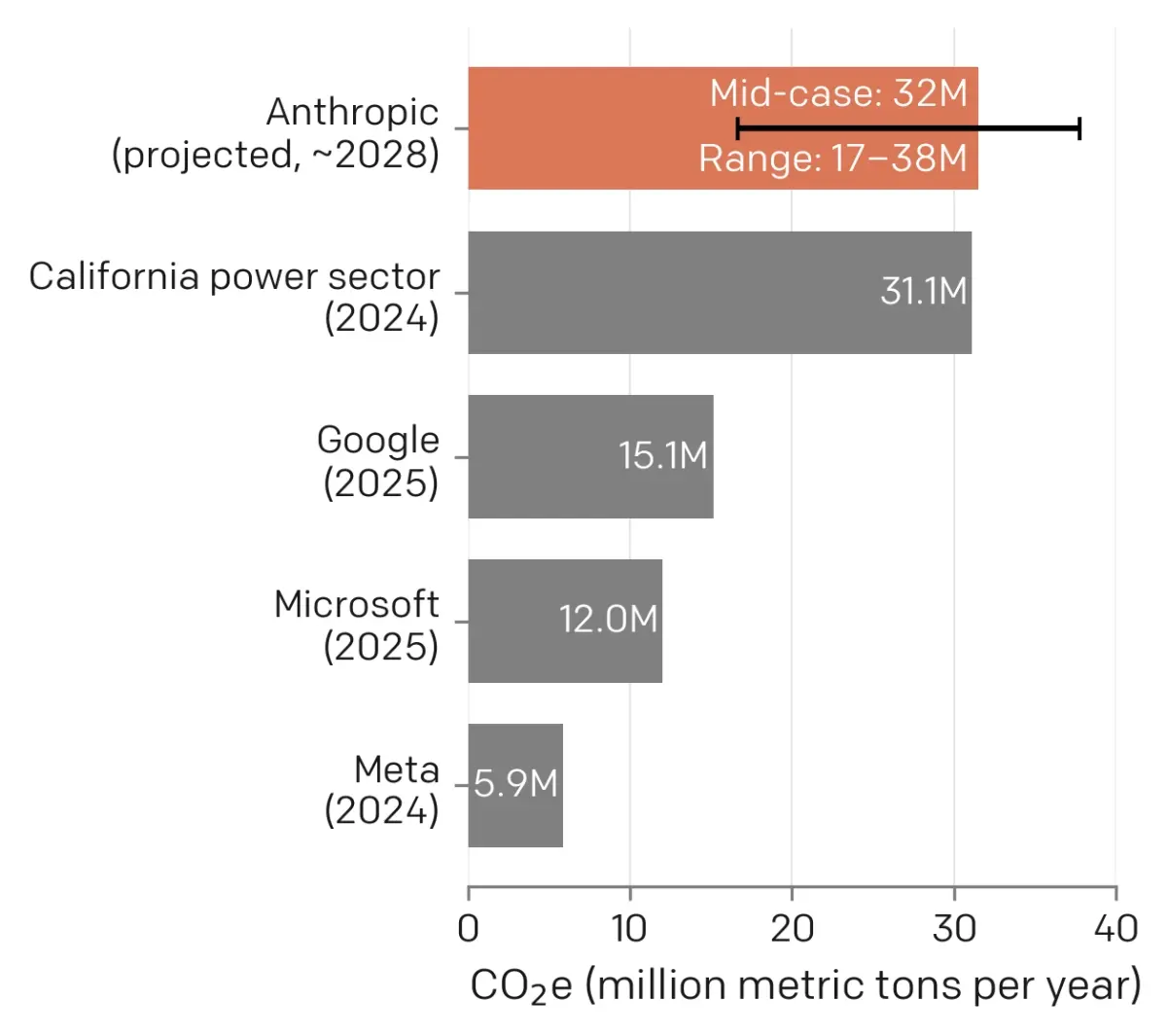
Anthropic’s US data centers will run almost entirely on fossil fuels for the next few years, according to an analysis by the Better Data Center Project. The group estimates that in 2028 about 87% of the company’s power will come from gas and 11% from coal. By its count, the emissions from that power could be larger than those of every power plant in California.
The Better Data Center Project’s report follows its earlier work on “bring your own power”: data centers that build their own power plants instead of relying only on the utility. The group picked Anthropic as a case study of how the AI buildout drives new fossil plants, both on site and on the grid.
Where the power comes from
As of October 2026, Anthropic had contracted 15 GW of compute, and about 5.9 to 9.6 GW of it is tied to specific data center sites. The authors say 9.6 GW could power about 7 million homes. About a quarter of the contracted power will come from gas generators on the data center sites themselves. Most of that on-site capacity, 80%, is simple cycle turbines and engines, an older, less efficient design that gives off more pollution per unit of electricity than modern gas plants.
The rest comes from the grid, and the authors explain why none of it counts as renewable. When a big new customer plugs in and nobody builds new wind or solar for it, the extra demand is met by gas and coal plants that can be turned up on request. Anthropic’s sites also sit in regions where the grid mostly burns coal and gas, so the group puts the carbon intensity of its power 35% above the US average.
How big the emissions are
The report estimates 17 to 38 million metric tons of CO2 equivalent a year in 2028, with 32 million in its middle case. California’s power plants emitted 31.1 million in 2024. The authors also say Anthropic’s figure could exceed the 2025 grid-power emissions of Meta, Microsoft and Google combined, though they add that the comparison doesn’t mean Anthropic will be the biggest emitter, since those companies’ emissions are expected to grow too. Using EPA estimates, they put the health damage from the air pollution at $2 to 3 billion a year.
The figures are modelled, not measured. The range comes from uncertainty about cooling needs and how hard the hardware is used, and the middle case assumes all 9.6 GW is running in 2028.
What Anthropic says
Anthropic has said it is “working to broaden our energy mix with geothermal, wind, solar, and emerging technologies.” Yet its only disclosed renewable commitments are in Norway and Canada, the report says. In the US it is buying gas equipment directly: the authors cite its purchase of commitments for 1.7 GW of heavy-duty gas generators for $3.4 billion.
The report also points to a gap in Anthropic’s own rules. In October the company wrote that the plants powering its data centers must have air permits and use emissions controls. But since May 2026 it has used compute at SpaceX’s Colossus 2, which still gets most of its power from temporary, unpermitted turbines, most of them without those controls. The authors estimate Anthropic will draw up to 600 MW there by the end of 2026. Another contracted site, in Mason, West Virginia, will run on gas engines that the report says emit significant formaldehyde and other hazardous pollutants.
What comes next
The totals cover only the sites known today. Some analysts expect Anthropic to secure 30 GW by 2030, and the authors say the emissions could double by then.
Up next

OpenAI launches a checker for its own images and audio
Drop an image, audio clip or PDF onto a new OpenAI page and it tells you whether ChatGPT, Codex or the API left a watermark or metadata in it, if that signal survived. Would you run a viral image through this before sharing it?
Related stories
- Australians push back on Anthropic’s data centre
- FT: Anthropic strikes $3.4B gas power deal for data centers
- Anthropic mathematician claims Riemann proof with Claude
- Claude modeled a whole virus shell overnight
- Anthropic raised $107 billion, promised $900 billion
- Claude solved two open problems about black holes
Comments
No comments yet. Be the first.
Join the conversation
Sign in to leave a comment. It appears after moderation.