
anthropic
Five agent tools land on Claude in Microsoft Foundry
Promtime
 anthropic
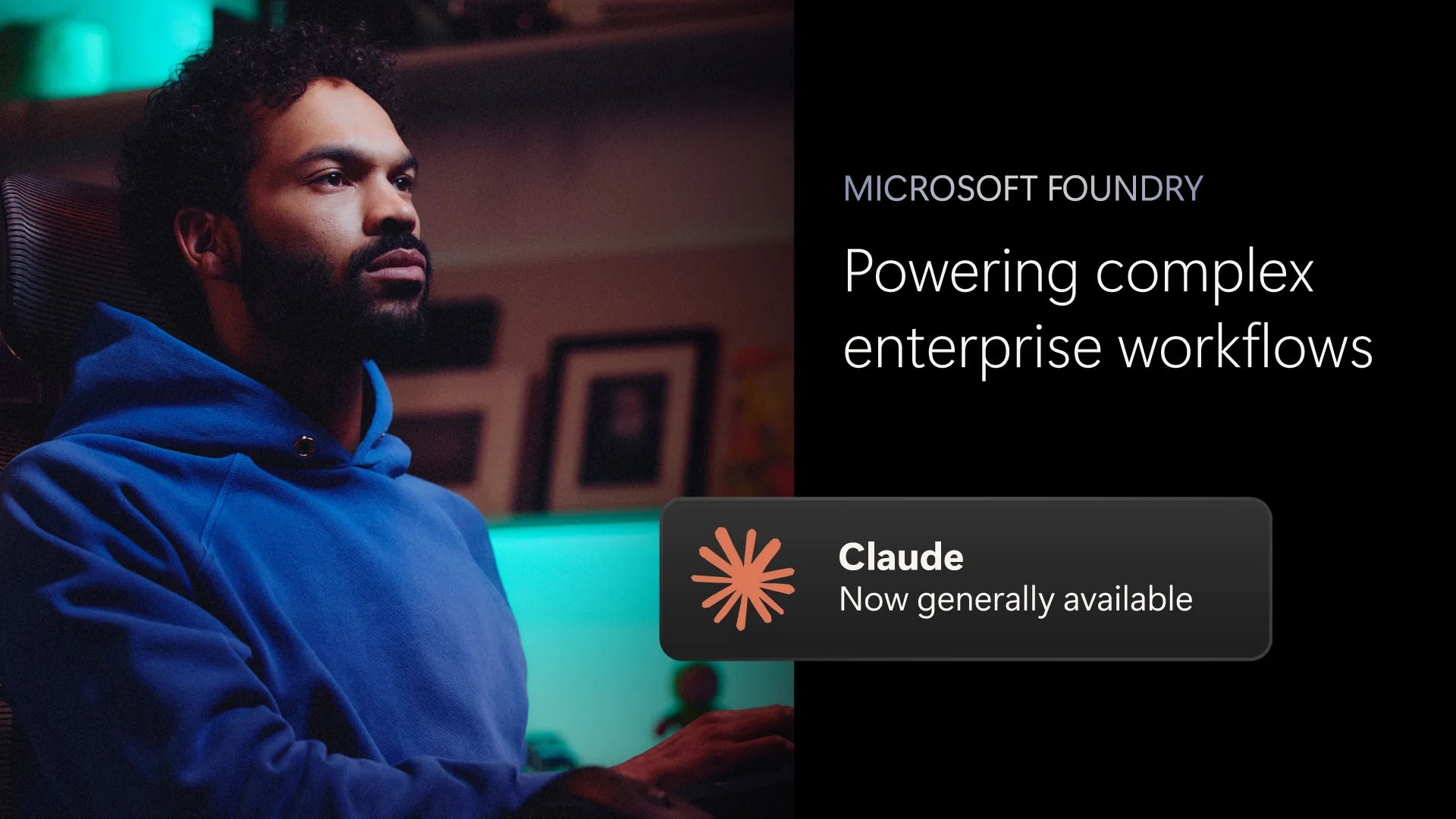
Structured outputs, web search, web fetch, the MCP connector and tool search are now available on Claude deployments hosted on Azure in Microsoft Foundry, five capabilities that previously ran only on Hosted on Anthropic deployments. Microsoft presents the set as the building blocks that turn a model endpoint into a production agent platform, and says they arrive after Claude models became generally available in Foundry in June 2026.
At a glance
- Structured outputs constrain decoding with a grammar compiled from a JSON Schema, and strict tool use guarantees schema-valid tool inputs, removing the retry loops teams write around malformed model output.
- Web search bills at $10 per 1,000 searches while fetch and tool search carry no per-call charge; tool search cuts tool-definition tokens by over 85% by loading three to five tools per request.
- Deployments hosted on Azure keep prompts and completions within Azure, so regulated teams on US Data Zone Standard can now run search-backed agents without rebuilding crawlers and MCP clients client-side.
The June 2026 general availability of Claude in Foundry solved procurement and governance: Azure-native endpoints, Entra ID authentication, Marketplace billing. It did not solve the agent problem, and the trade-off it left behind appears to have been the sharper one for regulated buyers, who had to choose between an in-Azure data posture and the agentic feature set. Closing that gap likely shifts the competitive question from where inference runs to how much scaffolding the platform itself owns.
Hosted on Azure deployments keep prompts and completions within Azure
Claude deployments in Foundry come in two hosting options chosen at creation. Hosted on Azure runs an Anthropic-operated service on Azure infrastructure, offers Global Standard and US Data Zone Standard deployment types and carries the latest Opus, Sonnet and Haiku models; Hosted on Anthropic runs on Anthropic infrastructure as Global Standard only and carries the full Claude catalogue on Foundry.
On Hosted on Azure deployments only usage metadata and content flagged by Anthropic's safety systems leave Azure, and Anthropic acts as an independent processor for Microsoft. A US Data Zone Standard deployment keeps inference within the United States, which Microsoft describes as equivalent to setting inference_geo to "us" on the Claude API.
Grammar-constrained decoding removes the JSON retry loop from data pipelines
Structured outputs work in two parts: output_config.format controls the shape of Claude's response text, and strict: true on a tool guarantees schema-valid tool inputs. The Foundry SDKs expose the first through messages.parse, which takes a Pydantic model in Python or a Zod schema in TypeScript and returns a validated object.
Basic web search, version web_search_20250305, loads every result into context in full. From web_search_20260209 onward Claude writes and runs code that filters results first, with allowed_callers defaulting to code_execution_20260120; Foundry provisions that code execution automatically and charges nothing beyond standard token costs. The parameters allowed_domains and blocked_domains are mutually exclusive, and sending both returns a 400.
Web fetch reads a named URL and returns page text or, for PDFs, base64 document content, with citations off by default. Microsoft puts a 10 kB page at roughly 2,500 tokens, a 100 kB documentation page at 25,000 and a 500 kB research-paper PDF at 125,000.
Tool search cuts definition tokens by over 85% on large catalogues
The MCP connector points the Messages API at remote MCP servers, with mcp_servers defining connections and mcp_toolset entries in tools deciding which server tools are enabled, including denylists and read-only allowlists. It runs in beta on Foundry behind the mcp-client-2025-11-20 header, and calls return as mcp_tool_use and mcp_tool_result blocks carrying server_name.
A multi-server setup spanning GitHub, Slack, Sentry, Grafana and Splunk consumes roughly 55,000 tokens in tool definitions before the model does any work, and selection accuracy falls off once more than roughly 30 to 50 tools are available, according to Microsoft.
Tool search keeps those definitions out of context and lets Claude query the catalogue instead, typically loading three to five tools per request. The regex variant takes Python re.search() patterns of up to 200 characters, the BM25 variant natural-language queries of up to 500. The full tools array still ships on every request, and deferring every tool returns a 400.
What Foundry still lacks
The Message Batches, Admin, Models and Compliance APIs, Claude Managed Agents, server-side fallback and the Advisor tool are not available on Foundry. Microsoft also notes that Foundry does not surface Anthropic's rate-limit headers, so clients need their own exponential backoff.
Structured outputs are ZDR-processed, but schemas are cached for 24 hours, so Microsoft advises keeping PHI out of them; the MCP connector's server exchange is not covered by ZDR at all. Usage bills as Claude Consumption Units through Azure Marketplace, metered hourly and invoiced monthly in arrears.
Comments
No comments yet. Be the first.
Join the conversation
Sign in with Google to leave a comment. Your name and avatar come from your Google profile, and the comment appears after moderation.
We only use your name and avatar from Google. We never store your email address.