
research
Homework scores rose, exam scores fell in AI study
Promtime
 research
A working paper tracking 26,811 secondary school students in China reports that generative AI use lifted homework scores by 18 percent and cut unaided monthly exam results by 20 percent within six months. The Economist analysed the findings on August 18, after the paper circulated as a Centre for Economic Policy Research discussion paper in June.
At a glance
- The authors attribute most of the damage to homework outsourcing, a pattern of unusually fast assignment completion paired with high marks that fits roughly 80 percent of the students using AI.
- Scores fell about 5 percent for students using AI up to one hour a week and about 30 percent for those using it five hours or more, a dose-response gradient across self-reported usage.
- A separate randomised experiment by two Middlebury College economists found that undergraduates given AI access in proctored sessions scored 0.27 standard deviations higher, an advantage that held a week later.
The two working papers cited together do not cancel each other out so much as mark a boundary. The Chinese data capture unsupervised homework done at home, where an assignment can be handed off wholesale; the Middlebury experiment captures a proctored session where the tool sits inside the work. That distinction likely matters more to schools setting AI policy than either headline effect size, and it points at supervision rather than access as the policy lever.
The records cover 30 months, nine subjects and grades 7 to 12 in one central Chinese county
The paper, "The Generative AI Learning Penalty: Evidence from Chinese Secondary Education," is by David Stromberg of Stockholm University and Victor Lei and Yanhui Wu of the University of Hong Kong. It was published on June 2, 2026 as Centre for Economic Policy Research discussion paper DP21577.
The dataset covers 30 months of administrative records from a single county in central China, spanning grades 7 to 12 and nine subjects. It combines homework scores and completion times, monthly closed-book exams, and results from both the zhongkao high school entrance exam and the gaokao university entrance exam.
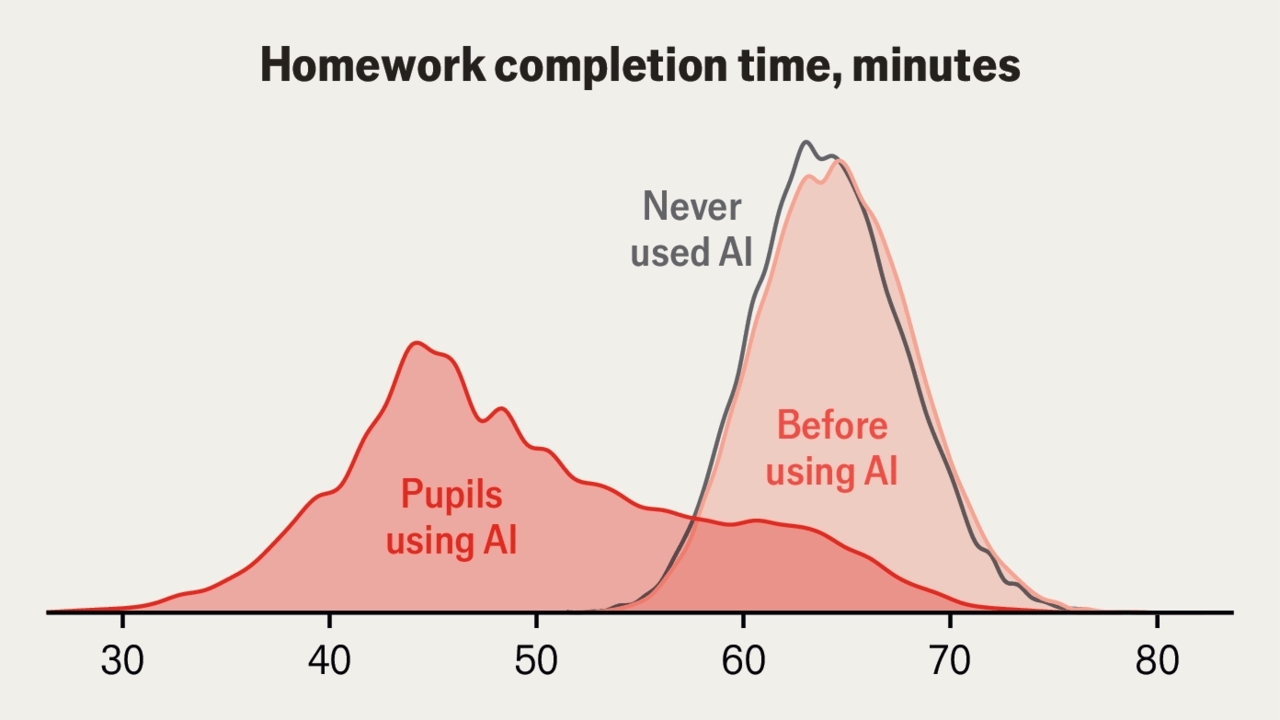
AI adoption cut homework completion time by 30 percent, and average homework time among users fell from 64 minutes to 45. Scores on unaided monthly exams dropped 20 percent within six months. On the entrance exams the declines were 18 percent and 24 percent, with the full penalty emerging only after roughly two years.
Most of the penalty sits with the 80 percent of users the authors class as homework outsourcers
The losses are not evenly distributed. They concentrate among roughly 80 percent of AI users whose behaviour matches what the authors call homework outsourcing: unusually fast completion paired with high homework marks. Users who spent about as long on assignments as non-users showed small learning losses.
The paper reports a dose-response pattern, with an average 5 percent score decline among students using AI zero to one hours per week against 30 percent for those at five hours or more. Effects were largest in social science subjects, followed by STEM and languages, and larger for younger students, high achievers and boys.
Adoption was self-reported and rose from near zero to about 80 percent over the 30 months, with students naming tools such as Doubao and DeepSeek. The authors exploit the differing timing of take-up in a staggered-adoption difference-in-differences design.
A Middlebury experiment found a 0.27 standard deviation gain from AI access
Zara Contractor and German Reyes of Middlebury College ran a randomised experiment in proctored sessions, where undergraduates learned an unfamiliar topic and wrote an essay with or without access to generative AI. AI access raised immediate test scores by 0.27 standard deviations, and the advantage persisted when students repeated the assessments a week later.
That paper circulates as arXiv:2607.08849 and as IZA discussion paper 18792. The Chinese county has a population above one million and GDP per capita slightly below 6,000 US dollars, which the authors describe as representative of Chinese counties outside the developed coastal belt. Some coverage has presented the study as a six-month experiment with a control group, whereas the analysis is observational.
Untested outside one county
Neither working paper has been peer reviewed, and the Chinese findings rest on a single county of more than one million people. Whether the pattern holds in systems without the zhongkao and gaokao as terminal exams, or in schools that structure homework differently, is left open. No date has been given for a peer-reviewed version of either paper.
Comments
No comments yet. Be the first.
Join the conversation
Sign in with Google to leave a comment. Your name and avatar come from your Google profile, and the comment appears after moderation.
We only use your name and avatar from Google. We never store your email address.