
meta
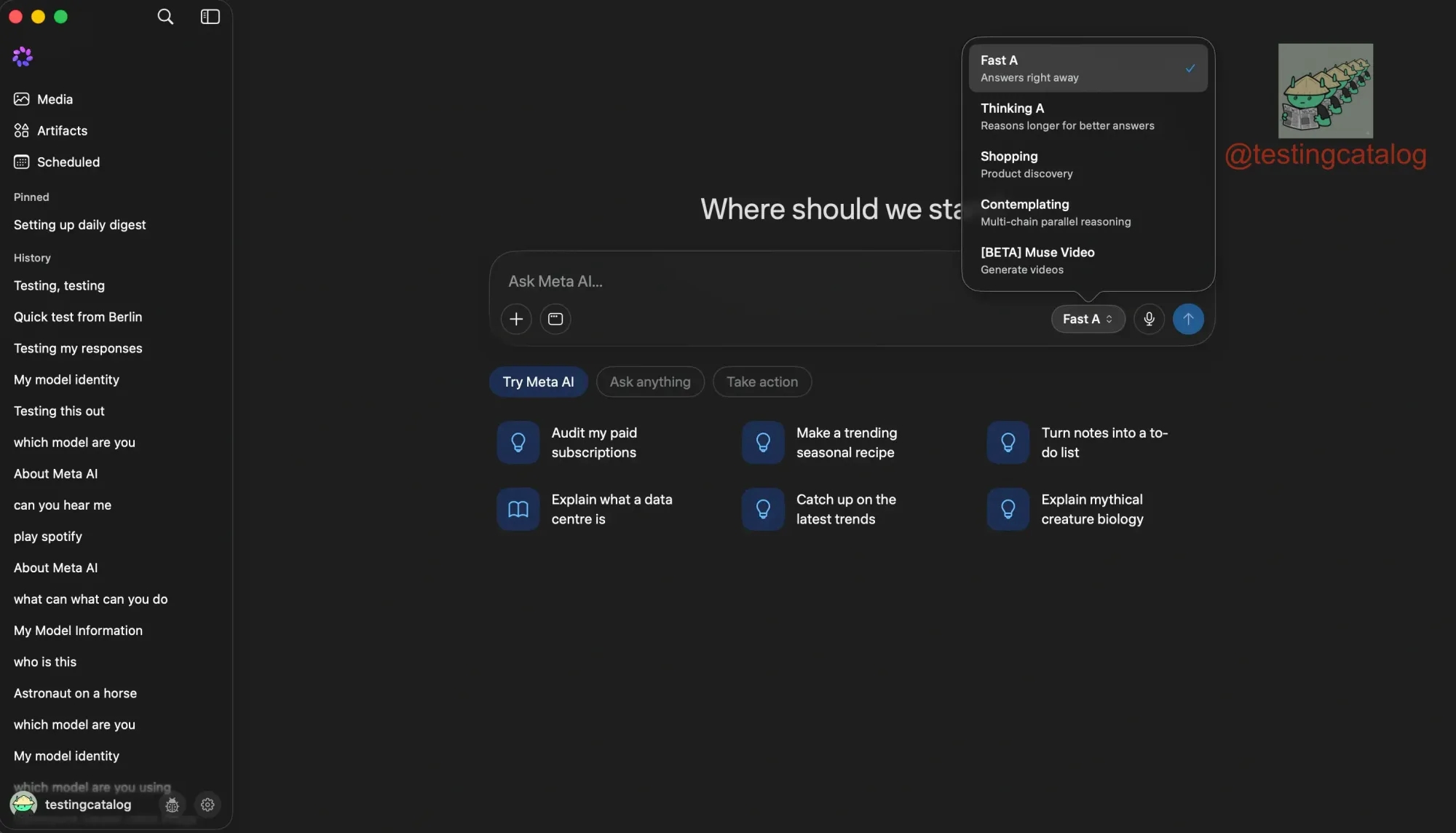
Muse Video beta makes 10-second clips with native audio
Promtime
 meta
metaMeta is testing Muse Video, its upcoming generative video model, in a closed beta with selected partners, and the current build produces clips of 10 seconds that carry native audio. Testingcatalog says it obtained access to the model and ran its own generations through it.
At a glance
- Native audio with voice and music support ships out of the box, though Meta has previously acknowledged remaining gaps around audio-video synchronization and physically accurate fast motion in the model.
- Muse Video was first previewed in July alongside Muse Image, when Meta released initial samples and said the video model would soon become available to creators and Meta AI.
- Testingcatalog rates fine detail, world understanding and temporal consistency as strong in its early generations, and reports that the model is already quite restrictive when prompts touch copyrighted content.
Video generation sits at the centre of Meta's effort to build its own media models and ship them inside products that already run on visual content. Facebook and Instagram give that work a distribution base few rivals can match, which likely matters more than any single quality comparison. The Vibes feed for AI-generated videos and the Edits video creation app both look like natural landing points if the model holds up at scale.
The current build produces 10-second clips with native audio
Muse Video generates 10-second videos in the build Testingcatalog tested, and the outlet describes output quality as remarkably high for that length. Its early generations point to state-of-the-art potential in fine detail, world understanding and temporal consistency, the three areas it singles out.
Meta has confirmed that the model supports native audio, with voice and music included out of the box. The company has also acknowledged that gaps remain around audio-video synchronization and physically accurate fast motion. Testingcatalog also found the beta restrictive when prompts involve copyrighted material.
Muse Video first appeared in July in a preview alongside Muse Image, when Meta published initial samples and said the video model would soon be available to creators and Meta AI. The model carried a Beta label then and still does in the current closed beta.
Sample prompts cover camera moves, dialogue and physics gags
The published set of 12 sample generations leans on camera work and physical interaction: a glass of red wine tipping over on white marble in a static shot, a 180-degree orbit around a chef plating a dish, and car headlights sweeping across a bedroom wall at night.
Others test dialogue and sound, including a man shouting that he is a cat dad while a kitten meows, and a handheld selfie-style clip in which someone asks people on a busy street how they feel about being AI generated, complete with wind noise and a finger over the lens.
Fight and destruction scenes appear as well: two swordsmen in a bamboo forest exchanging three strikes under overcast light, and a rocket launch that ends with the vehicle bursting into confetti. Testingcatalog credits the test prompts to @MarsForTech, @bughuntergeek and @BartokGabi17.
Meta has said Muse Video is coming to Meta AI
Meta has already stated that Muse Video is heading to Meta AI. Muse Image, the image model previewed alongside it, is available there for free everyday creation. Testingcatalog expects Meta.ai and the Meta AI app to be the first destinations for the video model.
Beyond the assistant, Meta runs Vibes, a feed for AI-generated videos, and Edits, its video creation app, alongside the video formats already central to Instagram and Facebook. Testingcatalog notes that Muse Video could later expand across those products, though only Meta AI has been named so far.
Release date and limits unknown
There is no confirmed public release date for Muse Video, and neither pricing nor generation limits has been described. Whether it arrives on the same free everyday-creation footing as Muse Image is open. What the current partner access does establish is that development has moved past the July public preview into working beta testing.
Comments
No comments yet. Be the first.
Join the conversation
Sign in with Google to leave a comment. Your name and avatar come from your Google profile, and the comment appears after moderation.
We only use your name and avatar from Google. We never store your email address.