
anthropic
Wet lab tested 1,320 Claude protein designs blind
Promtime
 anthropic
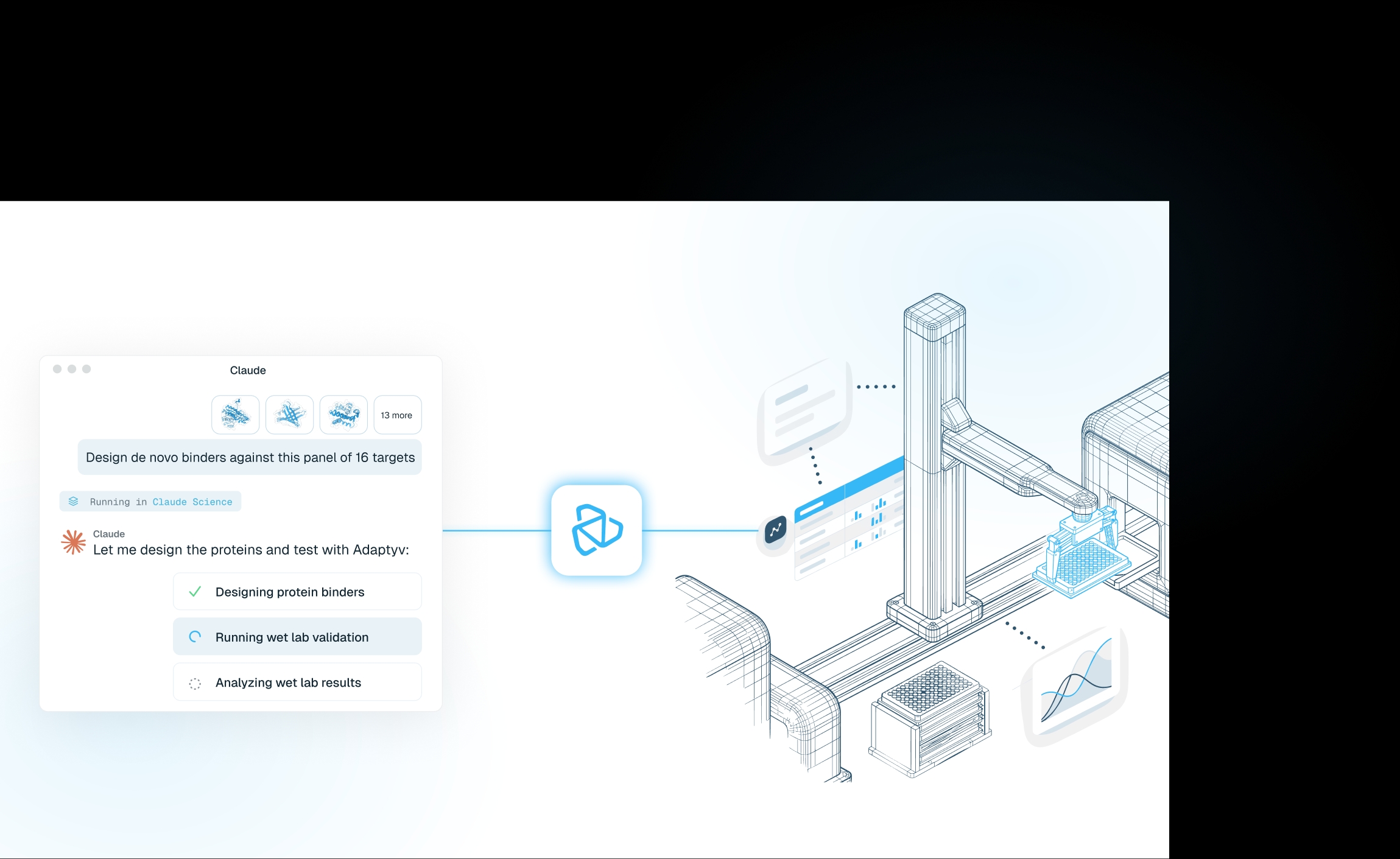
Adaptyv Bio ran 1,320 protein binders designed by Anthropic's Claude Mythos Preview and Opus 4.8 through its automated wet lab, and 354 of them bound their target, an overall hit rate of 26.8%. The designs were submitted anonymized, so the lab did not know which model produced which sequence, Adaptyvbio reports.
At a glance
- Anthropic selected 16 targets from earlier Adaptyv competitions, hackathons and BenchBB, prompting each Claude version through Claude Science with the same publicly available design tools.
- 95% of the designs expressed in cell-free synthesis, and binders emerged against 14 of 15 scored targets; MBP produced none, and GDF-8 mature was excluded over low-quality measurements.
- On TREM2 Claude designs hit 80%, against the 38.3% Adaptyv recorded in its own public competition, and the best binders beat five of six competition winners on affinity.
Protein design tooling has been the bottleneck as much as protein design itself: folding and binder models are notoriously awkward to install and orchestrate. A run in which a general model matches specialist humans at driving those tools reads less like a modeling breakthrough than like a shift in who can operate the stack. The wet lab remains the constraint, and hit rates near 27% still mean most designs fail.
95% of the designs expressed, matching the best rate from Adaptyv's EGFR competition
Adaptyv converts each submitted amino acid sequence into a DNA sequence, assembles the physical DNA in the lab and produces the protein through cell-free synthesis, which runs ribosomes, enzymes, amino acids and an energy supply without a cell around them. Automated workcells handle the pipetting at the small volumes and high throughput the assay requires.
95% of the Claude designs expressed. Adaptyv says that figure matches the best expression rates from its EGFR competition, which drew hundreds of expert protein designers, and exceeds the rate seen in its RBX1 challenge. Binding was then measured on SPR at five target concentrations in duplicate, under Adaptyv's Affinity Characterization assay.
A lower K_D value indicates tighter binding, and Adaptyv processes the raw instrument data with its own software to produce clean K_D values across targets relevant to therapeutic, diagnostic and research work. Binders are proteins meant to stick to one target and nothing else.
Claude's best 15-PGDH binder reached 33.4 nM against 1.7 µM in the competition
Per-target hit rates varied widely. On TREM2, 80% of Claude's designs bound, against the 38.3% Adaptyv reported for the same target in its public competition, and on 15-PGDH the success rate came out more than three times higher than what Proteinbase records. For the comparison, Adaptyv subsetted each competition's results to de novo minibinders only.
On affinity, the best Claude binders beat five of six competition winners. The 15-PGDH binder improved from 1.7 µM to 33.4 nM and the RBX1 binder from 25.7 nM to 3.9 nM, while the winning entry from the Nipah virus competition remained unbeaten. Claude spread its GDF-8, RBX1 and Nipah designs across many epitopes but converged on one for TREM2.
Claude produced binders against 14 of the 15 scored targets, and Adaptyv says the model would have been a prolific entrant in its own design competitions, surpassing every competition hit rate once each run submitted for a target is counted on its own.
Sequences and experimental data are published on Proteinbase
Anthropic and Adaptyv released the protein sequences Claude designed together with the experimental results on Proteinbase, the open protein data platform. Anthropic drew the 16 targets from Adaptyv's earlier public competitions, hackathons and BenchBB, and each Claude version was prompted in the same way through Claude Science with access to the same publicly available tools.
Adaptyv describes the intended workflow as a closed loop: a model reads the literature and sequence databases, builds structures with folding models such as Boltz, generates candidates with design models such as BindCraft, submits the best of them through the lab API, and gets experimental results back within a couple of weeks.
Adaptyv frames the result as evidence of an agentic science loop, in which a model reasons over scientific knowledge, designs molecules with specialised tools, sends them to an automated lab and learns from the returned data. Its lab is on the Biopole campus in Epalinges near Lausanne.
The targets Claude missed
MBP produced no binders at all, and GDF-8 mature was dropped from scoring because the measurements were low quality, likely because the target was aggregating and binding to copies of itself. Adaptyv states plainly that AI does not yet solve diseases and that the case study shows expert-level orchestration of design tools. No further design rounds or timelines were announced.
Comments
No comments yet. Be the first.
Join the conversation
Sign in with Google to leave a comment. Your name and avatar come from your Google profile, and the comment appears after moderation.
We only use your name and avatar from Google. We never store your email address.