
DeepSeek, Kimi models carry Blackwell GPU fingerprint
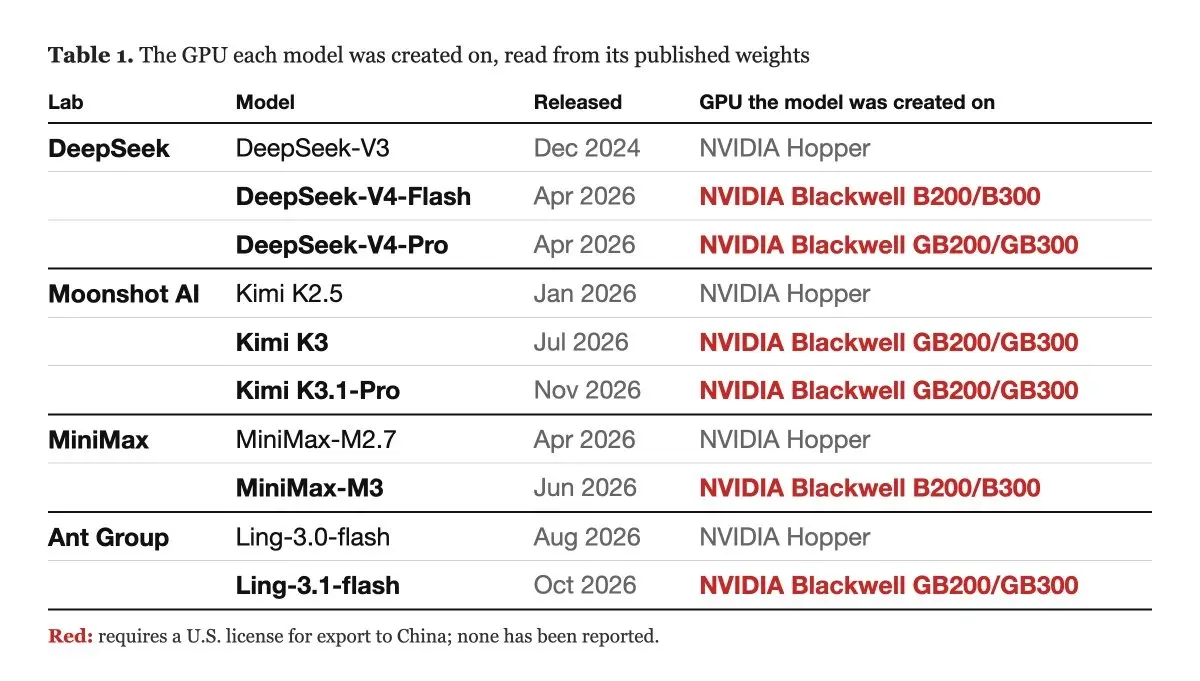
Six open-weight models that DeepSeek, Moonshot AI, MiniMax and Ant Group released since April 2026 were initialized on Nvidia Blackwell GPUs, which need a U.S. license for export to China, says a forensic report from Unemployment Labs revised on November 12. The chip identification is the part that can be checked: it rests only on the labs’ published weights, and the author’s replay, which runs without a GPU, gave us the same chip for every model it covers. The report sets its own limit next to that: the fingerprint supports, without proving, that Blackwell also did the training, and it doesn’t establish where the chips sat, how access was obtained or whether export controls were violated.
The author, former OpenAI researcher DePue, says senior researchers at OpenAI and Anthropic have independently verified the result. U.S. officials and press reports had already alleged that DeepSeek and Moonshot AI were using Blackwell chips, without publishing technical evidence, and on November 12 The Information reported that companies tied to Alice Huang invested in DeepSeek and promised it Nvidia chips.
How a seed gives away the chip
Before training, every weight needs a starting value. In PyTorch those values come from Philox, a generator that turns a seed into the same pseudorandom numbers every time. On Nvidia GPUs PyTorch splits that work across threads through cuRAND, and a large enough tensor gets 2,048 threads per streaming multiprocessor (SM), the chip’s basic processing unit. Hopper chips (H100, H800, H200) have 132 SMs, B200 and B300 have 148, GB200 and GB300 have 152. Keep the seed, change the SM count, and each thread’s numbers land in different positions.
Training overwrites most of those values, but every large model keeps some rows essentially untouched. The report recovers them and searches roughly 6 trillion seed-and-layout combinations for the one that regenerates them. The best chance match would be expected to reach about 8 sigma; the strongest evidence for the six models runs from 49 to 1,385 sigma, and the weakest single test the report gives reaches 20.
DeepSeek’s seed is 953049583, and it used the same one for DeepSeek-V3 and DeepSeek-V4-Flash. V3’s preserved rows regenerate at 132 SMs, V4-Flash’s at 148, and moving the seed by one breaks the match.
The signal needs a big tensor. PyTorch caps the thread grid at the SM count times the number of 256-thread blocks each SM can hold, and the 2,048 comes from the device’s own limit, not from a PyTorch constant. In our emulation, the 132- and 148-SM layouts are identical for the first 270,336 elements, and the 148- and 152-SM layouts for the first 303,104. On a 4,096-wide embedding, the first 66 rows can’t tell Hopper from Blackwell, and B200/B300 separates from GB200/GB300 only from row 74. That is emulated, not measured on a GPU.
The report names one alternative: AMD’s MI300X, also restricted from export to China. Limited to 148 or 152 of its units, a physical MI300X reproduces the layouts the report ties to Blackwell, so the layout alone doesn’t settle the question. For DeepSeek-V4-Flash the report runs a narrower test: in the 377 values where the two vendors’ results differ, the published weight matches Nvidia’s in 363 and AMD’s in none. For the other five models it calls AMD very unlikely.
Which labs switched, and when
DeepSeek-V4-Flash and MiniMax-M3 match the B200 or B300. DeepSeek-V4-Pro, Kimi K3, Kimi K3.1-Pro and Ling-3.1-flash match the GB200 or GB300, the Grace Blackwell parts in Nvidia’s flagship liquid-cooled rack-scale systems, as the author’s announcement puts it. K3.1-Pro starts from K3’s seed and may be a K3 checkpoint with further post-training.
Each lab’s switch is recent. DeepSeek reads as Hopper through V3 (December 2024) and as Blackwell from V4 (April 2026); Moonshot as Hopper through Kimi K2.5 (January 2026) and Blackwell from K3 (July 2026); MiniMax as Hopper through M2.7 (April 2026) and Blackwell from M3 (June 2026); Ant Group’s Ling-3.0-flash (August 2026) as Hopper and Ling-3.1-flash (October 2026) as Blackwell. Kimi K2.7-Code, posted six weeks before K3, sits in between: Hopper-era weights with a small part that matches the B200 or B300. A Hopper reading can’t separate an H800 from an H100 SXM or H200, so the H800 labels in the report’s table are the labs’ own disclosures.
The newest models the report could read from Alibaba (Qwen), Zhipu (GLM), Tencent, Xiaomi and StepFun all read as Hopper. Meituan says LongCat-2.0 was trained entirely on “AI ASIC superpods,” and the report found no Nvidia fingerprint in the weights it released.
On real hardware, the author says, a B300 running unmodified PyTorch reproduced V4-Flash’s untouched starting weights, a rented GB200 reproduced Kimi K3’s to a correlation of 0.999995, and an H100 reproduced none of V4-Flash’s. The method also agreed with the 24 models whose developers have said what hardware they used, among them Nvidia’s Nemotron-3 Ultra: its technical report names the GB200 for one phase of training, and it reads as 152 SMs, like K3.
Thousands of GPUs, give or take
Assuming each model was trained on the hardware that initialized it, the report estimates that Kimi K3 and DeepSeek-V4-Pro needed about 4,500 and 3,000 Blackwell GPUs for two to three months, roughly 11,500 and 7,500 H100 equivalents, and about 12,000 Blackwell GPUs across the five runs it sizes, K3.1-Pro not among them. At roughly $70,000 per GPU, a price implied by a Wall Street Journal report that about 36,000 Blackwell chips being installed in Malaysia for ByteDance’s use would cost more than $2.5 billion, the largest cluster comes to roughly $200 million to $300 million and the five together to “more than half a billion dollars.” Those cover only the final training runs.
“We are not confident in these estimates,” the report says. They assume the GPUs ran at about 20% of peak (25% for DeepSeek), run lengths estimated from release timelines and, outside DeepSeek, token counts from a method the author hasn’t yet published; halving a run’s length doubles its GPU count. At the pace Microsoft reports for MAI-Base-2, 16,000 GPUs in 38 days, the two largest runs would have needed about 8,000 to 9,000 Blackwell GPUs.
In the Wayback Machine we found three versions of the scale estimate within about seven hours (UTC). At 21:56 on November 12, Kimi K3 sat at 2,000 to 3,000 GPUs, at 35% utilization, with $150 million to $200 million for the largest cluster; at 01:57 on November 13, K3 was at 3,400 and the largest cluster “about $200 million”; by 04:57, the current 4,500, 20% of peak and $200 million to $300 million. The first version also tested its arithmetic on DeepSeek-V3, getting 2,000 to 2,500 chips against the 2,048 DeepSeek disclosed, and that check was later removed. The author’s announcement still carries the first version’s 2,000 to 3,000 GPUs and $150 million to $200 million. So the scale estimate has already moved twice, while in our comparison the sections that identify the chips did not change.
Kimi K3’s 4,500 GPUs at $70,000 each come to about $315 million, slightly above the report’s own range. The five best estimates add up to about $840 million, which the report still words as “more than half a billion,” the phrase it used when the first version’s estimates summed to $462 million to $647 million.
Our analysis
What we checked
On November 15 we ran the author’s CPU replay (repo commit b633870c, numpy 2.2.6, about 6.6 seconds for five models), then fetched 1,025 rows of DeepSeek-V4-Flash’s embedding from DeepSeek’s own Hugging Face repo and regenerated them with our own Philox implementation.
The identification held: each model landed on the SM count the report gives, V4-Flash’s evidence rows are DeepSeek’s published bytes rather than anything the author prepared, and a seed off by one gave correlation near zero. The announcement says a B300 matched V4-Flash bit for bit; on a CPU we got about 97% of values bit-identical, so the full-row figure stays the author’s GPU result. And the 24-model agreement is, in the report’s own appendix, “a consistency check rather than a measured accuracy rate”: eleven are step-zero checkpoints, and related models are not independent.
| Model | Seed | SMs | Rows matched | Median r | Seed+1 r |
|---|---|---|---|---|---|
| DeepSeek-V3-Base | 953049583 | 132 (Hopper) | 8/8 | 0.999999 | -0.0038 |
| DeepSeek-V4-Flash | 953049583 | 148 (B200/B300) | 461/469 | 0.999999 | 0.0016 |
| Kimi K3 | 20256586 | 152 (GB200/GB300) | 13/13 | 0.999996 | 0.0042 |
| MiniMax-M3 | 2760 | 148 (B200/B300) | 17/17 | 0.999990 | 0.0017 |
| Ling-3.1-flash-base | 3952 | 152 (GB200/GB300) | 384/384 | 0.983436 | 0.0004 |
- All 469 V4-Flash rows the author lists are byte-identical to our fetch; 461 match at 148 SMs, none at 132, 152 or seed ±1. We found no untouched row the author left out: 13 sit in the first 256 rows of the vocabulary, 448 in the last 512.
- In those 461 rows, 96.85% of values are bit-identical under 148 SMs and 0.09% under 132 or 152, but only 157 whole rows, against 445 the report states on a physical B300. CPU-versus-GPU rounding is our likely explanation, not something we measured.
- Ling’s weaker match the repo README puts down to its imperfect model of
trunc_normal_. - In 256 ordinary trained V4-Flash rows (50000 to 50255), none untouched, the pooled correlation with the regenerated starting values is +0.026 under 148 SMs, about 26.6 times the naive error, against -0.6, -1.4 and +0.6 times under 132 SMs, 152 SMs and seed+1. That is one block of one tensor.
Up next
Claude Code 2.1.325 adds Bash prompts, fixes security gaps
In Claude Code 2.1.325, sandboxed Bash commands ask for permission by default, and running them prompt-free takes sandbox.autoAllowBashIfSandboxed set to true. Is your sandboxed Bash set to run without prompts or to ask every time?
Related stories
- Bloomberg: OpenAI backs bills to cut China’s AI chip access
- DeepSeek, Moonshot reportedly distilled GPT-6 Astra
- DeepSeek open-sources DeepInfer with Huawei Ascend support
- Muse Spark Open fits on two Mac Studios with a terabyte
- Surface Laptop Ultra slows down on local AI once unplugged
- Perplexity runs its agent locally on Windows RTX cards
Comments
No comments yet. Be the first.
Join the conversation
Sign in to leave a comment. It appears after moderation.