
developer-tools
Cursor's new coordinator agent writes no code itself
Promtime
 developer-tools
A lint rule appears the second time the same mistake does. That is one of the standing jobs inside Cursor's internal design-system Project, which the company expects to touch 20 to 100 pull requests a day, and it runs on Projects, the agent-coordination beta Cursor announced on September 10 and covered by Testingcatalog.
At a glance
- Projects sits in Cursor's left-hand navigation and coordinates long-running software work across thousands of delegated agents, aimed at multi-PR features, broad migrations, whole applications and recurring upkeep.
- Cursor says new Projects users merge 30% more PRs, and people who make Projects their primary workflow merge six times as many; internally it has run for several months, including migrations across hundreds of PRs.
- Cursor gives no baseline for those merge figures, no pricing for the cloud machines that keep agents running, and no date for when the beta ends.
If you have not followed Cursor: by Curo's account it began in March 2023 as a fork of Visual Studio Code rather than an extension, so the AI could reach the whole codebase, and its 2026 Background Agents already worked in a separate cloud VM and pushed a pull request. Anysphere, Cursor's parent, is now a SpaceX subsidiary after an all-stock deal worth 60 billion dollars closed on August 14, 2026.
The coordinator plans and dispatches, and writes no code itself
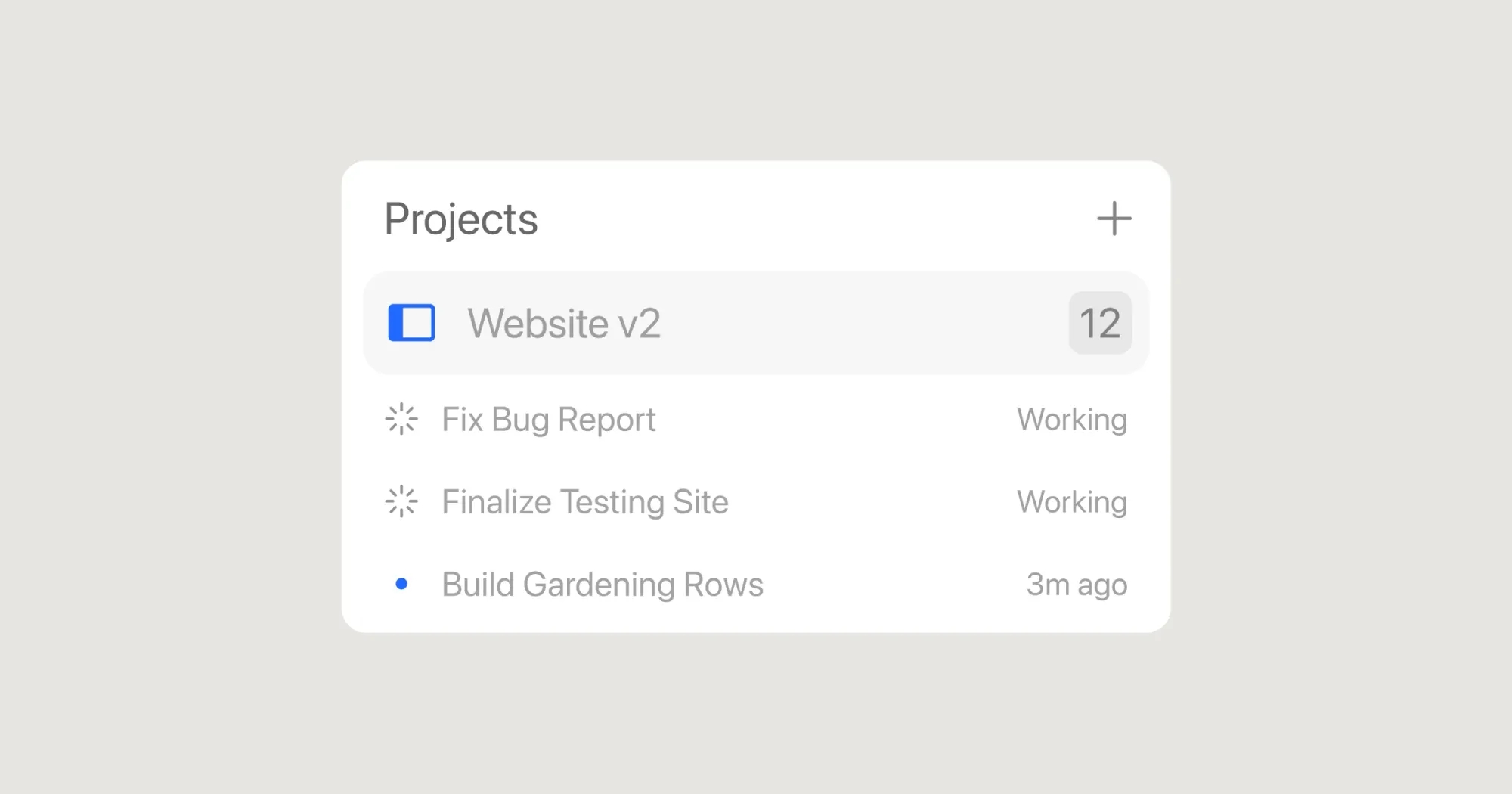
Projects sits in Cursor's left-hand navigation, and each one is led by a coordinator agent. You describe what you want built; the coordinator plans the work and dispatches it to coding agents rather than editing files itself. Cursor says that split keeps the coordinator responsive while other agents research, implement and test in parallel, across what the company calls thousands of delegated agents.
The targets are jobs that do not fit inside one chat: features spanning several pull requests, broad migrations, whole applications, and recurring maintenance that continues after a conversation ends. A Project can set reminders, run scheduled tasks, follow pull requests to fix CI issues, and watch Slack for bug reports.
The work runs on Cursor's cloud machines, not on your laptop
Projects get their own cloud computers. Work keeps going after you close the laptop, and more agents can run at once than a local machine would allow. When something has to be tested on a developer's own hardware, the coordinator can start a local agent for that piece.
Shared files sync between the Project's cloud machines and the local ones, carrying research, artifacts, codebase knowledge, testing instructions and developer preferences into later tasks. Subscriptions turn a Project into a standing operator: it can watch Slack, run on a schedule, or follow pull requests and respond when they open or merge, fixing CI along the way.
Cursor names three patterns it sees in use: feature development, incremental migrations, and «gardening» work such as code-quality upkeep and regression monitoring. The beta is rolling out to all Cursor users, with the coordinator taking over once you have described what to build.
New Projects users merge 30% more PRs, Cursor says
Cursor has run Projects internally for several months: migrations covering hundreds of pull requests, design-system maintenance, and the development of Projects itself. According to the company, new Projects users merge 30% more pull requests, and people who rely on Projects as their primary workflow merge six times as many.
The internal design-system Project is the sharpest example of the shape this takes. Cursor expects it to touch 20 to 100 pull requests per day, scanning incoming changes, extracting reusable components out of them, and adding a lint rule when the same mistake appears twice.
Why does the coordinator hand off work instead of writing it?
Because of how supervisor architectures behave. In LangChain's description of the pattern, a supervisor agent calls specialized subagents as tools: the main agent holds the conversation context while subagents stay stateless, which isolates context, routes every decision through one place, and allows several subagents to be invoked at once.
Think of a shift supervisor who keeps the whole job in her head and hands each worker one sheet of instructions. The worker never needs the rest of the plan, so nobody's attention gets crowded out. LangChain cites research in which a lead Claude Opus 4 agent with Claude Sonnet 4 subagents outperformed single-agent Claude Opus 4 by 90.2% on internal research evaluations.
The bill for that design, by LangChain's account, is one extra model call per interaction, because results must flow back through the main agent: latency and tokens traded for central control. Compute is the other input. By Valueaddvc's account, Cursor's place inside SpaceX gives it access to the Colossus supercomputer, reported at roughly 200 000 Nvidia GPUs and scaling toward one million.
Cursor publishes the merge figures without a baseline, a sample size or a time window, and says nothing about what the cloud machines cost or how many agents one Project can run at once. In our view the design-system example is the honest tell: a Project expected to touch 20 to 100 pull requests a day moves the bottleneck to review, and the announcement does not say who does that reviewing.
When the beta label comes off
No date has been given for general availability, and no pricing has been named for the cloud machines the coordinator runs on. Two things are worth watching once outside teams drive it: whether the design-system Project holds 20 to 100 pull requests a day in other people's repositories, and whether the 30% merge figure survives codebases Cursor did not write itself.
Comments
No comments yet. Be the first.
Join the conversation
Sign in with Google to leave a comment. Your name and avatar come from your Google profile, and the comment appears after moderation.
We only use your name and avatar from Google. We never store your email address.