
Gemini 4 Argon reportedly lands in Antigravity for Pro users
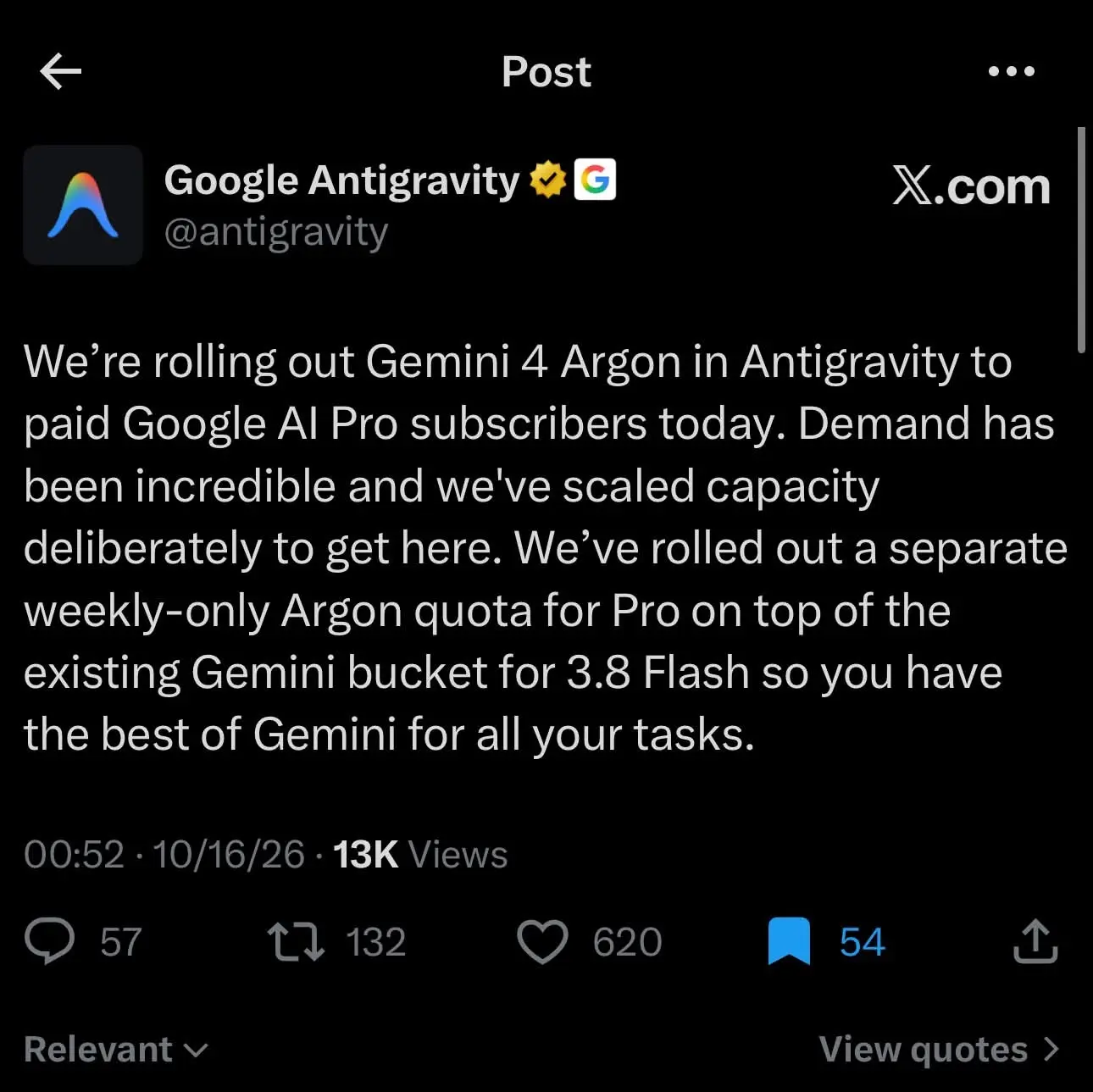
"A new dedicated weekly quota, specifically for Argon model." That line, from a post claiming Gemini 4 Argon is rolling out to Google AI Pro subscribers in Antigravity, is the detail that matters most here, and also the one nobody has measured yet.
The claim comes from a post on Threads. The post gives no quota size, no rollout schedule and no comment from Google. It does say the move came quickly, and the dates support that: Google announced Argon on September 30 and put it on the paid tier of the Gemini API on October 13.
At a glance
- A Threads post says Gemini 4 Argon is rolling out to Google AI Pro subscribers in Antigravity, with a weekly quota reserved for Argon alone.
- The post gives no size for that quota.
- Google's current Antigravity documentation names Gemini 3.8 Flash as a core agent model and does not mention Gemini 4 or Argon at all.
Google's Antigravity documentation does not mention Argon yet
The Antigravity docs list Gemini 3.8 Flash as a core agent model. A pricing write-up by Justin McKelvey agrees, listing Gemini 3.8 Flash as added September 1 to a lineup that also includes Gemini 3.1 Pro, Claude Sonnet and Opus 4.6, and gpt-oss-120b. Neither page names Argon. Our short item noted that Google's official materials describe Argon as rolling out, but they don't confirm Pro-tier access in Antigravity or the separate quota. Those two specifics rest on the Threads post alone.
One caution about reading too much into a missing name: docs often trail a staged rollout by days. So the docs don't contradict the post. They simply don't back it up yet.
How would a separate Argon quota fit Antigravity's plans?
Quite naturally, on paper. According to Google's Antigravity docs, quota is already tracked per model. Pro subscribers get "a high, generous quota, refreshed every five hours until the weekly limit is reached" plus "a higher weekly rate limit". Ultra gets the highest quota and weekly limits along with third-party models, and users on neither plan get "a meaningful quota, refreshed weekly". The same docs say limits "correlate with the amount of work done by the agent", so a complex task burns more quota than a simple one. Limits depend mainly on available capacity and are "subject to modification".
Google's docs also describe the overflow valve. Pro and Ultra users can buy AI credits for usage beyond the baseline quota, and an "AI Credit Overages" setting (Never or Always) decides whether credits are spent automatically once a model's baseline runs out. McKelvey puts top-up credits at $0.01 each and reports AI Pro at $20 a month and AI Ultra at $249.99 a month, the latter not printed on Google's own page. He also writes that Antigravity became "Generally Available" after a September 10, 2026 update, with a $0 Individual plan on "basic weekly rate limits".
None of the documented tiers comes with a number. That gap is the main thing we hold against the plan: a dedicated Argon pool of unknown size, on top of five-hour refreshes and a weekly ceiling of unknown size, gives a Pro subscriber no way to plan a week of agent work around it.
Quota changes in Antigravity have gone badly before
Antigravity launched on November 18, 2025, alongside Gemini 3, as a free public preview with "generous rate limits" on Gemini 3 Pro that refreshed every five hours, according to Wikipedia. The same entry says Google raised limits for AI Pro and Ultra subscribers in December 2025 and moved free users to a weekly limit. It traces the product back to July 2025, when Google hired Windsurf CEO Varun Mohan and co-founder Douglas Chen and paid $2.4 billion to license Windsurf's technology. Antigravity 2.0, a standalone desktop agent app with a CLI and SDK, followed in May 2026.
Spring 2026 was rough. An analysis on the Apiyi blog dates an AI Credit system ($25 for 2,500 credits) to 2026.03.11. It reports complaints that the Pro "5-hour refresh" behaved like a weekly one, multi-day Pro lockouts from 2026.03.12, and sudden limits for Ultra users from 2026.03.18+. A March 14, 2026 piece on Claude-world said AI Pro subscribers at $20 a month reported 5–7 day lockouts after hitting vaguely defined weekly limits, and noted Google's habit of saying "high", "generous" and "meaningful" instead of giving figures. Both are third-party accounts.
Argon moved from announcement to the API to Antigravity in about two weeks
On September 30 we reported Google's launch table, where Argon led or tied in 13 of 18 tests and the output cap was given as one million tokens. On October 8 we wrote that Argon was still in limited preview for vetted cyber defenders with no public release date. By October 13 it was live on the paid tier of the Gemini API, with the 1 million tokens recast as a shared input/output budget and introductory pricing of $2 per million input tokens and $10 per million output through November 30. The same day, a Threads post put Argon fifth on Arena's overall ranking. Until this week, every route to Argon we had covered went through the paid API.
What we don't know
- How large the Argon weekly quota is, and whether it follows the five-hour refresh pattern Google documents for Pro.
- Whether Argon usage also draws down the general Pro weekly limit, or only its own pool.
- Whether AI credit overages apply to Argon once its quota runs out, as the docs describe for other models.
- What Ultra subscribers and users on the free Individual plan get, since the post mentions only Pro.
- How far the rollout has reached; "rolling out" says nothing about timing or regions.
For now the rollout itself looks more solid than the quota claim. Argon's quick path through the API makes an Antigravity release plausible, and per-model quota tracking already exists in Google's docs. The size of Argon's reserved pool is the open question, and on Google's track record we would expect it to stay unpublished. If you're on Pro, the quick test is to open the model picker and see whether Argon shows up with its own meter.
Up next

GhostAction digs deleted API keys out of Git history
A workflow called "Security Audit" combed Git history for deleted keys in more than 30,000 GitHub repos, GitGuardian says, pushed from about 1,900 hijacked accounts. When you delete a leaked key from a repo, do you rotate it too, yes or no?
Related stories
- Gemini 4 Argon's 1M tokens now cover prompt and answer
- Gemini 4 Argon wins at office work and trails in coding
- Google's Nano Banana 2.1 costs $0.076 per 4K image
- Gemini 3.7 Flash lands at half the price of 3.6 Flash
- Krea 3 edits a 2K image in under 8 seconds
- Gemini 4 Argon lands fifth on Arena, behind Opus 5.5
Comments
No comments yet. Be the first.
Join the conversation
Sign in to leave a comment. It appears after moderation.