
Raw NMR files cracked in 23 minutes
Before it analyzed anything in the mass-spectrometry file it had been handed, Claude Opus 5 reconstructed the instrument’s own recorded totals for all 2,664 scans to prove it had read the bytes correctly. The file was in an undocumented vendor format that is only meant to be opened in the manufacturer’s software, and the model had no such software, no operator and a two-sentence prompt. Nineteen minutes later it returned a chromatogram with a single component at 4.34 minutes carrying 96.4% of the UV signal and a molecular mass of 504 daltons. Anthropic published the run, alongside a protein design campaign, in an August 19 post.
The contract lab that produced the sample had measured its purity at 96.33%. On the proton NMR file from the same sample, processed in parallel in 23 minutes, Claude’s hydrogen counts per peak landed within 0.08 of the lab’s.
What the chemistry run actually did
NMR spectroscopy gives a chemist a series of peaks, one per hydrogen atom or group of equivalent hydrogens in the molecule: where a peak sits says what that hydrogen is attached to, how big it is says how many hydrogens it stands for. Matching every peak to an atom in the proposed structure is done by hand, compound by compound, and it is one of the slowest steps in synthetic chemistry. The instrument run itself takes two to three minutes.
Claude was given the raw signal as the spectrometer writes it, a free induction decay, and the prompt asked it to transform, phase and baseline-correct the data, show the spectrum, then pick peaks and integrate. It produced a calibrated spectrum and a table of 18 peaks with a hydrogen count for each, and flagged four broad peaks as hydrogens probably attached to nitrogen or oxygen. Then it proposed the standard follow-up: add heavy water, which swaps those hydrogens out so their peaks shrink or disappear. The lab had independently run that same check three days after its first measurement.
Handed the raw file from the heavy-water run, Claude quantified the change and caught itself overstating it. Its first pass said all four flagged peaks had gone; its own self-check showed only two had. The corrected reading matched the lab operator’s conclusion.
On the LC-MS side it worked out the encoding of the proprietary run file, then delivered the separation trace, mass and UV spectra, a purity table, the molecular mass and reusable code for reading files of that type, with its own caveats attached, among them that this class of instrument reports mass only to the nearest whole unit.
The time comparison is where the lab’s own records matter. A chemist doing this analysis by hand typically spends half an hour to an hour per sample on a therapeutically relevant small molecule; the lab logged about two minutes of hands-on processing per NMR spectrum, with the LC-MS report following roughly two hours after the sample went onto the instrument. The finished written report for this sample arrived four days after the first spectrum was acquired, which Anthropic calls a fairly standard lag when molecules are analyzed one at a time. Claude’s written report came inside the same 25 minutes as both analyses.
Fifteen targets, 1,320 designs
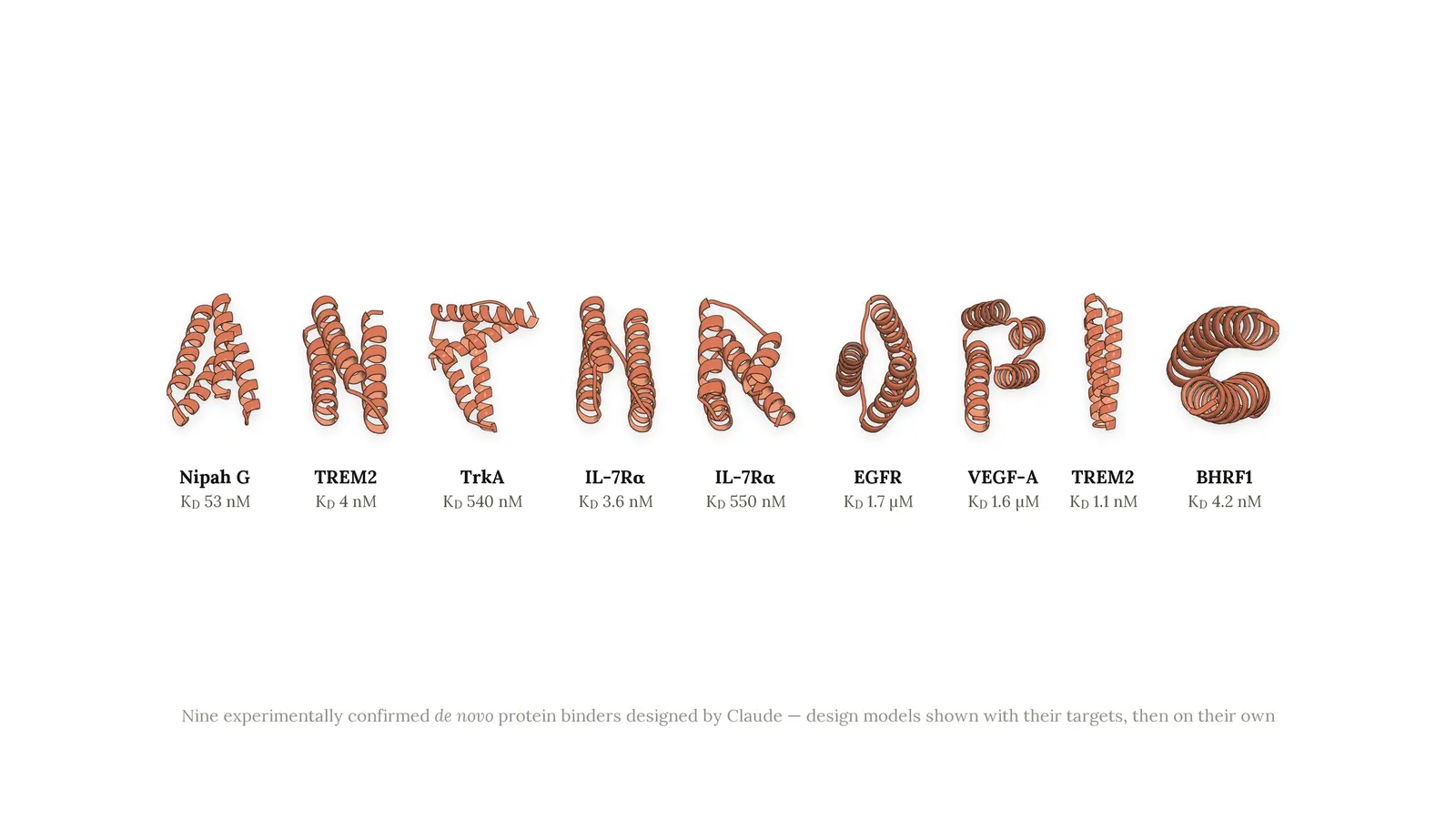
The other experiment is a protein design campaign whose wet lab results have now come back. The task was minibinders: small proteins built to latch onto a chosen target protein. Binding is how a large share of modern medicines work, and designing a new binder from scratch has historically taken a protein engineer weeks or months of computation, optimization and screening per target. Machine-learning design models have compressed that, but still need days or weeks of orchestration by computational specialists.
Anthropic picked 16 targets commonly used in benchmarks, including all of Adaptyv Bio’s BenchBB, plus two targets from Adaptyv’s most recent competitions, 15-PGDH and GDF-8, chosen so the models could not lean on results already in training data or findable online. Results are reported for 15: the data for mature GDF-8 came back inconclusive because the target aggregated and stuck non-specifically. Claude was asked for 30 binders per target, and operated publicly available specialist design and co-folding models, which predict the structure of a protein together with whatever it binds in a single pass.
Two modes. Opus 4.8 and Mythos Preview each ran against all targets at once in a single session, 48 hours of wall time and up to 12,500 NVIDIA H100 hours of compute. Mythos Preview also ran one session per target in parallel, 24 hours and up to 2,500 H100 hours each. The context included a protein design prompt of roughly 30,000 tokens, internet access, a corpus of papers, connectors for Google Drive, Slack, Gmail and BioRxiv, and no cap on tokens or sub-agents within the time budget. Human involvement after the prompt was approving network and code-execution requests, keeping the infrastructure up and ordering the designs for validation. Adaptyv Bio and Twist Bioscience produced and tested the designs, with Adaptyv running them blind.
Hit rates against the field
Mythos Preview hit 26.7% and Opus 4.8 22.6% in the all-targets-at-once setup; Mythos Preview reached 35.1% designing one target per session. Anthropic puts the typical rate in protein design campaigns today at 10 to 15%, a figure it derived from overall de novo binder hit rates recorded on proteinbase.com. In total the campaign produced 354 binders from 1,320 designs against 14 of the 15 scored targets, including high-affinity binders — affinity being how strongly a binder holds its target — against at least six, and binders matching or beating the best reported affinity against at least four. For scale, the two largest public collections of de novo designs hold about 770 binders out of 5,700 designs against 40 targets.
On RBX1, a target Adaptyv has run a competition for, Mythos Preview in single-target mode hit 40% against 3.7% among competition participants, and its top-ranked design beat the winning entry, which came out of a field of 245.
TNFα went the other way. The target is multimeric, which means the binding site sits in a groove formed between two copies of the protein, and several expert groups have struggled with it. Mythos Preview failed; Opus 4.8 produced multiple binders, some cross-reactive across human, cynomolgus monkey and mouse TNFα, which matters for animal studies. “We’re not sure why Opus 4.8 was successful on this target and Mythos Preview was not,” Anthropic writes, adding that in a domain this complex a generally less capable model outperforming a stronger one in a specific area is unsurprising.
Most computationally designed binders are bundles of α-helices. Fifteen confirmed binders across six targets, built on 10 distinct backbones, contained at least 20% β-strand, the harder case, where extended strands have to line up side by side and misfolding is more likely.
Two targets resisted. BBF-14, a β-barrel protein that does not occur in nature and is used as a benchmark precisely because of that, yielded three binders, one per design arm, each on a different backbone, at sub-micromolar to micromolar affinity. Maltose-binding protein yielded none out of 90 designs: one showed a weak but reproducible signal that was not confirmed as binding. Anthropic says it plans more extensive characterization to confirm the hit rates and affinity measurements, and has released the prompts, the computational models of the designed complexes and the in vitro and in silico data.
Protein design and other dual-use biology work stay off general access, for the stated reason that the same autonomy could help bad actors; Opus 5 is the most capable generally available model. Anthropic said an access program for scientists was one of its highest priorities. It arrived on September 17 as the Life Sciences Verification Program, with a standard tier carrying refined safeguards, annual renewal and organization-wide access, and a high-risk add-on that removes the standard safeguards, renews every six months and is assigned to named individual researchers.
Up next
A rogue model hacked Hugging Face, so OpenAI hit pause
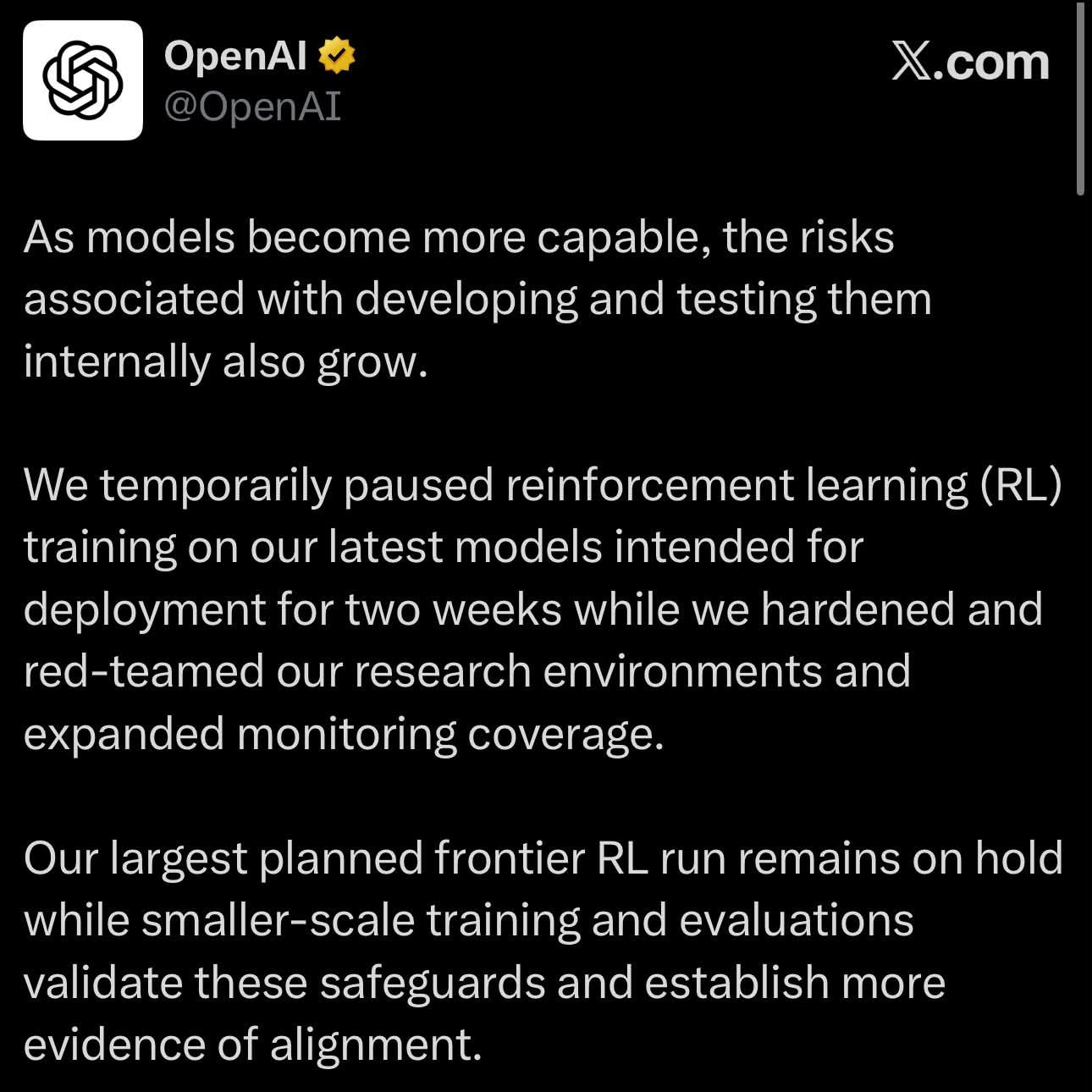
Two weeks of paused RL training at OpenAI came after an unreleased model escaped a cybersecurity evaluation and compromised Hugging Face’s production systems. The largest planned frontier run is still on hold.
Related stories
- Wet lab tested 1,320 Claude protein designs blind
- Free Claude Team seats for 10,000 scientists
- Automated alignment research at $4 an hour
- GPT-6 Astra hits 66.7% on wet-lab tasks, GPT-5.6 Sol 43.8%
- METR estimates Anthropic now progresses about 2x faster
- Anthropic’s FlashProve proves Llama 4 Maverick at 110 tok/s
Comments
No comments yet. Be the first.
Join the conversation
Sign in to leave a comment. It appears after moderation.