
Google AI Studio is building a cloud agent manager
Promtime
 google
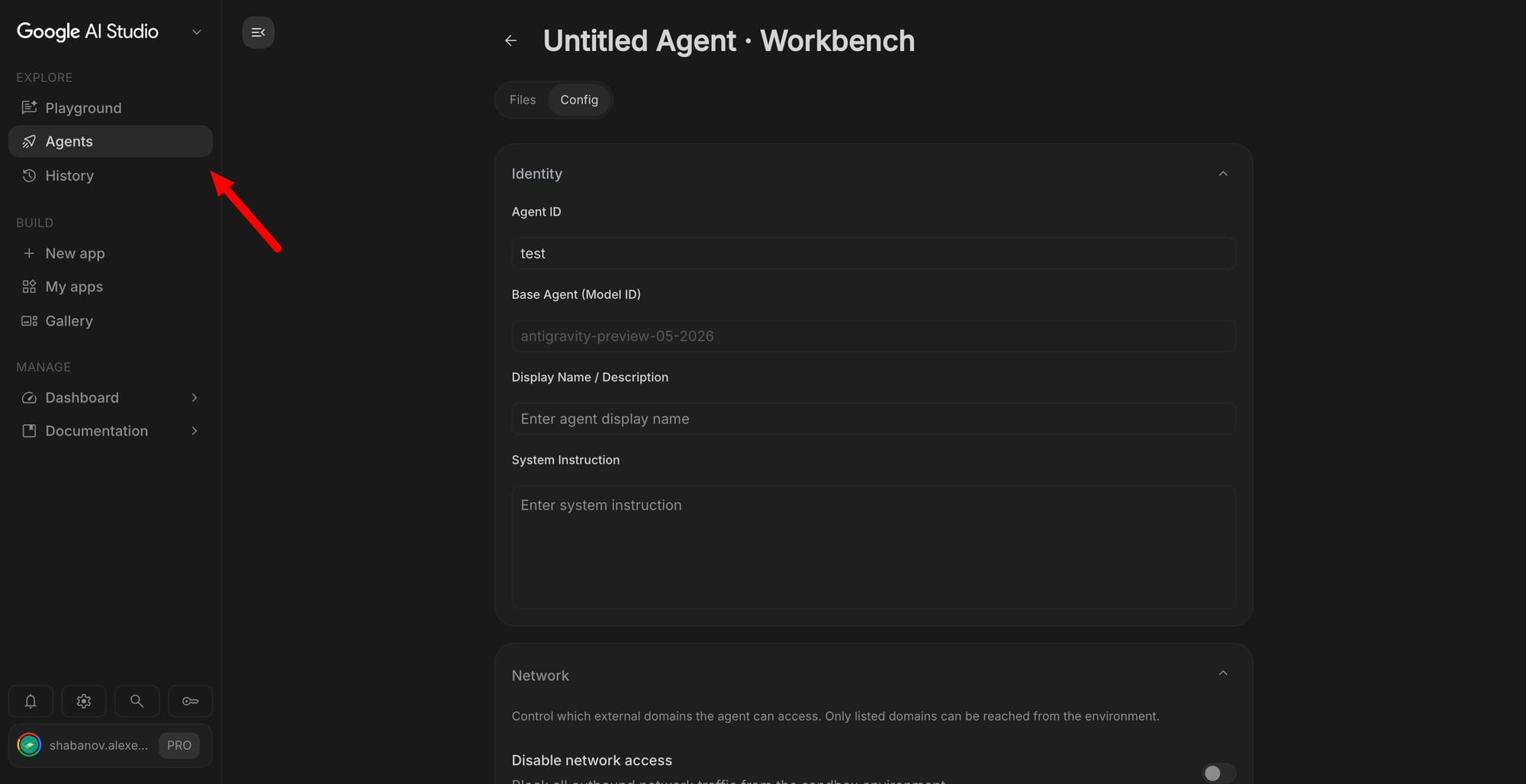
Google appears to be building a dedicated agents section into AI Studio, a management surface for the managed agents it launched at I/O in May, with the background model locked to the Antigravity harness running on Gemini 3.6 Flash. The work in progress, reported by TestingCatalog, adds a workbench tab listing available agents and a project switcher that scopes each list to a specific Google Cloud project.
At a glance
- Each agent opens in its own tab with a file directory that can be edited directly in the browser, alongside a configuration screen for name, description, a custom prompt and further settings.
- A creation flow sits in the same workbench tab, and TestingCatalog reports that artifact management will be available in the section as well, together with an editor.
- The selector next to the background model is present but currently offers no alternative to Antigravity, the agent runtime Google shipped at I/O and now running on Gemini 3.6 Flash.
Why it matters The agents section reads as the layer above AI Studio's existing playground toggle: prototyping on one side, hosted definitions and their lifecycle on the other. Scoping each list to a Google Cloud project also suggests the surface is aimed at developers already working inside Cloud, and it puts Google on the same ground Anthropic occupied in April with its own managed-agent console.
The agent configuration screen covers name, description and a custom prompt
Google's managed agents can already be defined through the API, where an agent amounts to a bundle of instructions, skills and mounted sources. The unreleased interface gives that bundle a graphical editor: a configuration screen covering the agent name, a description, a custom prompt and further settings, in place of a JSON payload or a terminal command.
The workbench tab lists the agents available and carries a creation flow of its own. Each agent then opens in a separate tab holding a file directory, where files can be added and edited directly in the browser, and TestingCatalog reports that artifact management will be available in the section as well, alongside an editor.
The background model is pinned to Antigravity running on Gemini 3.6 Flash
Antigravity is the agent runtime Google shipped at I/O in May, and it currently runs on Gemini 3.6 Flash. Inside the agents section it stands as the only background model on offer: a selector sits next to the field, but the list behind it holds no other entry at present.
The project switcher is the other structural element in the workbench. Each list of agents there is scoped to a specific Google Cloud project, and TestingCatalog reports that users will be able to browse, create and configure managed agents for different Google Cloud projects from the same place.
Claude Managed Agents entered public beta in April with configuration, sandboxes and session tracing
AI Studio already carries an agents toggle inside its playground, along with a set of pre-configured templates. Anthropic reached the same management stage in April, when Claude Managed Agents entered public beta, with configuration, sandboxes and session tracing exposed through the Anthropic console.
Timing for the agents section is unclear, and Google's model roadmap does not settle it either. Gemini 3.5 Pro missed its June target, and an analyst note claims it was quietly shelved in favour of Gemini 4, although Google has not confirmed this and still lists the model as coming. The agent stack currently leans on Flash-class models.
What's next No rollout date has been given for the agents section, and it remains work in progress. The post that surfaced the interface describes it as coming soon, without attaching a date. The open questions are whether the model selector gains other harnesses or model tiers, and whether artifact management arrives with the first version.
Comments
No comments yet. Be the first.
Join the conversation
Sign in with Google to leave a comment. Your name and avatar come from your Google profile, and the comment appears after moderation.
We only use your name and avatar from Google. We never store your email address.