
anthropic
Raw NMR files cracked in 23 minutes
Promtime
 anthropic
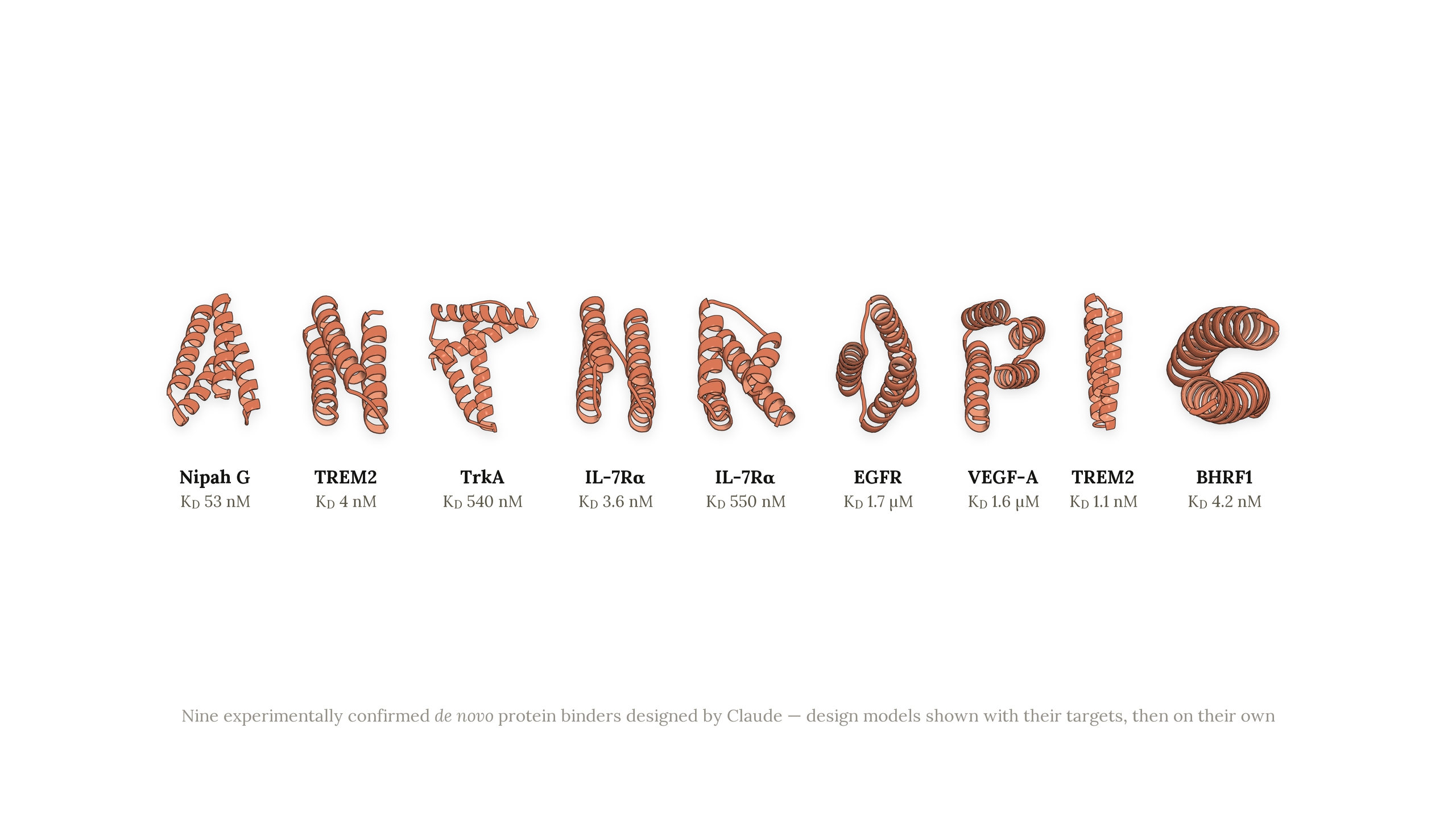
Claude designed protein binders against 15 targets and produced confirmed binders for 14 of them, with Mythos Preview reaching a 35.1% hit rate when working one target at a time, against the 10 to 15 percent typical in protein design campaigns today. Anthropic published the wet lab results together with the campaign prompts and all in vitro and in silico data.
At a glance
- Claude orchestrated public structure design, sequence design and co-folding models, chose the binding sites itself, and ran in silico optimization, with humans only approving access requests and ordering designs for validation.
- The campaign produced 354 confirmed binders from 1,320 designs; Adaptyv Bio and Twist Bioscience independently produced and tested them, with multi-target runs reaching 26.7% for Mythos Preview and 22.6% for Opus 4.8.
- On the chemistry side, Claude Opus 5 processed raw NMR and LC-MS files in 23 and 19 minutes, work that normally takes a chemist half an hour to an hour per sample.
The result that matters here is less any single binder than the removal of an orchestration layer: the days or weeks of expert setup that specialist design models normally require. Anthropic reports the campaign ran with no scientific guidance after the initial prompt, which reads as a shift in where the bottleneck sits, from computational skill toward wet lab validation and the policy and operational constraints the lab itself names as the larger drag on drug development.
Mythos Preview reached a 40% hit rate on RBX1 against 3.7% among competition entrants
The campaign ran in two modes. In multi-target mode, Opus 4.8 and Mythos Preview designed against all targets in a single 48-hour session with up to 12,500 NVIDIA H100 hours; in single-target mode, Mythos Preview ran a parallel 24-hour session per target with up to 2,500 H100 hours each. Claude was asked for 30 binders per target.
Targets included Adaptyv Bio's BenchBB set plus two newer targets, 15-PGDH and GDF-8, chosen so results could not draw on training data or online search. Against RBX1, Mythos Preview in single-target mode reached a 40% hit rate compared with 3.7% among participants in Adaptyv Bio's competition, and its top-ranked design was a high-affinity binder that outperformed the winning entry among 245 designs.
Opus 4.8 succeeded on TNFa where Mythos Preview did not
On TNFα, a multimeric signaling target that requires binding in the groove formed by two protein chains, Opus 4.8 designed multiple binders, some of them cross-reactive across human, cynomolgus monkey and mouse. Mythos Preview failed on the same target, and Anthropic says it does not know why.
Claude also produced 15 confirmed binders containing at least 20% β-strand across six targets and 10 distinct backbones, a fold class harder to design than the usual α-helical bundles. It failed elsewhere: none of the 90 designs against maltose-binding protein was confirmed as a binder, though one gave a weak, reproducible signal, while BBF-14 yielded three binders with sub-micromolar to micromolar affinities.
Claude Opus 5 returned 96.4% purity against the lab's 96.33%
Claude Opus 5, working in Claude Science, was given a contract lab's raw files for a routine quality-control sample and a short plain-language prompt, with no vendor software and no operator. It returned processed NMR and LC-MS results in 23 and 19 minutes, in parallel, with hydrogen counts per peak within 0.08 ¹H of the lab's.
For the NMR file it produced a calibrated spectrum and a table of 18 peaks, flagged four broad peaks as hydrogens probably bound to nitrogen or oxygen, and proposed a heavy-water check the lab had independently run three days later. On the follow-up file it corrected its own first reading, which had reported all four peaks vanishing when only two had.
The LC-MS run arrived in an undocumented vendor binary format. Claude worked out the encoding and reproduced the instrument's own recorded totals for all 2,664 scans before analyzing anything, then reported a single component at 4.34 minutes carrying 96.4% of the UV signal and a molecular mass of 504 daltons.
Access program still undated
Anthropic says life science research tasks remain blocked in its most capable model, and that protein design and other dual-use biology capabilities are not available for general access; an access program for scientists is described as a high priority, though no date or eligibility criteria have been given. Anthropic also plans more extensive characterization to confirm the reported hit rates and affinity measurements.
Comments
No comments yet. Be the first.
Join the conversation
Sign in with Google to leave a comment. Your name and avatar come from your Google profile, and the comment appears after moderation.
We only use your name and avatar from Google. We never store your email address.