
New model BDH-CQ costs $0.007 per task 11x less than OpenAI Luna even w 80% off
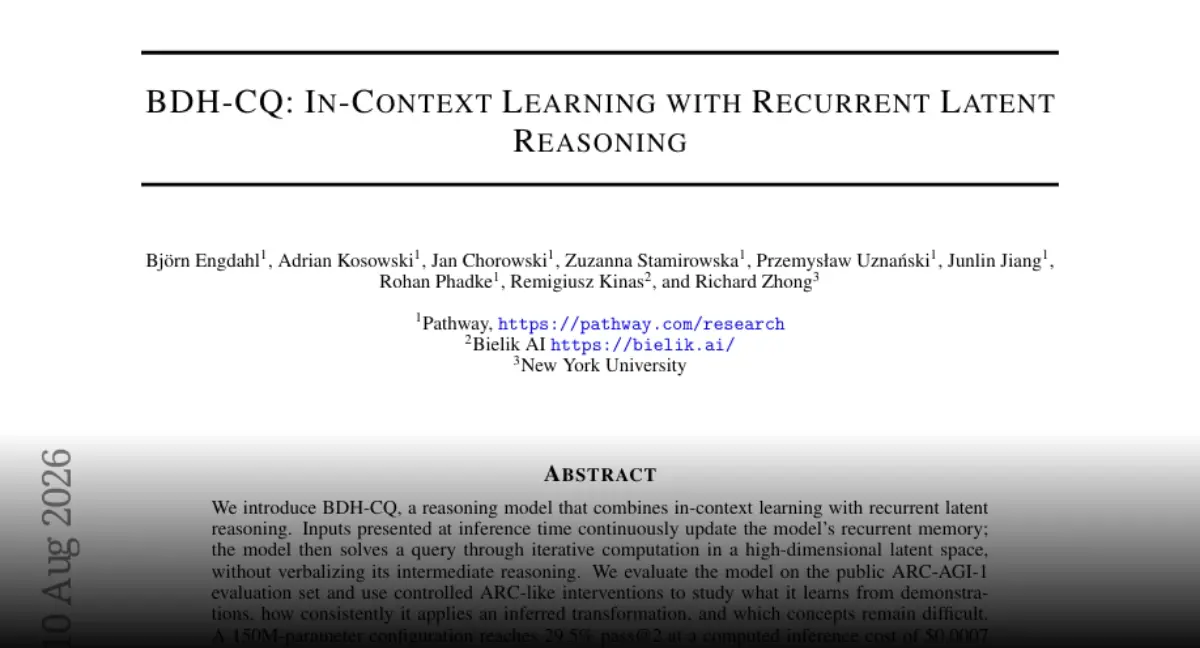
A 150M-parameter reasoning model called BDH-CQ reached 29.5% pass@2 on the public ARC-AGI-1 evaluation set at a computed inference cost of $0.0007 per task. The result comes from a preprint whose paper page is hosted on Huggingface, and it is presented as a new operating point on the benchmark's cost-accuracy curve.
At a glance
- The architecture pairs in-context learning with recurrent latent reasoning: demonstration examples supplied at inference time continuously update a recurrent memory that the model then queries through iterative computation.
- The authors describe that operating point as breaking through the previously reported ARC-AGI-1 cost-accuracy Pareto frontier, which they present as a new state of the art in benchmark cost efficiency.
- Alongside the public benchmark, controlled ARC-like interventions probe what the model extracts from demonstrations, how consistently it applies an inferred transformation, and which concepts stay out of reach.
Why it matters The accuracy number is not the headline here; the price attached to it is. A 150M-parameter model that answers ARC-AGI-1 tasks for a fraction of a cent shifts the argument from how much accuracy inference compute can buy to how cheaply a fixed level of it can be reached. It also reads as a practical test of latent reasoning against verbalized chains of thought, which currently dominate how reasoning models spend compute.
The mechanism is described in two stages. Examples presented at inference time continuously update the model's recurrent memory, and the query is then solved through iterative computation in a high-dimensional latent space. Intermediate steps are not verbalized, so the model produces no textual trace of its reasoning.
Evaluation runs on the public ARC-AGI-1 evaluation set. Beyond that, the authors use controlled ARC-like interventions to study three things: what the model learns from the demonstrations it is shown, how consistently it applies a transformation it has inferred, and which concepts remain difficult for it.
The $0.0007 figure is described as a computed inference cost for the 150M-parameter configuration at 29.5% pass@2. The authors state that this operating point breaks through the previously reported ARC-AGI-1 cost-accuracy Pareto frontier and amounts to a new state of the art in benchmark cost efficiency.
The preprint is available on arXiv under identifier 2608.09888, and the paper page points to both a project page and a GitHub repository. On Huggingface, the paper has been added to seven collections, while no model, dataset or Space on the platform currently links back to it.
What's next The reported result covers the public ARC-AGI-1 evaluation set at pass@2; no figures for other benchmarks or for larger configurations of the architecture accompany it. Whether the cost advantage holds once the same recipe is scaled, and whether the concepts the interventions flag as difficult can be closed by more training, are the questions the code and project page will have to settle. No release schedule is stated.
Up next
Same model, better scaffolding: 13.3% to 38.3% on ARC-AGI-3
GPT-5.6 Sol scored 13.3% on ARC-AGI-3 with a standard harness and 38.3% with reasoning persisted between turns plus built-in compaction of long conversations, per OpenAI's developer guide. Same model, roughly 6x fewer output tokens.
Related stories
- Qwen3.8-27B edges past Fable 5 by passing itself notes
- A one-line fake proof passes OpenAI's math Comparator
- $200 fine-tune beats OpenAI's Decisions API on email attacks
- Mistral Large 4 tops open models at just 15% on legal tasks
- Xiaomi's new MiMo models carry an unverified top-6 claim
- AWS says its open agent runs 45% cheaper than Claude Code
Comments
No comments yet. Be the first.
Join the conversation
Sign in to leave a comment. It appears after moderation.