
8 gigawatts of IT booked at Ohio's PORTS-Pike campus
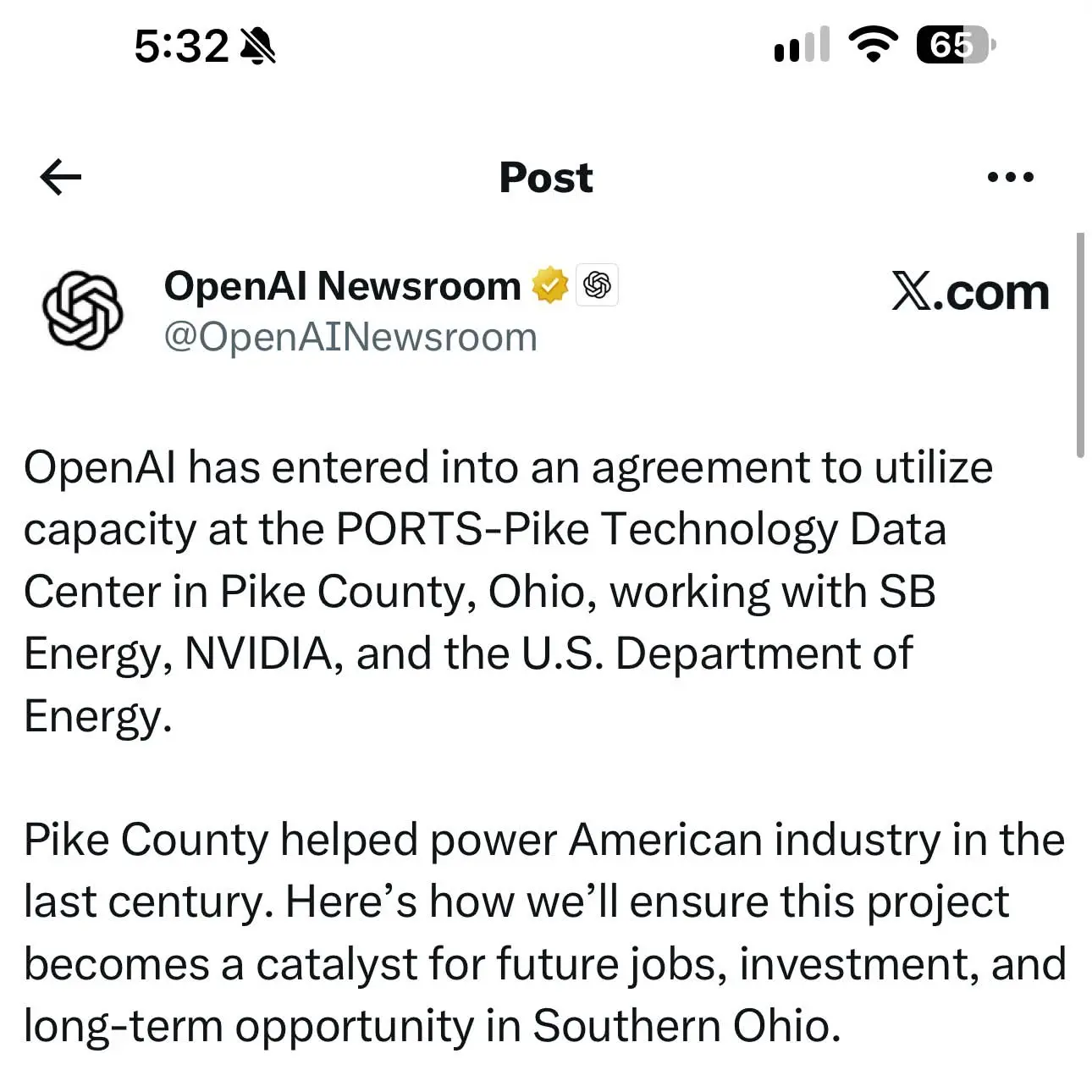
OpenAI has agreed to secure approximately 8 gigawatts-IT at the PORTS-Pike Technology Campus in Pike County, Ohio, working with SB Energy, NVIDIA and the U.S. Department of Energy. Details of the arrangement come from OpenAI's announcement of the project, relayed by Threads.
At a glance
- NVIDIA holds the exclusive AI compute infrastructure role at the Pike County campus, while SB Energy and the U.S. Department of Energy are the other parties named alongside OpenAI in the arrangement.
- The package carries an initial combined community investment of $80 million, of which $40 million comes from OpenAI, alongside the compute capacity commitment at the Pike County campus.
- OpenAI will make up to $84 million in Codex credits available to approximately 844,000 eligible Ohio students, extending its coding agent to a state-wide student population alongside the infrastructure commitment.
Eight gigawatts-IT contracted at a single campus sits closer to grid planning than to conventional datacenter procurement, and the partner list appears to matter as much as the figure: an energy developer, a chip vendor in an exclusive supply role, and a federal department. The community spending and the student credits read as the local counterpart to that load, the terms on which one Ohio county absorbs a campus of this size.
NVIDIA is the exclusive AI compute infrastructure provider at the site
NVIDIA's role at PORTS-Pike is exclusive: it is the AI compute infrastructure provider for the campus, with no second vendor named in that position. The site is the PORTS-Pike Technology Campus in Pike County, Ohio, where OpenAI is securing approximately 8 gigawatts-IT.
SB Energy and the U.S. Department of Energy are the other parties named alongside OpenAI and NVIDIA in the PORTS-Pike arrangement. OpenAI published the details itself, and the announcement presents the capacity commitment together with the local spending commitments in Ohio.
According to Reuters, NVIDIA will invest $1.5 billion in SB Energy. That figure comes from Reuters alone and sits outside the terms OpenAI set out for PORTS-Pike, which cover the compute footprint rather than financing arrangements between the partners at the site.
The community package opens at $80 million, with $40 million from OpenAI
An initial combined community investment of $80 million accompanies the capacity agreement, with $40 million of that total coming from OpenAI. The commitment is described as an initial one, which leaves the size and timing of any later spending unstated in the announcement.
OpenAI will also make up to $84 million in Codex credits available to approximately 844,000 eligible Ohio students. The credits are capped at that ceiling rather than committed in full, and they are tied to eligibility among Ohio students rather than offered to the state at large.
Codex is OpenAI's coding agent, so the $84 million ceiling denominates product usage rather than cash paid to the state. The two commitments stand apart in the announcement: $80 million as an initial community investment, and up to $84 million in credits for eligible Ohio students.
The announcement covers contracted capacity, not energized load
OpenAI's wording covers an agreement to secure capacity rather than infrastructure already in place. Contracted capacity, construction and energized load are distinct stages of a datacenter buildout, and the PORTS-Pike announcement as published addresses the first of them, with the later stages not detailed.
Multi-gigawatt campuses have become the standard unit for AI infrastructure planning, with power availability, rather than chip supply alone, setting the pace of buildouts. OpenAI has expanded compute capacity mainly through partner-built sites rather than facilities it owns and operates itself, and PORTS-Pike names both an energy company, SB Energy, and a compute supplier, NVIDIA.
No dates for the 8 gigawatts
OpenAI's announcement gives no construction start, no phasing schedule and no date by which any part of the 8 gigawatts-IT comes online. The timing of the Codex credits is likewise open, along with how eligibility is determined among the approximately 844,000 Ohio students covered. The $80 million is described as an initial figure.
Up next
Each coding session gets its own EC2 box
"Two links and a sentence" is how Vorflux describes the start of a session, and each one boots a full stack on a dedicated EC2 instance, snapshotted live so later sessions wake on a machine already running.
Related stories
- Ohio data-center backstop shrinks to under $120 billion
- OpenAI pays $300M for the team behind Apple's Portrait Mode
- Data-center chief exits OpenAI before the IPO
- Maia 300 promises Microsoft 40% more tokens per megawatt
- Per FT, OpenAI's run rate sits at $50B, below Anthropic's
- OpenAI closes in on Anthropic in OpenRouter coding data
Comments
No comments yet. Be the first.
Join the conversation
Sign in to leave a comment. It appears after moderation.