
Code strings point to a $50 production plan for OpenAI's API
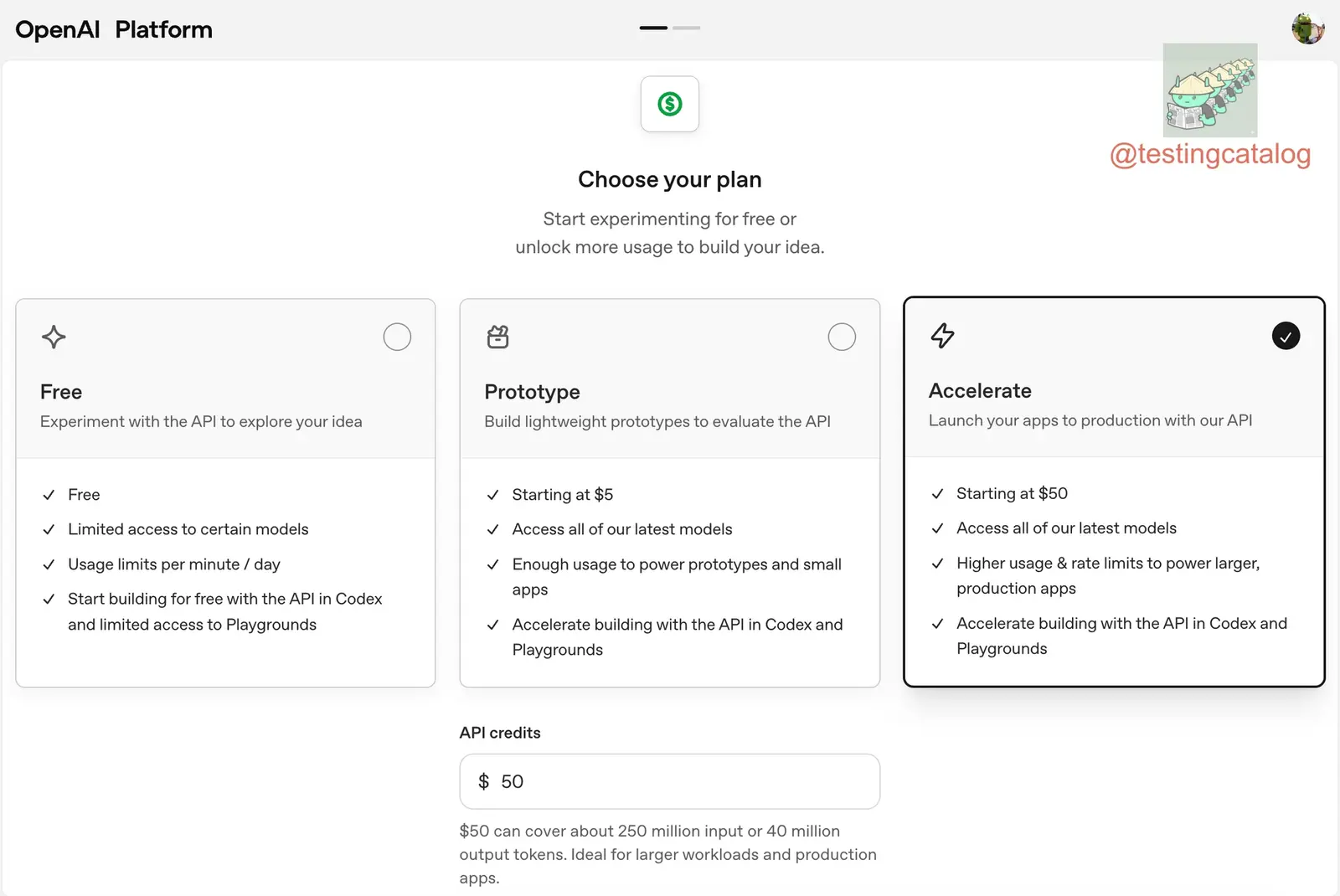
According to Testingcatalog, OpenAI appears to be preparing a new onboarding flow for its API platform, where production work would start at $50 and developers would pick one of three plans: Free, Prototype or Accelerate. The discovered strings show the plan names and what each one unlocks. No rollout date is visible yet.
At a glance
- OpenAI's API platform appears set to greet new developers with a choice of plan, running from free experiments through small prototypes to production apps, ahead of OpenAI DevDay on September 29 in San Francisco.
- Free gives API access through Codex and limited Playgrounds, Prototype adds all models and higher usage, and Accelerate starts at $50 with all models plus higher usage and rate limits.
- The strings confirm only a plan structure: there is no rollout date, no published rate-limit figures, and no sign yet of a product for hosting complete applications on OpenAI's platform.
If you haven't been following, OpenAI has spent the past year widening what its developer platform does. According to WorthvieW, the previous DevDay, held on October 6, 2025, in San Francisco, brought the ChatGPT App SDK for apps that run inside ChatGPT and the AgentKit toolkit for building agents. It also made Codex generally available, with Slack integration, an SDK and enterprise controls. The same report put the platform at 4 million developers.
Accelerate, the production tier, starts at $50
The new flow sorts developers by how far along their idea is. The Free tier is for people experimenting with API ideas and offers free API access through Codex, plus limited access to Playgrounds. Prototype is pitched at lightweight prototypes and small apps, with access to all models, higher usage and broader access to Codex and Playgrounds.
Accelerate is the tier for production apps. It starts at $50, includes all models and offers higher usage and rate limits. The copy runs as one progression from experimenting to prototyping to launching production apps. Testingcatalog reads that wording as a sign that OpenAI wants Platform to become a broader development environment rather than mainly an API dashboard.
The Agents API, launched September 10, already runs agents in OpenAI-hosted sandboxes
The plans would sit on top of a runtime that OpenAI already controls. On September 10, OpenAI introduced the Agents API, which lets developers run cloud agents using an OpenAI-managed Codex harness and OpenAI-hosted sandboxes. So the code those agents execute runs on OpenAI's machines, not on the developer's own servers.
On September 22, Sam Altman posted a message that Testingcatalog says fits the same direction:
And then we want you all to come up with great ideas and build them and to get to be happy users. The best ideas will come from you all.
The same post ended with a note to developers: see you next week. DevDay takes place on September 29 in San Francisco, and OpenAI promises technical sessions on APIs and developer tools. Testingcatalog names the event as a possible venue for further Platform changes.
Today's API bill is metered per million tokens
According to the OpenAI Developers pricing page, the API is currently billed by tokens, with separate per-model rates for input, cached input, cache writes and output. The rates vary widely: gpt-6-astra costs $10.00 per 1M input tokens and $50.00 per 1M output tokens, while gpt-6-luna costs $0.10 and $0.50. Tools cost extra, such as $10.00–$25.00 per 1k web search calls, and hosted containers are billed per 20-minute session by memory size.
It works like an electricity meter: you pay for exactly what flows through. Developers-openai documentation lists ways to shrink the bill: pick the smallest model that meets your quality bar, cache repeated prompt prefixes, cap output tokens, and batch requests during off-peak hours for a 50% discount. For high-volume usage, according to the same source, enterprise plans with committed-use discounts, dedicated capacity and custom rate limits go through direct sales, not self-serve pricing.
The new plans add named steps to that picture, each tied to a stage of a project and each unlocking more models, more usage or higher limits. The strings describe the steps. They don't describe how the steps connect to the per-token meter.
The strings confirm a plan structure, not an OpenAI-hosted app deployment product, and they leave the key numbers blank: what the $50 buys, whether token charges still apply on top, and how high Accelerate's rate limits go. In our view, a $50 floor is hard to judge without those limits, because at gpt-6-astra's $50.00 per 1M output tokens, a single million output tokens already equals it. The progression wording likely aims to keep a project inside OpenAI's ecosystem from first test to production.
What September 29 may settle. No rollout date for the new onboarding plans is visible yet. DevDay on September 29 in San Francisco, with its sessions on APIs and developer tools, is the nearest point where OpenAI could publish the prices and limits behind Free, Prototype and Accelerate. It is still unclear whether developers will be able to deploy or host complete applications directly on Platform, and the strings do not say.
Related stories
- GPT-6 caching update cuts cached input costs by up to 90%
- Token costs drop out of Replit's new Free Mode
- OpenAI's half-price GPT-6 Sol and Luna aren't a promo
- libheif bugs reached OpenAI repos and GitHub Enterprise
- OpenAI's lawyers and recruiters now work through Codex
- Every chatgpt.com page carries 377 KB of flag decisions
Comments
No comments yet. Be the first.
Join the conversation
Sign in with Google to leave a comment. Your name and avatar come from your Google profile, and the comment appears after moderation.