
Your ChatGPT Plus plan can now pay for other apps' AI
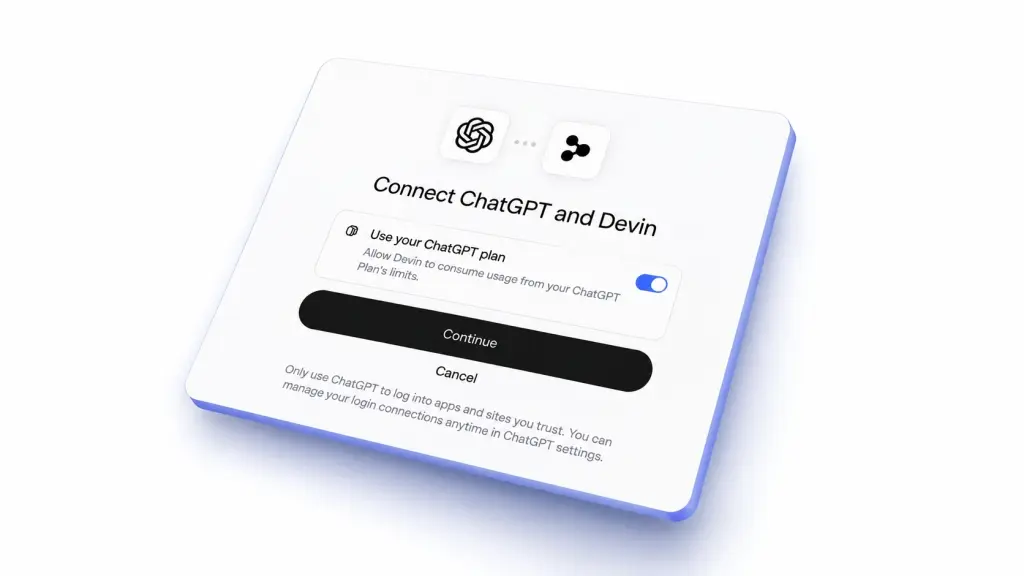
"They're already paying for an AI subscription, and now you don't have to cover their token costs to get them going," Sam Altman told developers at OpenAI DevDay, according to The News Stack. The OpenAI help page explains how this works. With the expanded Sign in with ChatGPT, Plus and Pro subscribers can let participating apps bill AI requests to the Work and Codex usage their plan already includes, and nobody has to create or share an OpenAI API key.
At a glance
- OpenAI named 16 launch partners for plan usage, including Devin, Amp, Warp, Notion and Vercel. Fifteen of them are available now, and Lovable is listed as coming soon.
- In Settings > Usage you give each app a weekly cap, set as a percentage of your overall usage. The cap limits that app but does not set aside any usage for it.
- Once your plan limits run out, an app can spend credits only if you opt in and its cap is at 100%. If auto-purchase is on, you may get no separate notice.
If you haven't been following, Sign in with ChatGPT first appeared in July as a beta, and back then it was mainly a way to log in. The News Stack reports that partners such as Airtable, GitLab, HubSpot, Notion, Supabase and Vercel received a user's name, email and profile picture. Some tools went further on their own. In May, OpenClaw let users power OpenAI agent turns with a ChatGPT subscription through the Codex authentication route.
OpenAI named 16 launch partners, and 15 of them are already live
The News Stack reports that the announcement came at DevDay, OpenAI's fourth developer conference. Dots, a new class of always-on agents, and the GPT-6.1 Sol model were announced there too. The partners already available are OpenCode, OpenClaw, Pi, T3, Hyperagent, Hermes Agent, Vorflux, Amp, Dactyl, Kilo Code, Warp, Conductor, Devin, Notion and Vercel. Lovable is listed as coming soon.
An OpenAI spokesperson told the outlet that the company is starting with these 16 and will expand quickly. The help page splits users into two groups. Anyone can sign in with ChatGPT and connect supported open source tools, but only Plus and Pro subscribers can use their plan inside commercial tools. Each app may also offer the option only on some of its own plans.
The app gets your name, email address and profile picture. Using your plan does not by itself give the app your conversations or memories. Signing out of an app does not stop it from using your plan. To end that, you have to click Disconnect under Settings > Security and login, and even that does not reverse usage already recorded.
An app's weekly cap is a share of your plan, not a separate pool
Requests from connected apps draw on the same ChatGPT Work and Codex usage you spend inside ChatGPT, though OpenAI warns that usage rates can differ between an app and ChatGPT. In Settings > Usage, under App limits, you can see how much each app used. You can also set each app's weekly limit as a percentage of your overall weekly usage.
The cap sets nothing aside for the app and does not raise your plan limits, so an app can hit its ceiling while you still have ChatGPT usage left. When an app runs out, it does not switch to another paid option by itself. Signing in again or retrying does not bring your usage back.
Once your overall plan limits run out, the app stops using your plan unless you have allowed it to use credits. The credits option is off by default and applies to all participating apps. It works only for an app whose limit is set to 100%, and setting 100% does not switch it on by itself. If automatic credit purchases are on, further usage can lead to automatic charges.
Dactyl charges $20 a month and leaves the agent's tokens to ChatGPT
Dactyl is a vibe-coding platform for native iOS and Android apps. Ryan Dahl, known for Node.js, introduced it on X on August 24, 2026. According to The News Stack, it has a free plan with 100 credits a month, and its $20-a-month Builder plan promises: "Agent runs on your ChatGPT subscription — no token bills from us."
Your ChatGPT plan pays for the agent that reads your request and writes the Swift code. Compiling, icons and images, 3D assets and publishing still use Dactyl credits. At the time, Dactyl limited plan sharing to personal ChatGPT Pro subscribers on Builder or higher, and Plus and Business users could only sign in. OpenAI's official launch opens plan usage to Plus as well.
The News Stack notes that OpenClaw's documentation now lists three separate ways to connect: Codex account login, Sign in with ChatGPT and a plain OpenAI API key. It describes the new option as using the Codex allowance, with its own usage tracking and token limits. OpenAI's help page adds that any app may still charge separately for its own subscription, infrastructure, services or premium features.
The DevKit gives open source apps two packages and a macOS demo
Under the hood this is a delegated login. The app sends you to ChatGPT, you approve, and the app gets credentials tied to your own account, so it does not need a developer's API key. Think of a family phone plan where you decide how much shared data each phone may use. The apps are the phones, and the pool stays yours.
OpenAI's DevKit is meant for open source apps that run on the user's own machine. Its @siwc/local package handles OAuth, credential storage, account profiles, model discovery and streaming Responses in a local Node.js process, and @siwc/react supplies components for sign-in, connection status and plan usage. The Paste Perfect sample app needs macOS 14, Node.js 22.12 and Xcode Command Line Tools. OpenAI's code in the kit is under a Noncommercial License v1.0.
The help page is open about what you cannot see. Usage settings show how much each app used but not what it did, and they may not keep a full history of individual actions, so OpenAI asks you to keep task details yourself. In our view, the setting to check first is a 100% cap combined with auto-purchase, because that is how included usage turns into automatic charges, possibly without a separate notice.
When Lovable joins the list
Lovable is the only named partner still marked as coming soon, and no date has been given for it or for the wider expansion OpenAI's spokesperson promised. Open source developers can start now with the DevKit and the developer docs. Commercial tools that want to integrate Sign in with ChatGPT, with or without token sharing, first have to fill in OpenAI's interest form.
Related stories
- OpenAI's $200 Pro plan comes back worth half the API spend
- Code strings point to a $50 production plan for OpenAI's API
- GPT-6 caching update cuts cached input costs by up to 90%
- Token costs drop out of Replit's new Free Mode
- OpenAI opens ChatGPT's 1.2B weekly users to developers
- OpenAI puts 8x faster Codex behind a new Pro 500 plan
Comments
No comments yet. Be the first.
Join the conversation
Sign in with Google to leave a comment. Your name and avatar come from your Google profile, and the comment appears after moderation.