
Delegation made Opus 5 refuse tasks it solves on its own
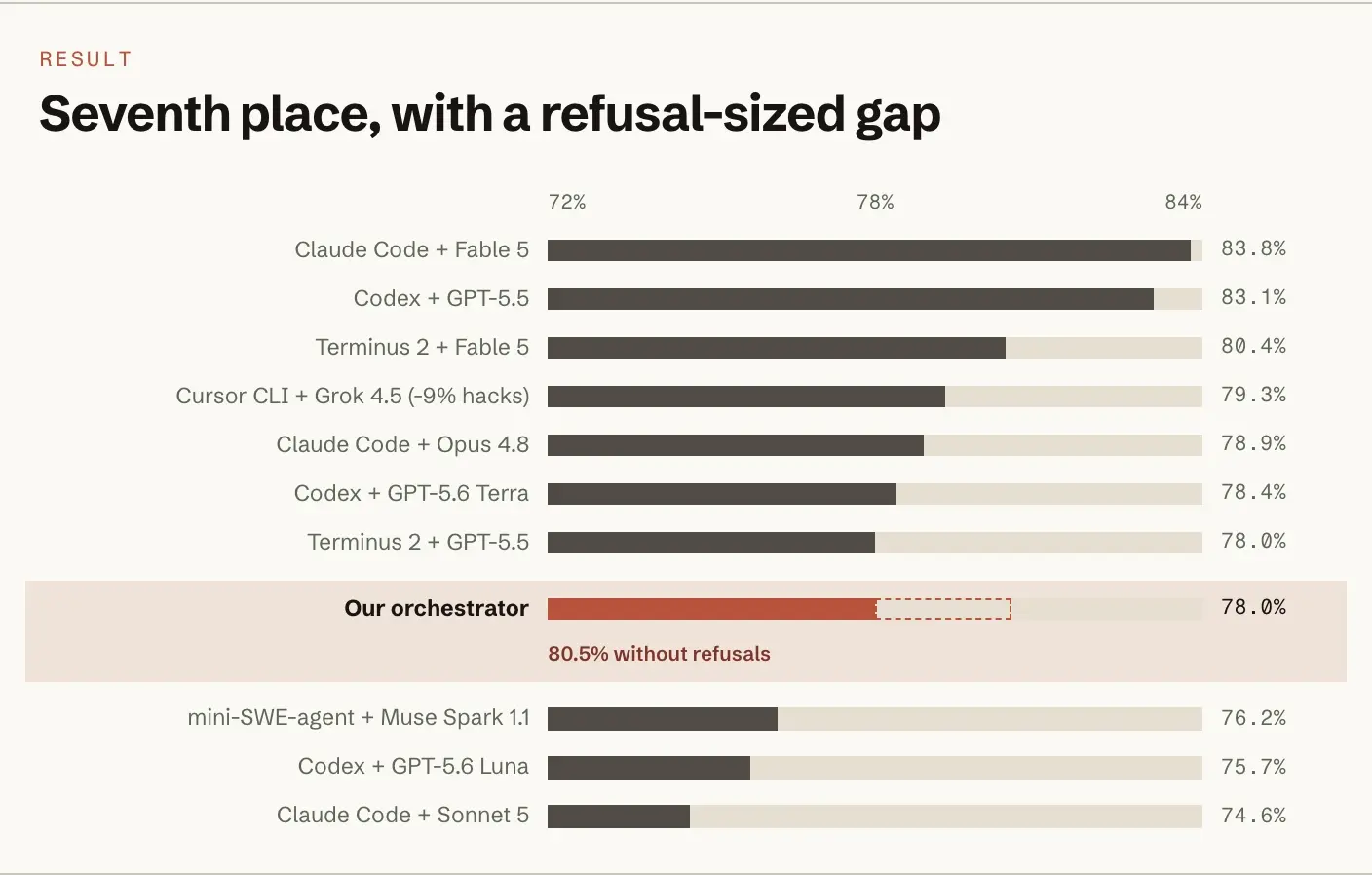
A four-model Claude stack running inside Claude Code scored 78% on Terminal-Bench 2.1, seventh place, and spent $1,178 doing it, roughly twice what the leader spent. The benchmark hands the agent 89 terminal tasks with five attempts each.
Three security tasks never got solved once. Opus 5, working as the executor, refused to take them on across all 14 attempts. The same Opus 5 in a plain session with no orchestration solved all three, six for six. Count those and the run lands at 80.5% and third place.
The verifier agent only ran when the orchestrator decided to call it, which happened in 76% of runs. With verification, tasks were solved 91% of the time; without it, 43%.
The Opus 5 executor burned 58% of the budget, $689. Runs with 3 to 5 handoffs between agents solved 90% of tasks at $2.41 per attempt. At six handoffs or more, the solve rate dropped to 50% and the cost rose to $9.51.
Up next

Meta releases Muse Glimmer weights for local agents
Meta Superintelligence Labs open-sourced Muse Glimmer, a 30B agent model, under Apache 2.0. Full precision needs 55GB+ of memory; quantized, it drops under 20GB and runs on one consumer GPU. Meta claims 3.1x faster decoding on an RTX 5090.
Related stories
- Raise effort before switching Claude models, Anthropic says
- Claude Fable 5.2 designed three working gadgets with Diode
- Goldman Sachs pulls Claude Code from traders and bankers
- Claude Code approvals put keys in 1,122 public GitHub files
- Claude Code put users’ emails in User-Agent headers
- Claude Code product lead Cat Wu joins OpenAI
Comments
No comments yet. Be the first.
Join the conversation
Sign in to leave a comment. It appears after moderation.