
openai
OpenAI's lawyers and recruiters now work through Codex
Promtime
 openai
Some Codex threads inside OpenAI stay open for days: someone sets a goal, and the agent keeps working until it reaches it. According to Pragmaticengineer, that length is what pulled finance, recruiting and legal into a coding tool, from roughly 0% usage to 90% in four months, with no mandate from above.
At a glance
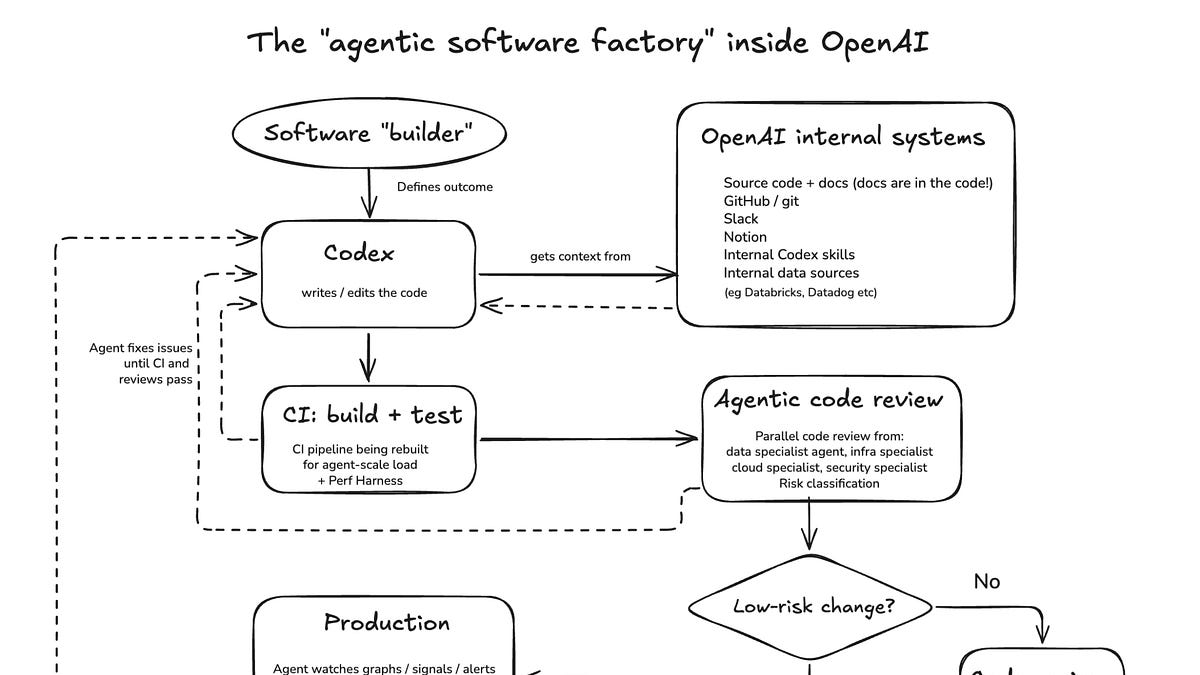
- Engineering now runs what its infra VP calls a software factory: agents gather context, open pull requests, review them as domain specialists, and walk an approved change into production.
- Close to 40% of non-engineering teams picked up Codex while the app still showed raw code on screen, and usage across those teams climbed from 60% to 90% between April and May.
- Sevbot, the internal incident agent, collects context and proposes mitigations but never executes one, so oncall duty survives, and native mobile releases still wait on Apple and Google review.
Codex is a name OpenAI has used twice. As Kunal Ganglani recounts, the first was a 2021 model fine-tuned from GPT-3 to turn English into code, and it powered GitHub Copilot's June 2021 preview; OpenAI deprecated that API on March 23, 2023. The Codex in this story is a May 2025 relaunch under the same name, a cloud coding agent that reads repos, runs tests and opens pull requests.
Finance, recruiting and legal went from about 0% to 90% in four months
OpenAI shipped the Codex app for Mac in February and for Windows in March, then ChatGPT Work, built on the Codex harness, in July. Non-engineers moved their workflows over. Between February and April, when the app still put source code on screen, close to 40% of non-engineering teams were already using it to research and produce decks, documents and spreadsheets.
Then came the /goal setting, where you hand the agent an objective and it works until the objective is done. Usage climbed from 60% to 90% between April and May. Desktop lead Andrew Ambrosino says long threads also cut parallel work, because a long-running agent spins off other agents and shrinks the surface a human has to manage.
Akshay Nathan, engineering lead on the productivity team, calls what is left an awareness gap rather than a capability one: colleagues learn from teammates that Codex can watch Slack or update Airtable.
IDE usage at OpenAI has been falling since January
In December 2025 the Codex team was not sure it should ship a desktop app at all. There was the CLI on one side and feature-rich IDEs on the other, and Ambrosino worried the result would be an iPad: bought, then left alone because people reach for the phone or the laptop.
Antigravity had arrived in November as a VS Code fork, which made forking VS Code look like the safe move. OpenAI went the other way on a gut call that better agents make IDEs matter less. IDE usage there has dropped since January, and the app has drifted slightly toward what it avoided: editing files inside Codex shipped in June.
Roughly a 10x load increase on some systems in six months
Pull requests per engineer are growing like a hockey stick, says Venkat Venkataramani, VP of engineering for applied infra. Every part of build-test-deploy is absorbing dramatically more load, roughly 10x on some systems, growth most companies would spread over two or three years. Version control, CI and release processes each hit a new ceiling every month.
The harder wall is native mobile, because every iOS and Android update goes through Apple's and Google's manual review, which takes hours or days. Sulman Choudhry, head of engineering for ChatGPT, points to Facebook in the 2010s, which got App Store releases down to weekly and used feature flags to ship code before launch. He says OpenAI is nowhere close to web-speed mobile shipping today.
Codex reads Slack, Notion, Databricks and Datadog
OpenAI moved its documentation inside the source code, so an agent reading the repo reads the explanations too. Codex is also wired into git and GitHub, Slack and Notion, internal sources like Databricks, Datadog and raw logs, plus internal skills, some of which Codex's own implementation maintains. New engineers are told to put onboarding questions to Codex, because it holds a surprising amount of context.
After that the loop is mechanical. The agent writes the change, runs tests, fixes what it breaks, opens a pull request, then babysits CI until the build is green. A perf harness routes problematic PRs into the Synthetics A/B framework to check performance implications.
Review is not one generic bot. OpenAI spins up several agents, each configured as a domain specialist, the equivalent of a cloud infra engineer and a security engineer reading every change. Changes are classified by risk: high-risk ones can require a human after the agents finish, low-risk areas can opt into auto-approval.
Once a human approves a change for production, it gets its own agent told to handhold it until it is safely and fully rolled out. For a change behind a feature flag, the agent finds the flag in the codebase, works out what the change does, decides which signals mean success or failure, builds a dashboard for those signals, and watches it.
Downstream, Perf Factory sifts alerts and dashboards, de-duplicates signals, identifies real latency regressions, root-causes them and proposes fixes. Sevbot handles incidents: it collects context, determines possible mitigations, answers questions in the Slack channel, and applies a mitigation only when an engineer tells it to.
OpenAI's internal Codex is plugged into far more company systems than the version you can buy, and the 10x figure covers some systems, not the whole pipeline. The author also doubts that an agent told to be a cloud infra specialist reviews differently from a generic one; the answer he gets is context, not measurement. In our view the sharpest line is the one OpenAI draws itself: the incident agent may reason about an outage but not act on it.
Whether Sevbot gets to act
OpenAI says the goal is a per-change autonomous SRE, and a Sevbot that mitigates routine outages on its own so nobody is woken outside working hours. No date is given for either, and oncall duty is not a thing of the past at the company. Mobile is open too: shipping native code at web speed would need rethinking what gets shipped and what is activated remotely.
Comments
No comments yet. Be the first.
Join the conversation
Sign in with Google to leave a comment. Your name and avatar come from your Google profile, and the comment appears after moderation.
We only use your name and avatar from Google. We never store your email address.