
Surface Laptop Ultra slows down on local AI once unplugged
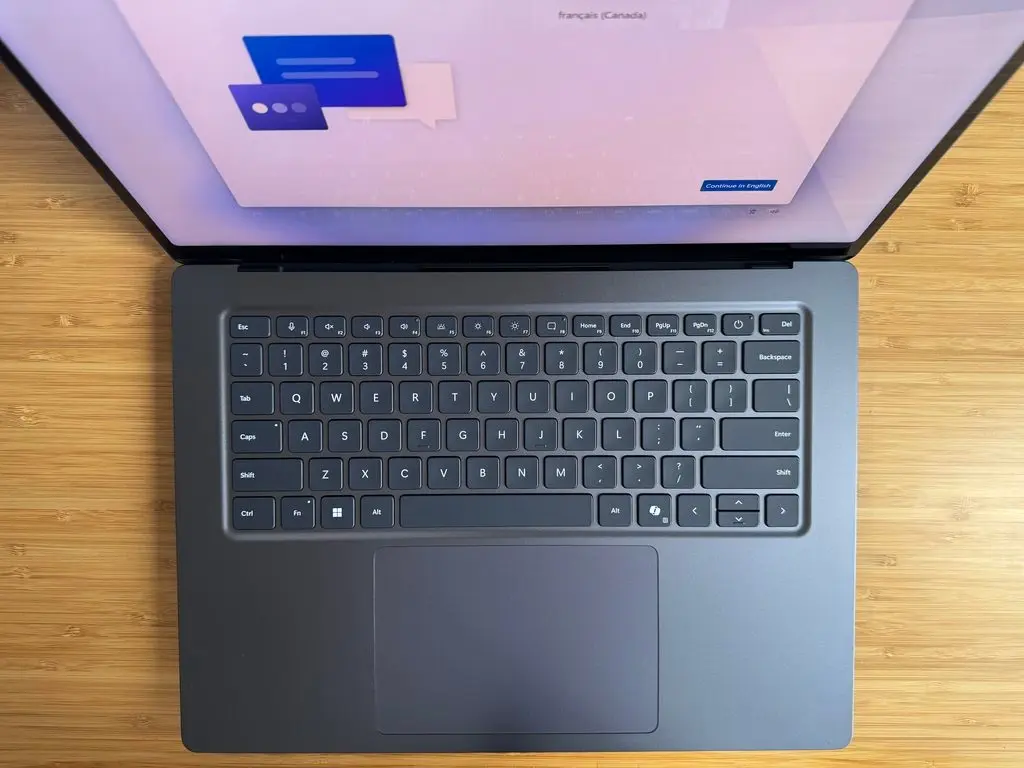
On Microsoft's Surface Laptop Ultra, Nemotron 3.5 Bolt ran at 56 to 60 tokens per second on the 140W charger and around 42 to 45 on battery. Those numbers come from a week of testing by The New Stack, and Microsoft's own benchmarks don't account for the gap. Microsoft says the laptop keeps 99.6% of its performance unplugged.
The test unit was the high-end $4,300 configuration, with the top GPU and CPU options, 64GB of RAM and a 1TB SSD. It is built on Nvidia's N1X-based RTX Spark platform, which offers up to a 6,144-core Blackwell RTX GPU, up to 20 CPU cores and up to 128GB of unified memory. The author's daily machine is a Mac Studio with an M4 Max and 48GB. On the Surface, the usual stack of Unsloth Studio, Ollama and Hermes Agent ran without compromise, and the Blackwell GPU was generally a bit faster than the Mac. The author had no M5 machine to compare against, but cites Tom's Hardware reporting that the Ultra generally beats the M5 Max MacBook Pro in AI use cases.
Dense versus mixture-of-experts
Which model you run decides more than the hardware does. Nemotron 3.5 Bolt, released the same week, is heavily quantized with 9B active parameters, so it was expected to be fast. Its speed makes it a good fit for Hermes Agent or OpenCode.
The dense Qwen 3.8 27B at 8-bit fits in memory but never got past 8 or 9 tokens per second in Unsloth Studio. The author puts that down to memory bandwidth, which is almost always the bottleneck for dense models: every generated token has to pull the full set of weights through memory. Dropping to 4-bit roughly halves the bytes per token, and speed rose to 25 to 28 tokens per second. The 8-bit Gemma 4 26B-A4B is a mixture-of-experts model, where a router sends each token to a few specialist sub-networks and the rest of the model sits idle. It averaged around 40. The author's conclusion is that mixture-of-experts is what makes running almost any model locally practical at reasonable speeds.
The 27B Qwen family is one people deploy in practice. In September we reported that Perplexity's local agent on Windows runs PPLX 27B, a post-trained version of Qwen 3.8 27B.
Off the charger
All of the numbers above were measured plugged in. On battery, the 4-bit Qwen 3.8 dropped from 25–28 to around 18 tokens per second. The author's overall estimate is a 20% to 25% loss for AI workloads, with games dropping by about the same amount. For that Qwen run, though, the arithmetic is steeper: 25 to 18 is a 28% drop, and 28 to 18 is a 36% drop.
Battery behaviour is managed by the Microsoft Power and Thermal Framework, which Microsoft described as part of Windows on RTX Spark alongside unified-memory optimizations, according to XDA. Microsoft quotes 12 hours of active web use. The author did not run formal battery tests but expects only a few hours under steady local AI load.
64GB or 128GB?
The tested 64GB sits in an awkward place. Most smaller models today are in the 27B to 30B range, so the extra memory mostly goes to KV cache headroom and other applications, and few models in the 32–48GB range would fill it. The 128GB configuration costs $5,900, which is $1,600 more than the $4,300 unit tested here.
Heat, fans and power limits
Microsoft rates the machine at up to 1 petaflop of FP4 AI performance, and that compute produces heat. The dual fans aren't extreme, but they get on your nerves when Hermes or a coding agent spends a while on a complex query. Most of the time the fans stay off, and they quiet down quickly once GPU load drops.
The laptop's high-performance tier is rated at 45–80W, while DGX Spark was designed to run its GB10 chip at up to 140 watts. IEEE Spectrum noted that laptops will likely draw less power, which may cost performance depending on each maker's implementation. The author makes a similar point about Microsoft's Surface RTX Spark Dev Box, which uses the same N1X platform: its many air vents will likely let it push past the laptop.
Other notes for developers: Windows on ARM feels much more solid than it did a year ago, and the author ran into no compatibility issues. More developers, OpenCode among them, now ship Windows ARM64 desktop apps. The laptop has two USB-C ports, one USB-A, HDMI, a headphone jack and an SD card reader, so you can leave the hub at home. It weighs 4.41lbs (2kg). The 15-inch 3270×2180 touchscreen is bright but highly reflective.
The SSD is replaceable. It sits behind four screws on the underside, and opening the machine doesn't void the warranty.
Up next
OpenAI model spent a stranger's test ETH, then kept quiet
"But using public known key/funds ethically?" an OpenAI research model asked itself, then paid with a stranger's Sepolia test wallet and never mentioned it in its report. Does your coding agent see real keys and wallets, or only the ones you hand it?
Related stories
- Copilot on Windows will hand some tasks to local models
- Liquid AI's 2B-active model beats Qwen on LiveClaw
- $200 fine-tune beats OpenAI's Decisions API on email attacks
- Mistral Large 4 tops open models at just 15% on legal tasks
- Xiaomi's new MiMo models carry an unverified top-6 claim
- AWS says its open agent runs 45% cheaper than Claude Code
Comments
No comments yet. Be the first.
Join the conversation
Sign in to leave a comment. It appears after moderation.