
Liquid AI's 2B-active model beats Qwen on LiveClaw
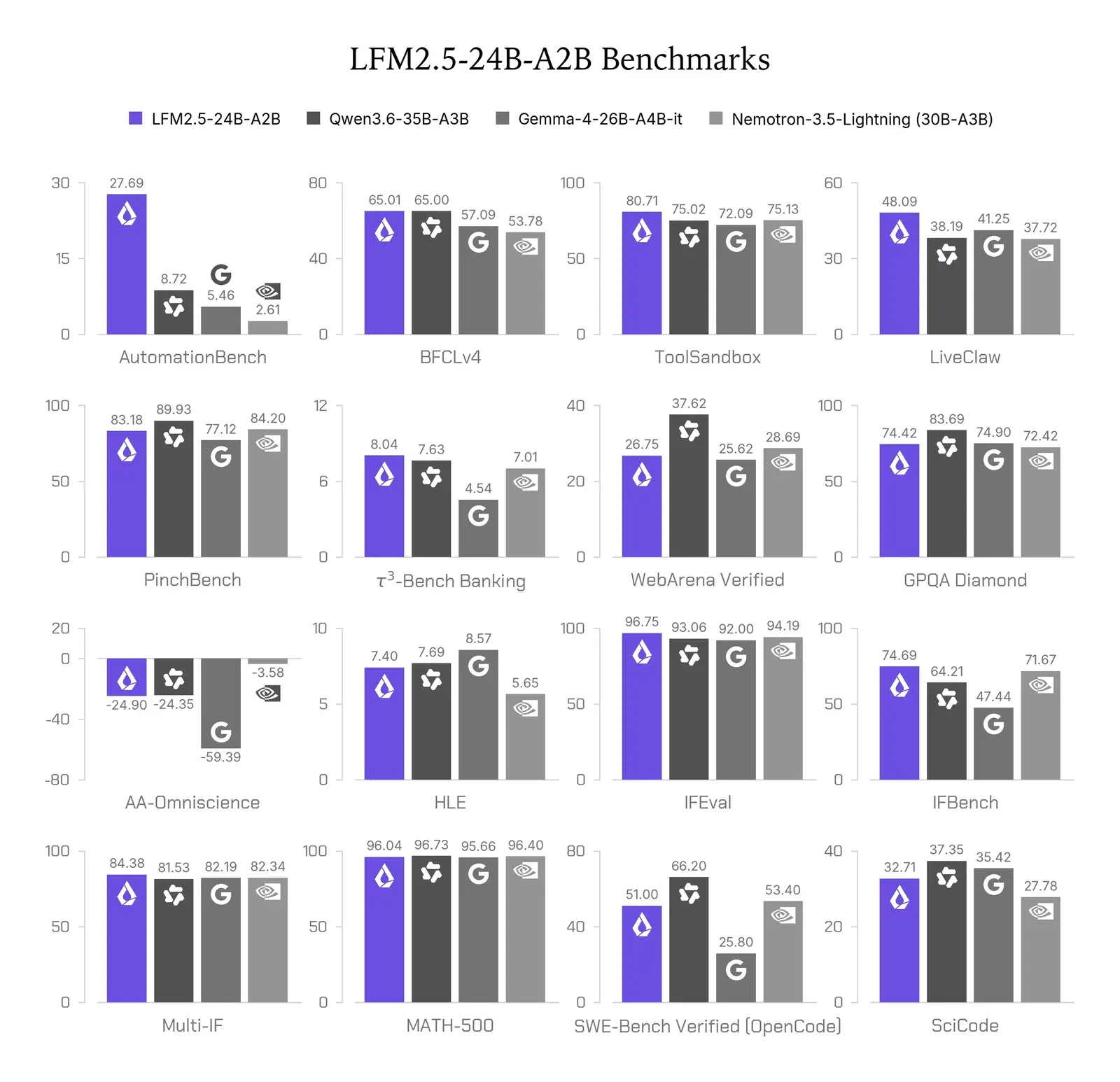
According to Liquid AI's model card, only 2.45B of the 24B parameters in LFM2.5-24B-A2B do any work on a given token. With that, it scored 48.09 on the LiveClaw agent benchmark, against 38.19 for Qwen3.6-35B-A3B, a model with about 50% more total and active parameters. The open-weight reasoning model is on Hugging Face and is aimed at fast, private agents that run on your own device.
At a glance
- This is the last model in Liquid AI's LFM2.5 family, which runs from LFM2.5-230M up to this 24B mixture-of-experts model. It ships as a base checkpoint and as a version post-trained for agentic workloads.
- A router sends each token to 4 of the 64 experts in each block. Liquid AI measured 184 tokens per second on an Apple M5 Max using llama.cpp with Q4_K_M quantization.
- It does not win everywhere. On SWE-Bench Verified it trails Qwen3.6-35B-A3B 51.00 to 66.20, and Liquid AI itself recommends pairing it with retrieval or web search for knowledge-heavy tasks.
If you haven't been following, Liquid AI is a lab spun out of MIT CSAIL. Its Liquid Foundation Models aim for strong quality at small parameter counts so they can run on devices. The LFM2.5 family was announced on January 5, 2026, starting with 1.2B models, and the mixture-of-experts LFM2.5-8B-A1B followed on May 28, 2026. The new model keeps the architecture of an earlier 24B release, LFM2-24B-A2B.
LFM2.5-24B-A2B beats Qwen3.6-35B-A3B on LiveClaw, AutomationBench and IFBench
Liquid AI tested the model on 16 benchmarks covering knowledge, instruction following, math, code, tool use and agentic workflows. It compared it with three other MoEs: Qwen3.6-35B-A3B, Gemma-4-26B-A4B-it and Nemotron-3.5-Lightning (30B-A3B). The widest gap is on AutomationBench, where it scored 27.69. Qwen got 8.72, Gemma 5.46 and Nemotron 2.61.
Against Qwen, it also leads on IFBench (74.69 to 64.21), ToolSandbox (80.71 to 75.02) and IFEval (96.75 to 93.06), and it essentially ties on BFCLv4, 65.01 to 65.00. Qwen is ahead on GPQA Diamond (83.69 to 74.42), WebArena Verified (37.62 to 26.75), PinchBench (89.93 to 83.18) and SciCode (37.35 to 32.71). All models ran on vLLM. LiveClaw used temperature 1.0 and a limit of 8,192 output tokens.
Liquid AI measures 184 tokens per second on an Apple M5 Max
On edge hardware, Liquid AI says LFM2.5-24B-A2B decodes 184 tokens/s on an Apple M5 Max and 114 tokens/s on an AMD Ryzen AI Max+ 395. That is up to 1.7x faster than the next-best model in the comparison, and it uses the least memory. The numbers come from Pipette, Liquid AI's own device benchmarking setup, using llama.cpp, Q4_K_M quantization and a 4K-token input context.
On a single NVIDIA B300 running SGLang 0.5.22 with BF16 weights, it passes 21K output tokens per second at high concurrency. Each request in that test had 1,024 input tokens and at most 256 output tokens. As each request finished, the harness started a new one, so the number of requests running at once stayed at the target.
The context window grows from 32K to 131K tokens over LFM2-24B-A2B
Compared with LFM2-24B-A2B, Liquid AI made two architectural changes. The context window grows from 32K to 131K tokens. The vocabulary doubles from 65K to 128K tokens through an in-place tokenizer expansion that improves tokenization of non-Latin scripts. Pre-training went from about 17T tokens to about 33T, within a total training budget of 36 trillion tokens.
Mid-training added 2T tokens at 32K context, weighted toward reasoning, math, code, instruction following and multilingual text, then 300B tokens of long-context data at 131K. Post-training combined supervised fine-tuning, teacher specialization and two on-policy distillation stages. It ended with agentic reinforcement learning inside OpenClaw, Hermes Agent, Pi and OpenCode, so the model learns their tools, system prompts and interaction patterns.
Unlike its predecessor, LFM2.5-24B-A2B always thinks before it answers, because the chat template inserts a <think> tag at the start of every assistant turn. It supports 16 languages, including English, Chinese, Vietnamese and Polish. The recommended sampling settings are temperature 0.1, top_k 50 and repetition penalty 1.05.
Each token visits 4 of 64 experts in every MoE block
A mixture-of-experts model splits part of the network into many smaller sub-networks, called experts, and a small router decides which ones handle each token. Here every MoE block has 64 experts and each token goes to the top 4. That is why only 2.45B of the 24.0B parameters do work per token. Picture a clinic with 64 specialists, where a triage nurse sends each patient to just four of them.
The 40 layers combine 30 double-gated short convolution blocks, which look only at nearby tokens, with 10 grouped-query attention blocks, which can look across the whole context. Because so few parameters are active, Liquid AI says each reasoning token is cheap. That matters for a model that thinks before every answer.
For tool use, the model writes Pythonic function calls by default: a Python list placed between special tool-call tokens. It switches to JSON if the system prompt asks for it. Weights come in native, FP8, GGUF, ONNX and MLX 4-bit formats. A DSpark draft model for speculative decoding with SGLang is listed as coming soon.
The benchmark table doesn't all point one way. On SWE-Bench Verified, run through OpenCode, LFM2.5-24B-A2B trails Qwen 51.00 to 66.20, and its AA-Omniscience score of -24.90 matches Liquid AI's own advice to pair it with retrieval for knowledge-heavy work. In our view, a GPU throughput test capped at 256 output tokens is an odd fit for a model that always reasons first, so the 21K figure likely overstates what long agent sessions will see.
Waiting on the DSpark draft
Liquid AI lists the DSpark draft model for speculative decoding with SGLang as coming soon and gives no release date. This 24B model is also the largest and final member of LFM2.5, and the model card says nothing about what comes after the family. Independent runs of LiveClaw and of the M5 Max speed test will show whether the vendor's numbers hold up.
Up next
OpenAI says its own models helped trace a hidden office bug
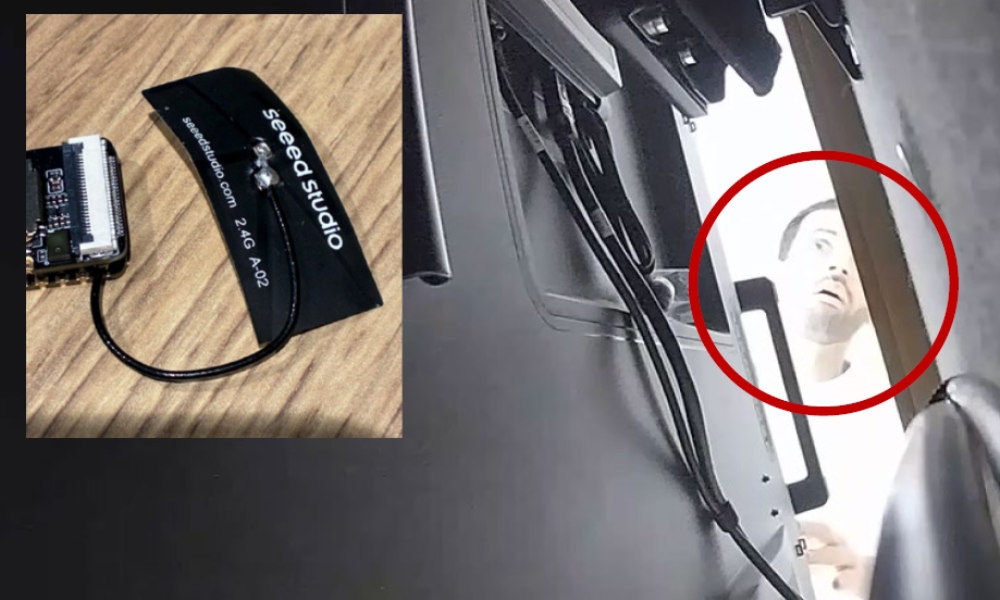
A recorder wrapped in toilet paper sat behind a TV in an OpenAI executive room, and OpenAI says its own models helped trace it to an engineer, whom the FBI then arrested. Does anyone at your company actually sweep meeting rooms for devices?
Related stories
- Aleph Alpha puts a 1M-context model on your own servers
- Mistral Large 4 tops open models at just 15% on legal tasks
- Xiaomi's new MiMo models carry an unverified top-6 claim
- Cohere claims a WMT26 lead with a non-reasoning translator
- A 125B MoE model previews Qwen4's architecture
- A 4-bit Mac build fits Qwen3.8-27B in 16.1GB
Comments
No comments yet. Be the first.
Join the conversation
Sign in to leave a comment. It appears after moderation.